
Why Every Enterprise Needs a SaaS Governance Platform in 2026
Enterprises need a SaaS governance platform in 2026 because SaaS sprawl, shadow AI, and consumption-based pricing have made manual governance impossible to keep accurate. In order to address these issues, enterprises require SaaS and AI app management software like CloudFuze Manage, which brings 360-degree IT stack visibility, Shadow AI detection, and token-based usage tracking on a single, user-friendly platform.
This blog post gives you a clear picture of why a SaaS governance platform is necessary for every business running hundreds of software and AI applications.
Key Takeaways:
What Is a SaaS Governance Platform and What Are Its Key Components?
A SaaS governance platform is your command center for managing every SaaS and AI app within your enterprise. Instead of switching between multiple spreadsheets and chasing down every department head for app lists, your IT, finance, and security teams get a single platform that allows them to control licensing costs, user access, compliance, and security status of your enterprise-owned IT stack.
The components of SaaS governance platforms are:
- Application & Shadow AI Discovery
- Spend & License Tracking
- User Access Automation
- Security & Compliance Oversight
- AI Agent Governance
Together, these above-mentioned capabilities convert your spreadsheet-based, blind, reactive process into enterprise SaaS governance you can measure.
Why Do Enterprises Need a SaaS Governance Platform in 2026?
In this age of AI, every enterprise’s IT stack is no longer just apps and people. It is apps, people, and also agents that act on their own. Yes! Autonomous AI is now rewriting the traditional way of managing enterprise software.
Meanwhile, Gartner estimates that up to $234 billion in enterprise application software spending could be exposed to agentic arbitrage by 2030. When agents transact on your behalf, the first question is always about your enterprise’s governance:
Who is accountable for these agent actions, what kinds of high-stakes actions do these agents perform, and why?
At the same time, software spend per employee keeps climbing, licenses sit unused, and most organizations cannot even name half of the software and AI tools they run.
Other key reasons why enterprises need a SaaS governance platform in 2026 include:
- Shadow SaaS and shadow AI expand fast.
- SaaS and AI sprawl go unnoticed.
- Agents need governance.
- License waste keeps growing.
- Unauthorized data access creates compliance and security risks.
- AI spend is unpredictable.
- Audits need real-time proof.
Therefore, in 2026, enterprises require a SaaS governance platform that serves as a control layer, offering agentic AI governance and SaaS governance side by side.
Challenges Enterprises Experience with Manual SaaS Governance
Manual SaaS governance means spreadsheet-based monitoring, chasing email threads, and quarterly reviews. All these manual processes fail in predictable ways.
Application and shadow AI discovery is always incomplete with manual tracking. Employees adopt tools faster than IT can log them, so shadow SaaS and shadow AI accumulate in the blind spots. License cost and usage data go stale over time. Offboarding processes become inconsistent, leaving former employees and orphaned user accounts with live access to your business data. Finally, security reviews happen on a calendar, not in real time, so risky OAuth grants and over-permissioned agents sit unnoticed for months.
A cost of data breach 2025 report from IBM found that 97 percent of organizations hit by an AI-related security incident lacked proper AI access controls.
Here, manual SaaS & AI governance using a shared spreadsheet is exactly the condition in which these cost and security gaps thrive.
Example: A 4,000-person IT service company tracks SaaS in a shared spreadsheet which gets updated each quarter. Between two consecutive updates, three departments adopted 3 new AI writing tools, two employees left the company with active licenses, and one contractor connected a third-party app to the company’s cloud drive via OAuth. None of it appears in the spreadsheet until the next review. This quarterly spreadsheet-evident audit is the attack surface manual governance cannot close.
How Does Manual SaaS Governance Differ from Automated SaaS Governance?
The table below shows the difference between manual SaaS governance and automated SaaS governance.
| Dimension | Manual SaaS Governance | Automated SaaS Governance (CloudFuze Manage) |
|---|---|---|
| Application discovery | Periodic, self-reported, incomplete, and spreadsheet-based | Continuous and automatic, including shadow apps |
| Cost visibility | Stale exports and human estimates | Live spend and license usage data |
| User lifecycle | Manual onboarding and offboarding | Automated provisioning and revocation by RBAC |
| Security monitoring | Scheduled quarterly or annual reviews | Real-time user permission and OAuth tracking |
| AI and agent oversight | Rarely tracked or never tracked | Discovered, owned, and governed continuously |
| Audit readiness | Reports are reconstructed under deadline pressure | Always-on, audit-ready logs with single-click download |
CloudFuze’s Five-Pillar Framework for Effective SaaS Governance

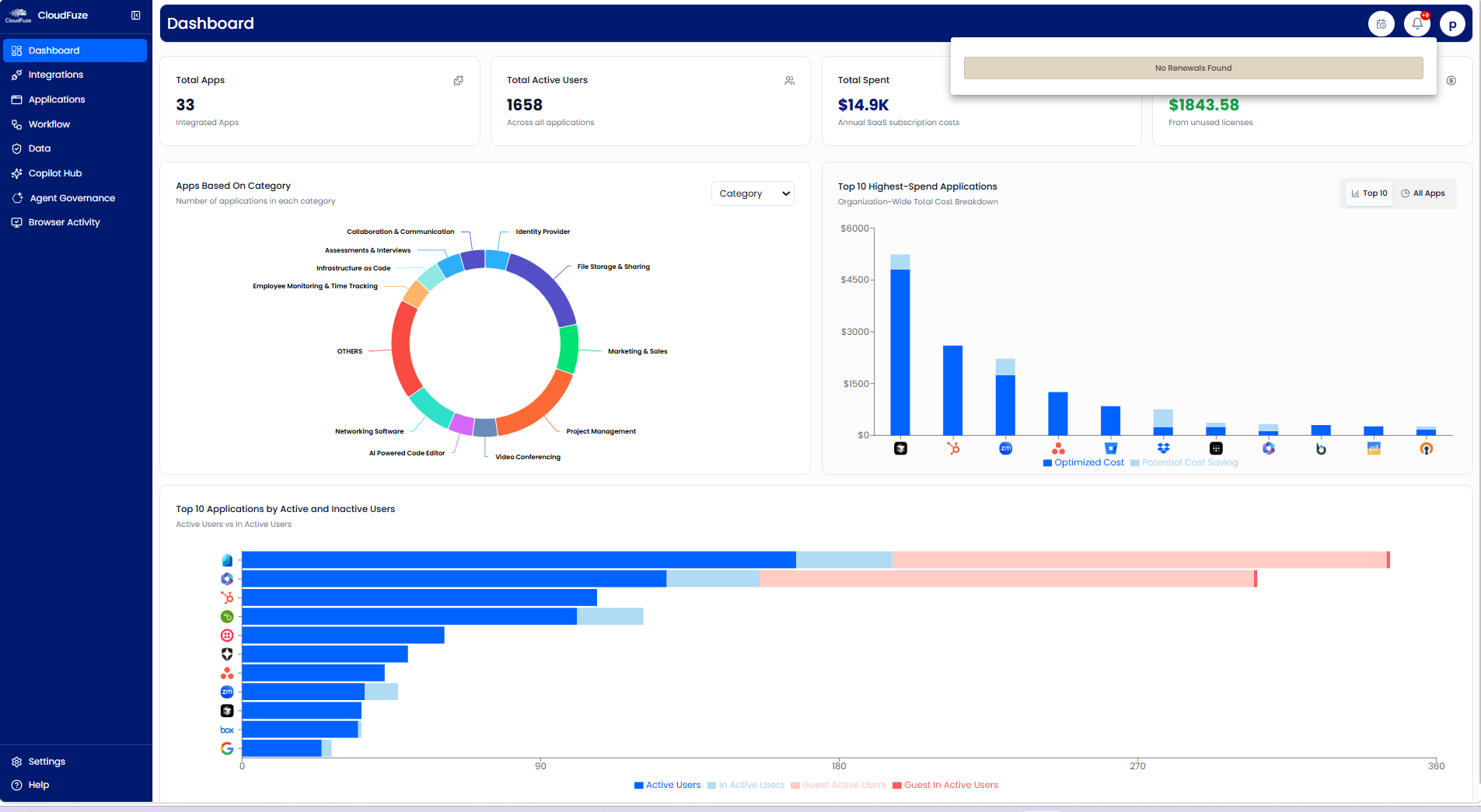
Our SaaS and AI app management solution, CloudFuze Manage, helps enterprises implement a SaaS governance framework from one centralized platform.
Here’s how CloudFuze Manage helps you implement your SaaS and AI governance:
- Discover every SaaS app and AI tool your enterprise owns, including Shadow IT and Shadow AI apps.
- Optimize unused licenses, redundant/duplicate tools, and overall software spend with automated renewal alerts and intelligent license right-sizing recommendations.
- Automate role-based user access allocation and orphaned user account revocation across your user lifecycle process and make it zero-touch.
- Secure SaaS user permissions, third-party app integrations, and inherited agentic AI data access in one platform and stay audit-ready.
- Govern AI agents, their accountability, and token consumption on a single dashboard.
Example: When an employee is offboarded, CloudFuze Manage automatically frees up license cost, their user access is revoked across every connected app (lifecycle), any agents they owned are flagged for reassignment (AI governance), the change is logged (compliance), and the freed seats update the live inventory (visibility).
One platform, fully governed IT portfolio, with no spreadsheet involved.
SaaS Governance Best Practices That Every Enterprise Must Follow
Strong SaaS governance best practices turn the framework into a repeatable operating process rather than a one-time cleanup. A few best practices are:
- Make sure to centralize human ownership by assigning clear agent accountability.
- Always automate user access by synchronizing your business access with your employee’s work status.
- Do not forget to right-size licenses using actual usage data before every renewal.
- Remember to govern AI agents early and manage them like human users.
- Ensure you stay audit-ready by maintaining continuous compliance logs and revamp your governance process for better outcomes.
Emerging Trends in SaaS Governance
The next phase of SaaS governance is being shaped by the arrival of non-human identities at enterprise scale.
For a decade, governance assumed a stack of humans using apps. AI agents now hold credentials, trigger workflows, and access data without a person in the loop, which means the unit of governance is shifting from the user account to non-human identity.
Secondly, consumption-based and token-based pricing are making AI costs less predictable, pushing governance from license counting toward live spend management. Finally, regulation (EU AI Act) is tightening, so audit-ready visibility is moving from a nice-to-have to a baseline expectation.
In short, a SaaS governance platform is quietly becoming a necessity in 2026 and beyond.
Achieve Next-Generation SaaS Governance with CloudFuze Manage
SaaS governance in 2026 is no longer about tidying up a software list once a quarter. It is about maintaining continuous control over a stack that now includes people, apps, and autonomous agents.
Our SaaS and AI governance platform, CloudFuze Manage, gives you 360-degree IT visibility, licensing cost control, and security policy enforcement to run your whole enterprise stack from one place.
If you are ready to bring your SaaS and AI environment under deliberate control, reach out to our governance experts to learn how CloudFuze Manage works in real practice.
Frequently Asked Questions
1. Are SaaS governance platforms only suitable for enterprises?
No. Large enterprises, MSPs, and SMBs equally benefit from using a SaaS management platform. This is because unmanaged apps, unused licenses, and shadow AI create proportional risk at companies of any size.
2. What is the difference between SaaS governance and AI governance?
SaaS governance manages the software applications your organization subscribes to, covering application discovery, licensing cost, user access, and data compliance. Whereas AI governance focuses specifically on how AI tools, assistants, and autonomous agents are used, owned, and permissioned.
3. What are the benefits of using a SaaS governance platform?
You’ll gain complete visibility into every app and its cost, recover wasted spend from unused and redundant licenses, close security gaps through automated access control, stay continuously audit-ready, and bring AI tools under your IT control along with the rest of your SaaS stack using a SaaS governance platform like CloudFuze Manage.
4. What is the best SaaS governance platform in 2026?
CloudFuze Manage is one of the best SaaS governance platforms because it unifies SaaS and AI governance rather than treating them separately, discovers shadow apps and agents automatically, and delivers cost, access, and compliance control from a single console. It supports 190+ SaaS and AI app integrations, including Google Workspace, Zoom, HubSpot, Salesforce, Tableau, OpenAI, Cursor, Claude, and more.
5. How can an organization choose the right SaaS governance platform?
Make sure to match the SaaS governance platform to your business priorities. Consecutively, confirm it discovers shadow SaaS and AI, integrates with your identity provider for user lifecycle automation, gives live cost and license data, maintains audit-ready logs, and governs AI agents as first-class identities. Then verify it covers the specific apps your teams actually use.
6. What is the difference between SaaS governance and SaaS management?
SaaS management handles the day-to-day operation and optimization of SaaS applications, while SaaS governance establishes the policies, security controls, and compliance standards that guide their use.
About the Author: Rashmi Ramesh



