
Introduction
IT leaders can choose an AI governance platform that automates five capabilities listed here. They are discovery of every AI tool and agent (including shadow AI), automated AI security policy enforcement, AI risk management, automated audit trails, and native integration with your existing identity, SaaS, and security stack.
Automating AI governance replaces manual spreadsheets, user management, and point-in-time reviews, specifically for large enterprises. This further reduces enterprise-wide data breach exposure, cuts IT regulatory overhead, and stops unapproved AI spend before it grows.
This guide gives IT leaders a framework to evaluate the best AI governance platforms.
Key Takeaways
What Is an AI Governance Platform?
An AI governance platform is software that centralizes visibility and oversight of every AI platform an enterprise uses or builds. It turns written AI security policies into automated controls that are enforced, monitored, and auditable with minimal human intervention.
It helps IT leaders discover, inventory, approve, monitor, and audit AI tools, language models, and agents across their enterprise. Instead of tracking AI use in spreadsheets and written policy documents, enterprises get a single platform that automatically applies your AI policy rules and automatically records every compliance evidence as it happens.
The automated AI governance solutions cover the following:
- Standalone AI tools such as chat assistants, AI-powered writing tools, and image generators.
- Embedded AI inside the SaaS applications your teams already use.
- AI agents that act autonomously on your company data and systems.
According to Gartner, traditional GRC tools were not built for AI-specific risks such as monitoring real-time automated agentic AI decisions, language model bias, and confidential data misuse. This gap has driven the rise of AI governance platforms, which have emerged as their own software category.
Why AI Governance Is Becoming an IT Priority
AI adoption is moving fast in every enterprise, which outpaces IT or security governance controls implemented to manage AI usage. This governance gap drives data breach costs, IT compliance exposure, and wasted licensing spend, making AI governance an IT priority now.
A few years back, AI governance used to be a policy discussion for legal and compliance teams. Now it is an operational problem for IT, because IT owns the governance of user identities, applications, and data that AI tools touch.
Several factors are driving this shift, and let’s discuss them in detail here. In 2026, enterprises are utilizing AI to automate business workflows, enhance decision-making, improve customer experiences, and accelerate innovation in their products and services. However, as AI becomes deeply embedded in your business operations, the risks associated with unchecked AI usage continue to grow.
Meanwhile, traditional AI governance methods built around spreadsheets, email threads, and written policy documents can no longer keep pace with the scale and speed of AI adoption.
Regulations such as the EU AI Act, the NIST AI Risk Management Framework, and ISO/IEC 42001 also push enterprise AI governance toward risk-based, auditable IT and security controls.
Additionally, IBM reports that 63% of breached organizations lacked an AI governance policy, while 97% of AI-related breaches occurred in organizations without proper access controls.
All these frameworks and statistics highlight the need for a comprehensive enterprise AI governance platform like CloudFuze Manage that provides centralized IT visibility and control.
What Are the Benefits of Using an AI Governance Platform?
When enterprises adopt an AI governance platform, they gain:
- One inventory of every AI tool, embedded AI feature, and agent, including shadow AI.
- Automated user access controls and policy enforcement close AI-related data breaches and lower regulatory expenses.
- Controlled AI spend by consolidating duplicate AI subscriptions and reclaiming unused licenses.
- Clear IT approval workflows let teams adopt approved AI tools quickly instead of raising several IT tickets.
Challenges Enterprises Face with Manual AI Governance Processes
If your enterprise’s AI governance runs on written policy documents and manual data access reviews, you are likely facing these challenges:
-
Incomplete AI Inventories
Self-reported AI adoption surveys and procurement records miss free AI apps, browser extensions, and AI features switched on inside existing SaaS apps.
-
Invisible AI Agents
Agents connected through APIs and third-party app integrations rarely show up in manual IT reviews, yet they can access sensitive files and information in shared drives, email, and customer data.
-
Governance Policies Without Enforcement
An acceptable written AI use policy tells employees what to do but cannot stop them from pasting sensitive data into unapproved AI apps when there are no adequate guardrails.
-
Disconnected Enterprise Teams
In most enterprises, AI governance efforts are initiated by security teams, leaving policy and enforcement owned by different teams.
-
Audit Scrambles
Compliance teams gather user logs and agent activity evidence manually before every audit. The result is often error-prone and consumes weeks of IT and compliance time.
-
Unmanaged AI Spend
Without accurate AI usage data, duplicate AI subscriptions and idle user licenses renew automatically.
How Do Manual AI Governance and Automated AI Governance Differ?
Manual governance documents compliance as well as security intent, whereas automated governance enforces it. The difference between manual and automated AI governance is clearly discussed in the table below:
| Area | Manual AI Governance | Automated AI Governance Platform |
|---|---|---|
| AI discovery | Surveys and spreadsheets, updated periodically by employees | Continuous, automated discovery of AI apps, embedded AI, and agents enterprise-wide |
| Shadow AI detection | Found only after a security incident | Detected as soon as shadow AI apps appear in your IT environment |
| AI agent oversight | Rarely tracked in a spreadsheet | Agent inventory, owners, permissions, and activity monitoring |
| Policy enforcement | Depends on employees’ compliant AI usage | Enforced automatically through IT approval and user access workflows |
| Risk assessment | One-time review at purchase | Ongoing risk scoring based on data access and app usage |
| Audit evidence | Assembled by administrators before each audit | Automated, continuous audit trails |
| AI Spend control | Wasted AI spend is discovered at renewal | Tracked by AI app usage, license allocations, and accountable owner |
| Scalability | Breaks as AI adoption grows | Scales easily with the number of AI platforms, users, and agents |
How IT Leaders Can Choose the Best AI Governance Platform
While choosing AI governance platforms, IT leaders must consider the following features:
- Select a governance platform that discovers and inventories all AI tools and agents, including shadow AI.
- Choose an automated AI governance tool that automates AI policy enforcement and IT approvals.
- Always prioritize a platform that assesses AI risk and maps compliance requirements.
- Go for an AI governance solution that offers audit trails and data privacy controls.
- Look for a platform that connects and works well with your existing tech stack and tracks AI usage and costs.
Why IT Leaders Consider CloudFuze Manage the Best AI Governance Platform
CloudFuze Manage brings SaaS and AI governance into one platform and serves as a control plane for IT, finance, HR, procurement, and security teams.
Here are its standout features that make CloudFuze Manage the best AI Governance platform for IT leaders:
- Discover shadow AI across your enterprise-wide tech stack so every AI tool, copilot, and AI-enabled app appears in one unified inventory.
- Govern AI agents with accountable human ownership, relevant data access, and autonomous activity oversight
- Implement governance policies across your SaaS and AI stack from a single platform.
- Control AI spend by identifying duplicate AI subscriptions, unused user licenses, and upcoming renewals.
- Stay audit-ready with centralized records of data access, user approvals, and both SaaS & AI application usage.
- Manage the end-to-end user lifecycle of SaaS and AI tools, from user onboarding to offboarding.
How Can IT Leaders Implement Proactive AI Governance with CloudFuze Manage?
Proactive governance of AI means catching AI risk before it becomes a severe security incident, an audit finding, or a renewal waste.
Our SaaS and AI management platform, CloudFuze Manage, helps enterprises manage AI apps and agents and implement AI governance and agent governance at scale.
Also, it supports over 190 SaaS and AI applications, including Salesforce, HubSpot, Okta, Entra SSO, Bill.com, Zoom, Microsoft 365, Claude, OpenAI, Gemini, and more.
Now Let’s see how CloudFuze Manage supports generative AI governance:
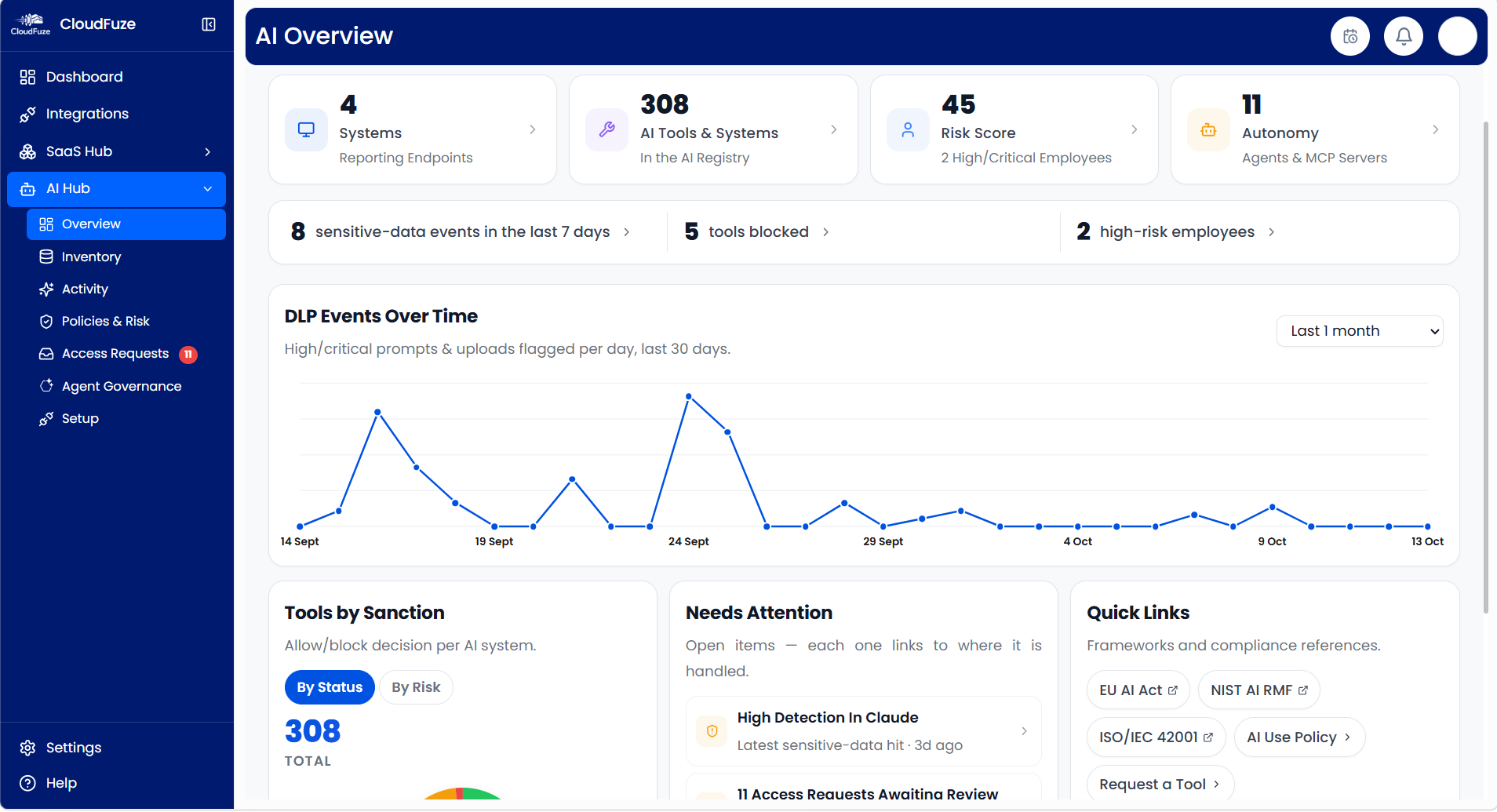
- AI Overview: CIOs/CTOs/CISOs can see all your AI tools, AI agents, risk levels, risky employees, blocked tools, and sensitive data alerts on one screen, so you always know where your biggest AI risks are and what to fix first.

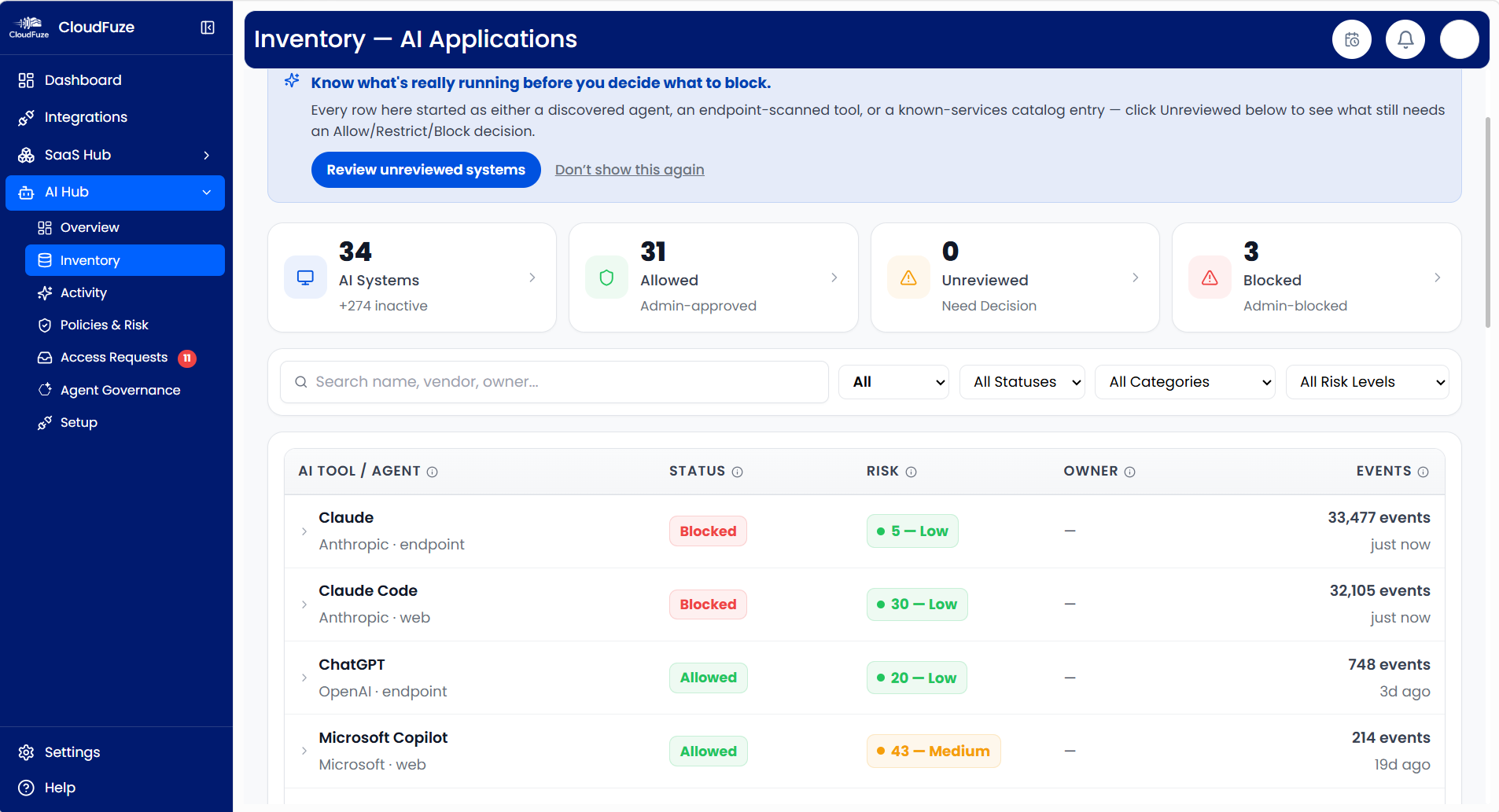
- Inventory: IT teams can find every AI tool your employees use, check who owns it, how risky the AI tool is, and how often it’s used, so IT admins can decide what to allow or block based on real usage.

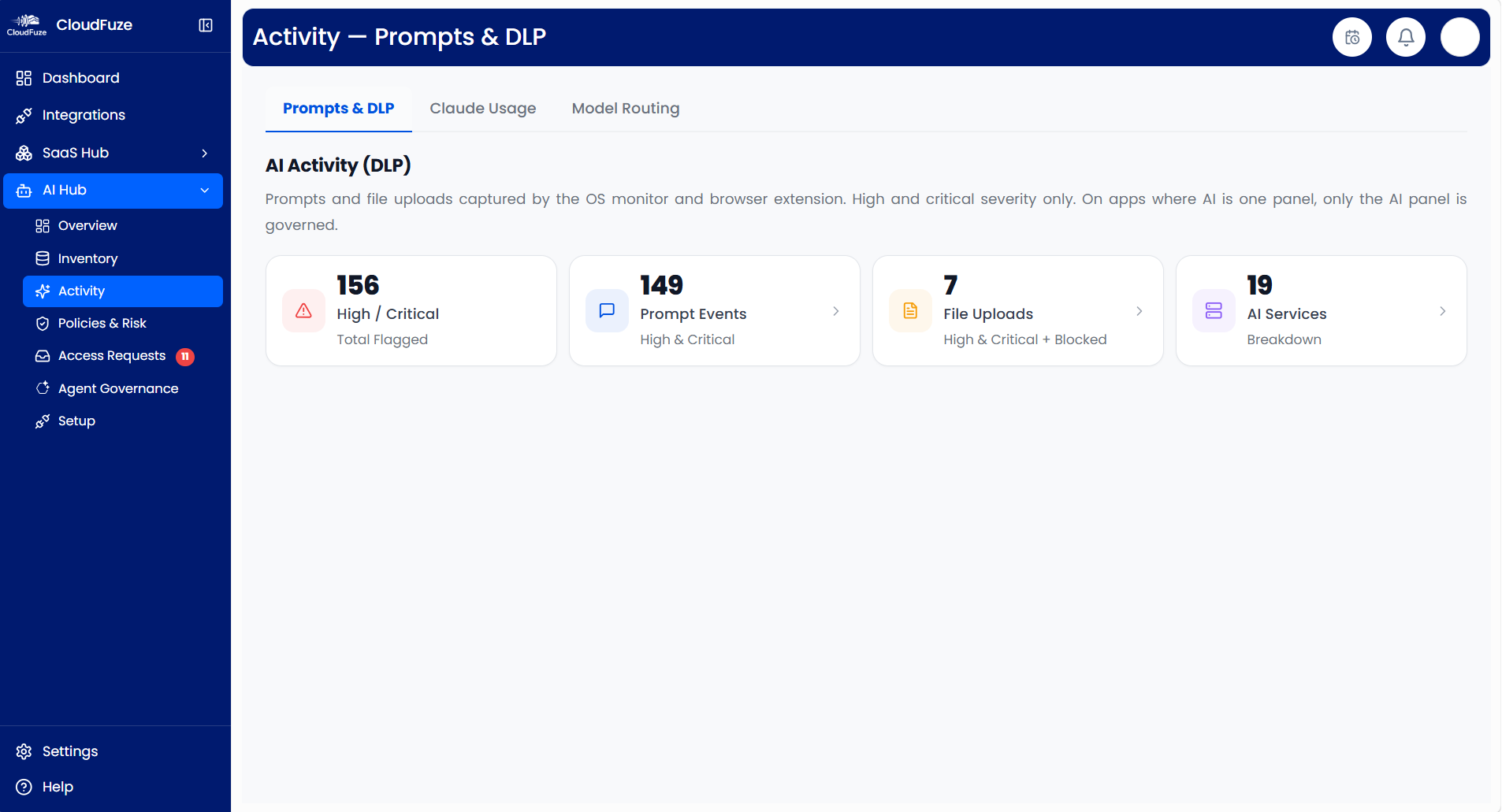
- Activity: Track what employees type into AI tools and which files they upload, on both desktop apps and browsers, so you can stop sensitive company data from leaking into AI.

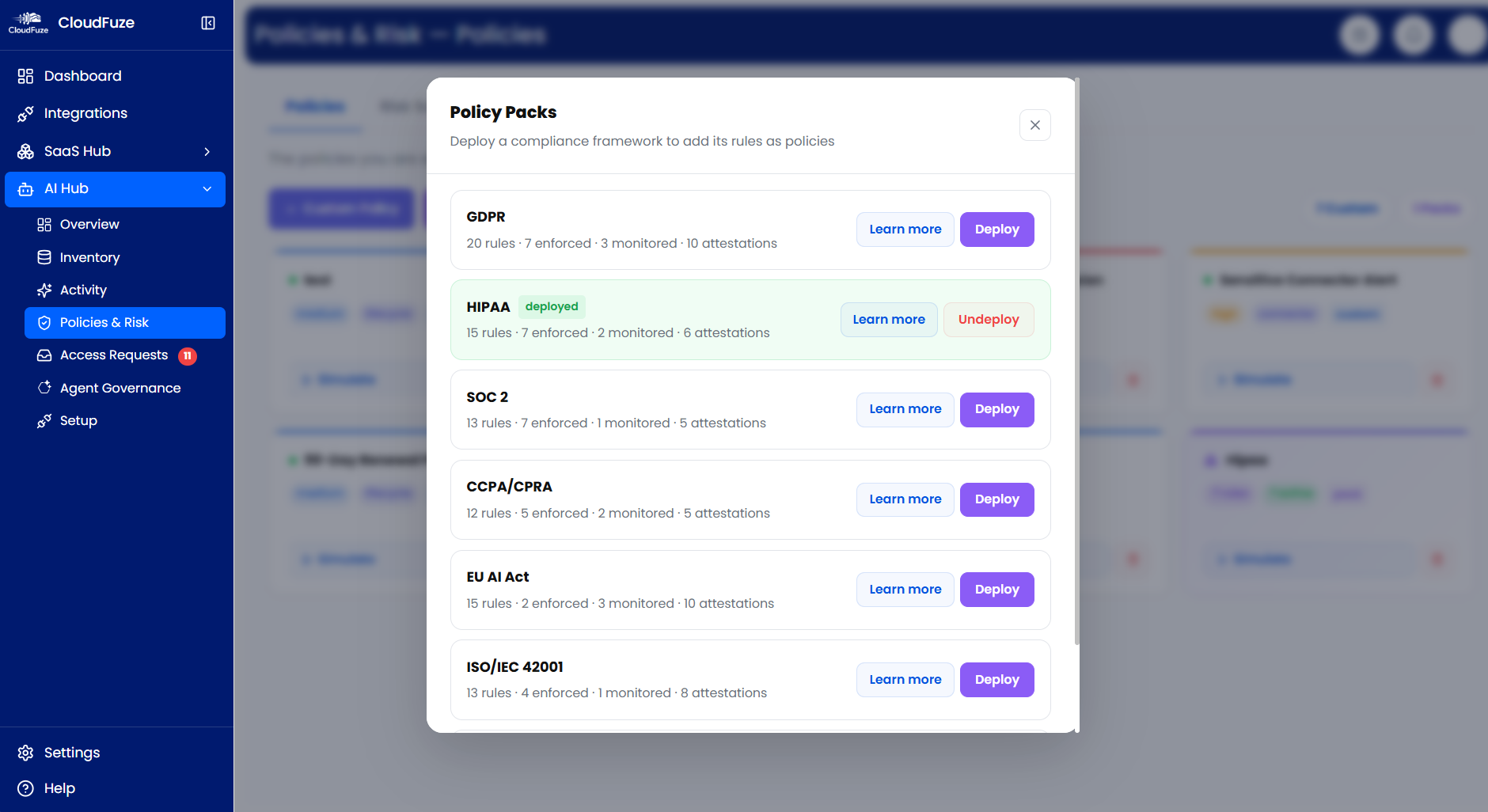
- Policy Enforcement and Risk Management: IT leaders can turn on ready-made rules for GDPR, HIPAA, SOC 2 Type 2, CCPA/CPRA, the EU AI Act, and ISO/IEC 42001 in one click, so your enterprise-wide AI use follows the regulations you need to meet without writing policies yourself.

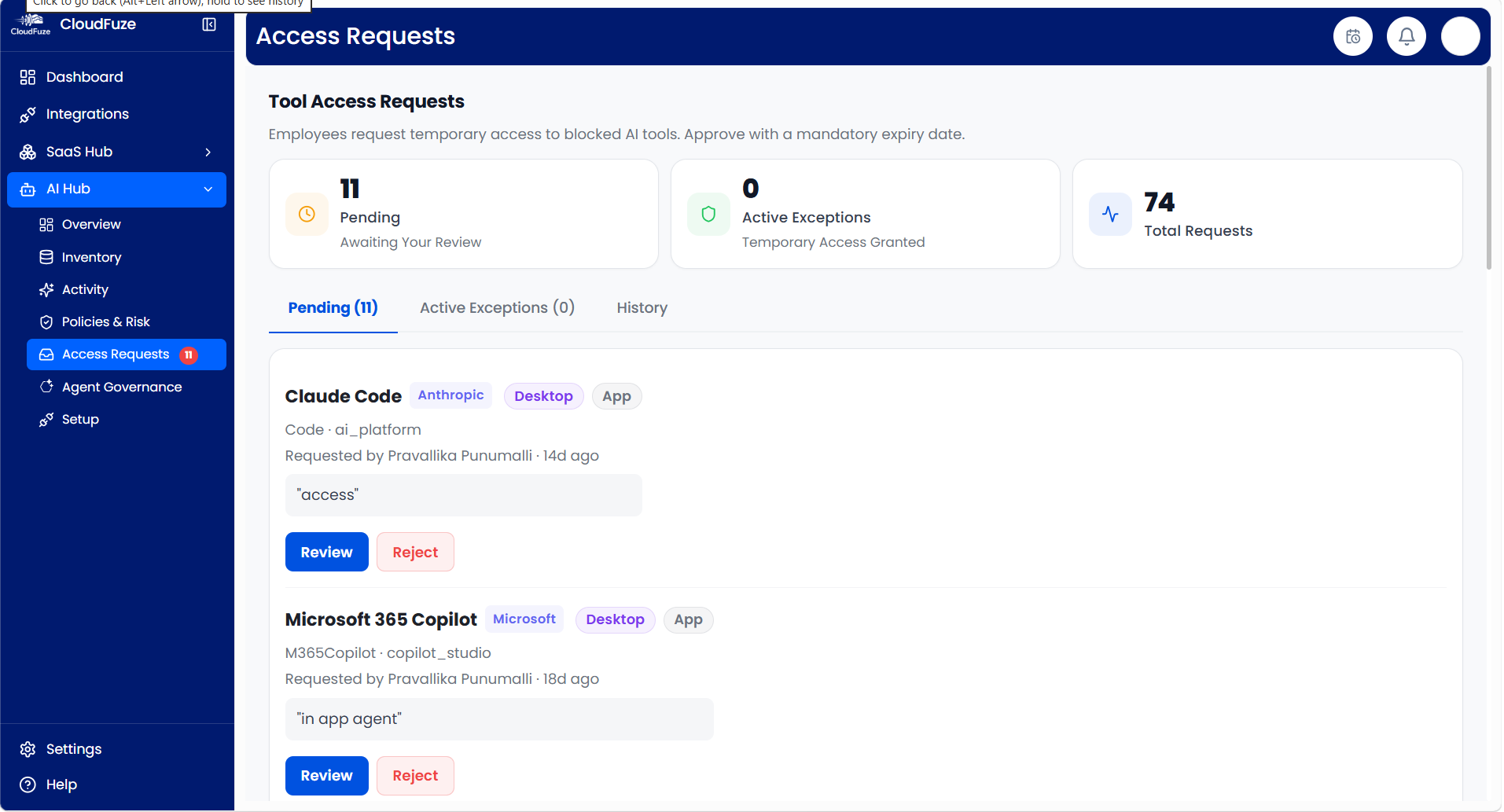
- Limited User Access Requests: Let employees ask for access to automatically blocked AI tools and approve it for a limited time only, so employees continue innovation with AI apps without leaving any permanent security gaps.

Also, CloudFuze Manage helps IT leaders with Agent Governance:

- Full Stack Agent Discovery: It surfaces every AI agent operating across your enterprise IT environment, including ones IT never sanctioned.
- Agent Access Control: It helps enterprises implement least-privilege permissions, so agents only reach your business data and systems they need.
- Agent Monitoring: It tracks every agent activity to catch AI misuse, behavioral drift, and anomalous agent actions early.
- Agent Lifecycle Governance: It helps IT leaders assign human ownership to every agent, review autonomous decisions, and decommission agents so nothing runs unaccounted for.
- Audit Readiness: It generates the agent activity logs and governance reports in one click that auditors and boards expect on demand.
Choose Right, Choose CloudFuze Manage
AI is already embedded across your enterprise, whether or not IT has approved it. Spreadsheet-based AI governance cannot see every AI app, enforce AI-specific privacy policy, or prove compliance on demand. The right AI governance platform, like CloudFuze Manage, gives you all three and helps IT leaders maintain compliance with a flexible pricing plan.
Frequently Asked Questions
1. Which AI governance platforms help IT leaders with strong data privacy features?
Platforms such as CloudFuze Manage help IT leaders strengthen AI governance with strong data privacy controls, including automated data discovery, security policy enforcement, risk assessments, compliance monitoring, and confidential data protection controls across AI environments.
2. Which Compliance Frameworks Should an AI Governance Platform Support?
AI Governance platforms must align with controls such as the EU AI Act, NIST AI Risk Management Framework, ISO/IEC 42001, and internal data privacy and security policies.
3. Does an AI governance platform cover AI agents and generative AI?
Yes. AI governance platform such as CloudFuze Manage covers generative AI tools, AI features embedded in SaaS apps, and autonomous AI agents. When choosing an AI governance platform, enterprises should confirm agent-specific capabilities, such as permission scoping and activity monitoring.
4. Which AI governance platforms support automated audit trails?
AI governance platforms such as CloudFuze Manage centralize data access, user approvals, AI usage, and agent activity records and apply automated controls to help IT teams stay audit-ready.
5. How does an AI governance platform ensure regulatory compliance?
An AI governance platform classifies each AI system by risk, maps internal controls to AI governance and compliance frameworks, and enforces policies as AI is used rather than only at approval. It then automatically collects evidence such as AI usage, AI safety, and data risks, so enterprises can demonstrate compliance at any time instead of manually preparing for audits at a single point in time.
About the Author: Rashmi Ramesh



