
Due Diligence Checklist IT Leaders Need Before M&A Migration
Regardless of whether your merger or acquisition involves consolidating Microsoft 365 tenants, combining Google Workspace instances, or bringing together hundreds of SaaS applications, not conducting due diligence will result in security exposures, compliance risks, unexpected expenses, and delays during the migration.
The M&A IT due diligence checklist enables IT professionals to understand the risks, assess the readiness for the M&A migration, and develop a better integration strategy even before the deal closes.
This guide provides key areas of evaluation that must be considered by IT professionals before launching a migration project following a merger or acquisition.
Key Takeaways
What is IT Due Diligence in Mergers and Acquisitions?
IT due diligence is the process of evaluating an organization’s technology environment before a merger or acquisition. It involves assessing IT infrastructure, cloud platforms, applications, cybersecurity, compliance, identities, data, and operational processes to identify risks and determine how easily the two organizations can be integrated.
What Key Items Need to be on an M&A IT Due Diligence Checklist?
The following areas must be on an M&A IT due diligence checklist:
- IT infrastructure and cloud environment
- Email and collaboration platforms
- Identity and access management
- Cybersecurity position
- Compliance and regulatory requirements
- Inventory of SaaS applications
- Data quality and governance
- Software licenses and vendor contracts
- Backup and disaster recovery plans
- Migration readiness and integration roadmap
All the above helps the IT leader spot potential technical risks.
Why Is It Important to Conduct IT Due Diligence Before an M&A Migration?
In an acquisition, companies not only inherit employees and processes but many other things such as email servers, cloud storage, collaboration tools, identity systems, software-as-a-service applications, security standards, compliance requirements, etc.
Failure to conduct adequate due diligence will lead to the following:
- Duplicated applications and licenses
- Identity/user problems
- Vulnerabilities from a security perspective
- Compliance issues
- Legacy infrastructure
- Unforeseen migration difficulties
- Extra downtime
Performing due diligence before migrating reduces all these challenges. It will also assist the enterprises in cost estimation, prioritizing workloads, and planning migration accordingly.
Checklist of M&A IT Due Diligence: What IT Leaders Must Know Prior to Migration
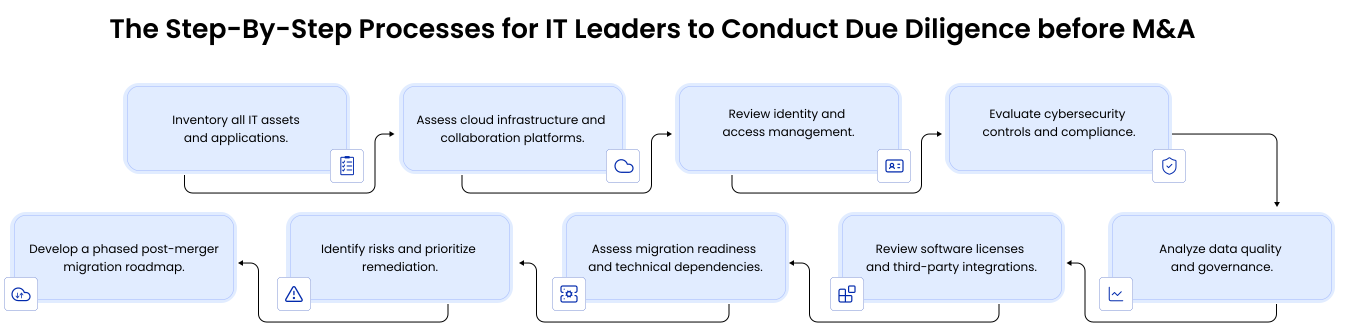
1. Create an Inventory of all IT Resources
Begin by listing down all the technology resources available in both companies. Doing this will ensure that none of the important technology assets are missed during migration planning.
Your list must cover the following:
- Microsoft 365 or Google Workspace instances
- Exchange Online mailboxes
- Data in SharePoint and OneDrive
- Google Shared Drives
- Microsoft Teams and Slack workspaces
- SaaS applications
- Active Directory or Microsoft Entra ID
- Servers/Cloud Infrastructure
- Databases
- Backups
Listing down all the technology assets available will give you an idea about the scope of the migration process and resources needed.
2. Assess Identity and Access Management
One of the most common problems faced when carrying out an M&A is identity conflict. This may happen due to different authentication methods, duplicate user accounts, inconsistent permissions, etc.
Consider the following:
- Identity providers
- Single Sign-On (SSO) setup
- Multi-Factor Authentication (MFA)
- Privileged administrator accounts
- Google Groups/Microsoft 365 Groups
- Guest accounts/external users
3. Security Assessment
With any new environment comes security risks. Assess security policies, endpoint protection, email security, conditional access policies, encryption, DLP policies, vulnerabilities, and past security events.
Also check audit logs and confirm if security policies are in line with your organization’s standards.
4. Compliance Assessment
Compliance analysis is greatly complicated by mergers, particularly in cases where companies function in different sectors, regions, or environments. Perform a detailed analysis of compliance rules relevant to your situation, such as GDPR, HIPAA, ISO 27001, SOC 2, and PCI DSS.
Moreover, check records of retention policies, legal holds, eDiscovery settings, audit logging, and data residency requirements for both companies.
Addressing compliance gaps early in the integration process helps reduce legal, regulatory, and operational risks while supporting a smoother transition.
5. Data Quality Assessment
Unnecessary or poorly managed data complicates the migration process and adds to storage costs. Check for duplicate files, old documents, old email mailboxes, big file repositories, shared folders with broken permissions, and orphaned accounts.
Data cleansing prior to migration leads to better performance and easier governance going forward.
6. SaaS Applications
Enterprises typically have hundreds of SaaS applications that overlap after the acquisition.
Check for duplicate software, shadow IT software, unnecessary licenses, critical business software and software integration points. Software rationalization saves money on licensing and future management.
7. Assess Migration Readiness
Every environment may not always be ready for migration. Consider factors such as mailbox size, total data volume, permission complexity, shared mailboxes, distribution lists, domain verification, API limitations, and available bandwidth to ensure a smooth and successful cross-tenant mailbox migration.
An insight into these dependencies will prevent delays in the production migrations.
8. Assess Backup and Disaster Recovery
Business continuity should never be compromised during an M&A migration. Ensure reliable backups are available, review your Recovery Point Objective (RPO) and Recovery Time Objective (RTO), verify your disaster recovery plan, and confirm that backup restoration has been tested. A well-prepared recovery strategy minimizes risk and protects critical business data throughout the migration process.
9. Locate Legacy Systems and Technical Debt
Identify legacy systems and technical debt early to avoid integration challenges during an M&A migration. Assess unsupported operating systems, end-of-life (EOL) software, custom-built applications, manual processes, and outdated authentication methods to determine whether they should be migrated, modernized, or retired.
10. Prepare Post-Merger Migration Roadmap
The final step is to create a structured migration roadmap that outlines migration priorities, pilot users, migration waves, user communication, cutover planning, validation testing, rollback procedures, and success criteria.
A phased migration approach help minimize disruption, reduce risk, and maintain better control throughout the post-merger integration process.
Best Practices for Enterprise IT Leaders
To ensure that an M&A migration is as successful as possible:
- Start with IT due diligence during the planning phase rather than wait until after the acquisition is completed.
- Include security, compliance, infrastructure, and application owners in the assessment process.
- Get rid of redundant data and inactive users before migration.
- Standardize identity and permission models wherever possible.
- Conduct test migrations before completing production migrations.
- Monitor migration progress and validate data after each phase.
This will lead to less downtime and more efficient integration overall.
De-Risk Your M&A Migration Before Day 1
A detailed M&A IT due diligence checklist provides IT leaders with the tools necessary to understand technical issues prior to the start of migration, achieve greater compliance, lessen the difficulty of migration, and develop an effective migration plan.
Organizations that invest time in due diligence are better positioned to complete migrations with fewer surprises, lower costs, and stronger long-term governance. Talk to an enterprise M&A migration specialist today.
Frequently Asked Questions
1. How does due diligence matter to IT professionals during the mergers and acquisitions process?
It assists in detecting any unknown technological risks before integration takes place by due diligence. Risks may include legacy system risks, security risks, duplication of software, non-compliance risks, and migration risks, which may lead to increased costs or an extended process. It also assists in good planning and ensures that there is no downtime in the process, thus resulting in a secure, compliant, and efficient technology integration after a merger.
2. What best practices should IT professionals follow during the process of due diligence in M&A?
IT professionals should carry out due diligence at an early stage in the acquisition process, involve other departments such as security, compliance, and infrastructure in due diligence, and conduct thorough IT assets inventory.
IT professionals should ensure standardization of identities, review user permissions, eliminate duplications, validate disaster recovery and backup, and pilot testing before production migration. Good communication between IT and business professionals will help make good decisions in the process.
3. What are some of the potential pitfalls or challenges in the M&A process for IT leaders?
Some of the most common challenges are: lack of IT documentation, legacy systems, identity, duplication of SaaS applications, bad quality of data, security policy compatibility, compliance, and underestimating the difficulty of migration. There can be issues with third-party integrations and even inactive users and extra permissions, which make the company more vulnerable to security and operational risks.
4. What are the key steps that IT leaders should take after doing due diligence in M&A?
After the completion of the due diligence process, it is essential to prioritize the risks identified, develop an integration strategy, set the schedule for the migrations, allocate resources, and inform all the parties of the migration process. Doing pilot migrations, testing the security and monitoring of the migration process, and its results are also vital steps.
5. Which are the important things to look into for the IT infrastructure due diligence process in a merger?
The important things to be looked into are servers, cloud infrastructure, Microsoft 365/Google Workspace, network, storage, identity, backup and disaster recovery, endpoint management, collaboration, databases, and critical applications.
6. What are the important IT risks that need to be analyzed by IT departments during M&A due diligence?
The important risks to be analyzed by the IT department during M&A are cybersecurity risks, compliance risks, identity management issues, outdated infrastructure, unsupported applications, duplicate software, poor data quality, inadequate backup policy, vendor licensing problems, and migration readiness.
About the Author: Aayushi Raj



