
AI Governance for Regulated Enterprises: A Guide for CISOs and Compliance Leaders
AI governance for regulated industries requires structured policies, risk management, human supervision, and compliance with sector-specific and international regulatory frameworks. It has become a business imperative as AI adoption accelerates across sectors like financial services, healthcare, legal, and other highly regulated sectors.
For CISOs and compliance leaders, effective AI governance is essential to maintain AI visibility, reduce security risks, and ensure that regulatory compliance is always in place.
The following blog post covers the basics of AI governance for regulated industries.
Key Takeaways
Is your enterprise ready to embrace AI? Take our AI readiness assessment to help identify governance gaps and compliance risks.
What is AI Governance for Regulated Enterprises
AI governance for regulated enterprises is a framework for handling confidential business data accessed by AI apps, determining who owns these apps, and ensuring AI use aligns with regulatory and business-specific standards.
Whether the organization operates in financial services, healthcare, legal services, insurance, or critical infrastructure, these governance principles play a critical role in overall enterprise AI governance.
Consider a healthcare provider using an AI-powered meeting assistant tool to improve productivity. Here, data governance teams need to answer the following questions-
- Is this specific AI application approved by the IT and security team?
- Can it directly access patient data?
- Where is the patient data stored?
- Who owns this AI application?
- Does it comply with healthcare data requirements and regulatory principles?
Without answers to these questions, CISOs cannot manage security risks or show data protection and confidentiality requirements. Similar governance challenges exist in financial services, legal services, and other regulated sectors handling sensitive information.
A clear AI governance assessment plan provides comprehensive visibility into the AI environment, AI agent accountability, and the human oversight needed to manage these security risks while enabling responsible AI adoption.
Why AI Governance Has Become a Strategic Priority for Regulated Industries
For many CISOs and compliance leaders, the biggest AI governance challenge is that they are not aware of AI adoption across teams.
Imagine a financial services business with about 5,000 employees that use approved AI tools for customer support and routine workflows. Soon, individual teams start experimenting with AI apps on their own, browser-based AI assistants, and other AI-enabled SaaS apps that security or compliance teams do not know about.
A few months later, leadership may discover:
- Customer information was shared with these unapproved AI applications.
- Multiple AI tools perform similar functions without any human oversight, with customer information shared using AI prompts.
- AI agents have been granted access to sensitive workflows, breaking regulatory rules.
- A complete inventory of AI usage across the enterprise is absent.
The challenge is no longer adoption, but AI governance that cannot keep up with the speed of AI adoption. This lack of AI visibility leads to the next issue: no audit-ready evidence of safe, regulated, and compliant AI activity across the enterprise, and no clear accountability.
Without proper AI governance controls, data leaks in regulated industries can lead to legal penalties, reputational damage, and loss of trust.
For CISOs, therefore, the priority is a reliable answer to the bottom line: Can we demonstrate complete compliance controls during an AI audit?
Let us look at AI governance challenges for regulated industries in more detail.
AI Governance Challenges Regulated Enterprises Face
The first AI governance challenge is the lack of a clear AI inventory, including AI features embedded in SaaS applications, collaboration tools, and specific business workflows.
For CISOs and security leaders, this makes tracking AI usage more complex and can violate regulatory norms.
1. Limited Visibility Leads to Poor AI Risk Management
Effective AI risk management depends on a clear AI inventory across the business. Most CISOs and compliance leaders discover new AI usage only after a governance policy review, AI security assessment, or a specific audit request.
Hence, CISOs and compliance teams cannot confidently answer fundamental governance questions about the AI environment. As a result, AI governance programs become reactive after a data leak rather than proactive in preventing leaks.
2. Shadow AI Creates Governance Blind Spots
Shadow AI occurs when employees use AI applications without any formal approval or governance oversight. These tools used across regulated industries may access confidential business or customer data without required security controls.
This causes security gaps and governance of blind spots for security leaders.
3. AI Agent Risks That Introduce Accountability Challenges
AI agents add another layer of security complexity. AI agents can act, interact with other applications, and execute workflows on their own over time.
If user permissions are granted broadly, enterprise IT teams may not be able to explain how these decisions were made, what corrective action is needed, or if this AI agent operates within boundaries in the first place.
4. Lack of Complete AI Governance Hampers Audit Readiness
Documenting security and regulatory controls for confidential business data is important for AI governance in regulated industries.
Enterprise IT security teams must maintain audit readiness through continuous AI governance, an updated AI inventory, and recorded human oversight processes. Last-minute preparation does not help here.
Enterprise AI governance starts with visibility. Discover how CloudFuze Manage helps regulated enterprises stay audit-ready. Talk to our governance experts.
What You Should Look for in an AI Governance Solution for Regulated Industries
An AI governance solution for regulated enterprises should provide AI visibility, data security controls, and evidence needed to support compliance, manage risk, and withstand regulatory scrutiny.
The following basic governance capabilities are critical for regulated environments:
| Capability | Importance in Regulated Enterprises |
|---|---|
| AI Discovery | Checks for unauthorized AI apps, helping teams uncover shadow AI before it introduces compliance risks. |
| Managing AI Inventory | Creates a centralized repository of all AI apps, agents, ownership details, and risk categories. Supports governance/audit readiness. |
| AI Agent Governance | Provides visibility into AI agents, user permissions, activities, and access to sensitive data. |
| AI Risk Assessment | Helps security and compliance teams assess AI risks and prioritize remediation efforts. |
| Compliance Reporting | Provides evidence needed to show governance controls during audits and regulatory reviews. |
| Continuous Monitoring | Ensures governance policies remain effective as AI adoption expands across departments, users, and SaaS environments. |
Businesses in regulated domains should also judge if a solution supports their broader compliance obligations. This is discussed in detail below.
From Governance Frameworks to Continuous Enforcement in Regulated Industries.
AI governance frameworks such as NIST AI RMF, ISO/IEC 42001, the EU AI Act, HIPAA, and SOC 2 Type 2 provide guidance on managing AI risk, establishing governance structure, and meeting compliance requirements.
Governance frameworks alone do not provide visibility into AI adoption or help implement controls. Enterprise Compliance leaders may have documented AI governance policies, but proving those policies are enforced across AI applications and agents is harder.
As AI adoption expands, CISOs need a way to test governance controls before deployment, identify policy violations, and continuously enforce AI governance policies across various business functions.
How CloudFuze Manage Helps Regulated Enterprises Govern AI
CloudFuze Manage is an enterprise AI governance platform that gives enterprises 360-degree visibility into their AI environment and helps them implement governance policy frameworks into day-to-day processes.
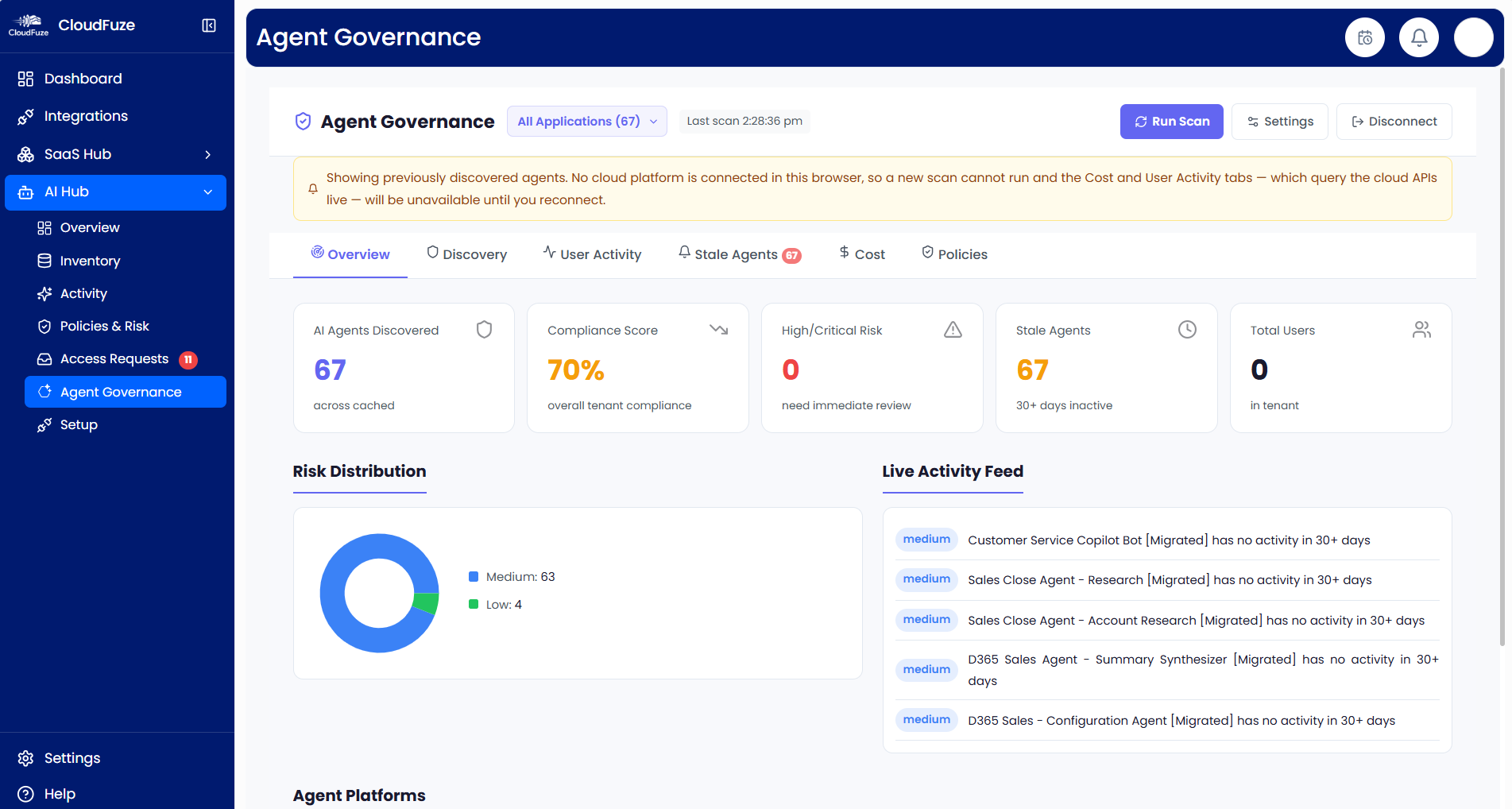
1) Discovery of AI Agent Governance
Enterprises can track all agent teams built across Microsoft 365, Copilot Studio, Gemini Enterprise, OpenAI, and Anthropic, along with their designated human owner and data security risk level.
2) Prebuilt Policy Packs
With prebuilt policy packs aligned to frameworks and regulations such as HIPAA, SOC 2, GDPR, CCPA/CPRA, the EU AI Act, ISO/IEC 42001, and NIST AI RMF, enterprises can establish controls that align with their regulatory and compliance objectives.
Take a look at the following-
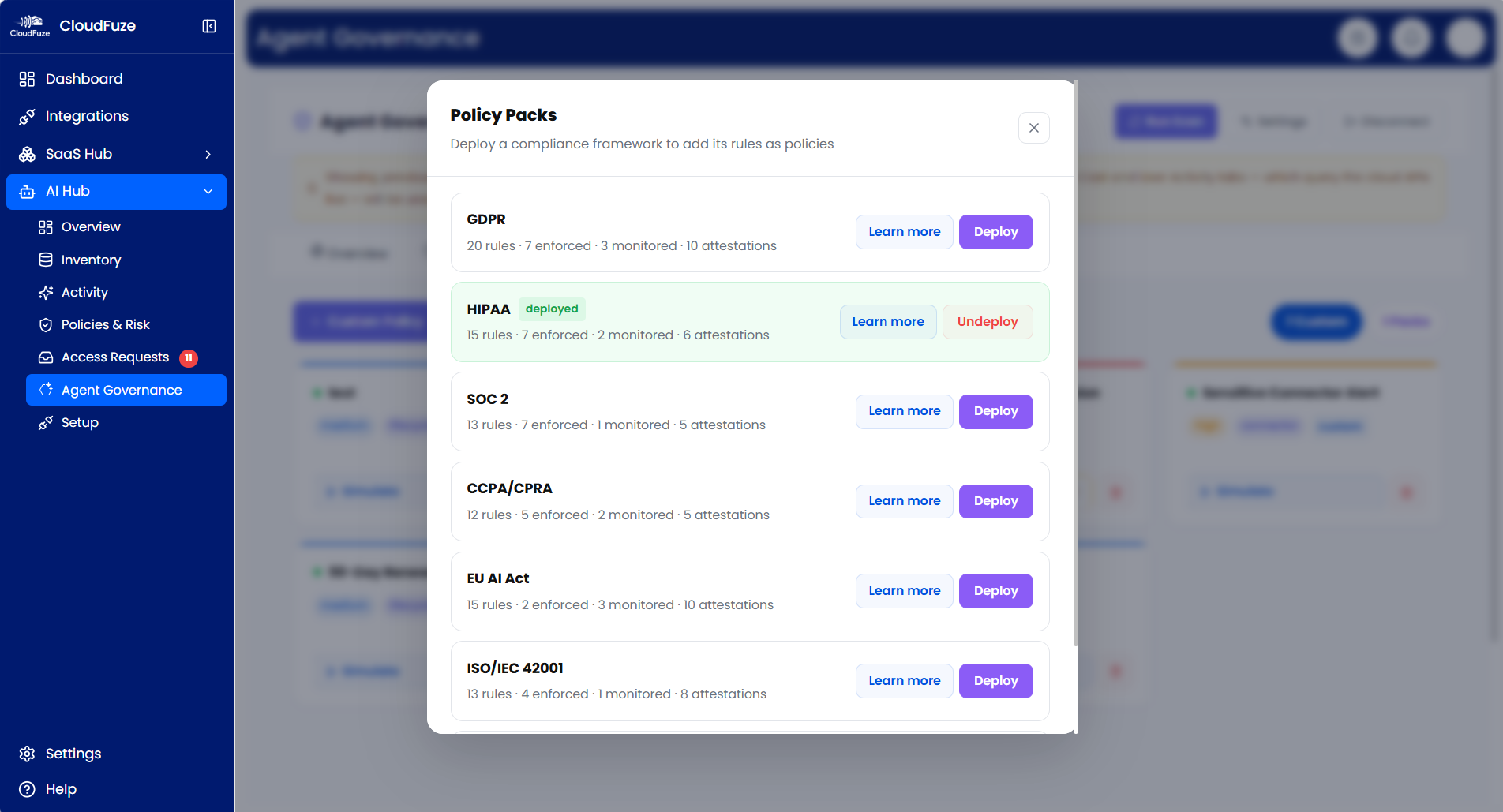
CloudFuze Manage helps regulated enterprises operationalize governance requirements through framework-aligned policy packs mapped to standards and regulations such as HIPAA, SOC 2, GDPR, CCPA/CPRA, the EU AI Act, ISO/IEC 42001, and NIST AI RMF.
3) Simulation of Governance Policies Before Complete Deployment
Security and compliance teams can simulate policy enforcement before deployment, check the impact of governance controls, and apply approved policies across enterprise AI environments.
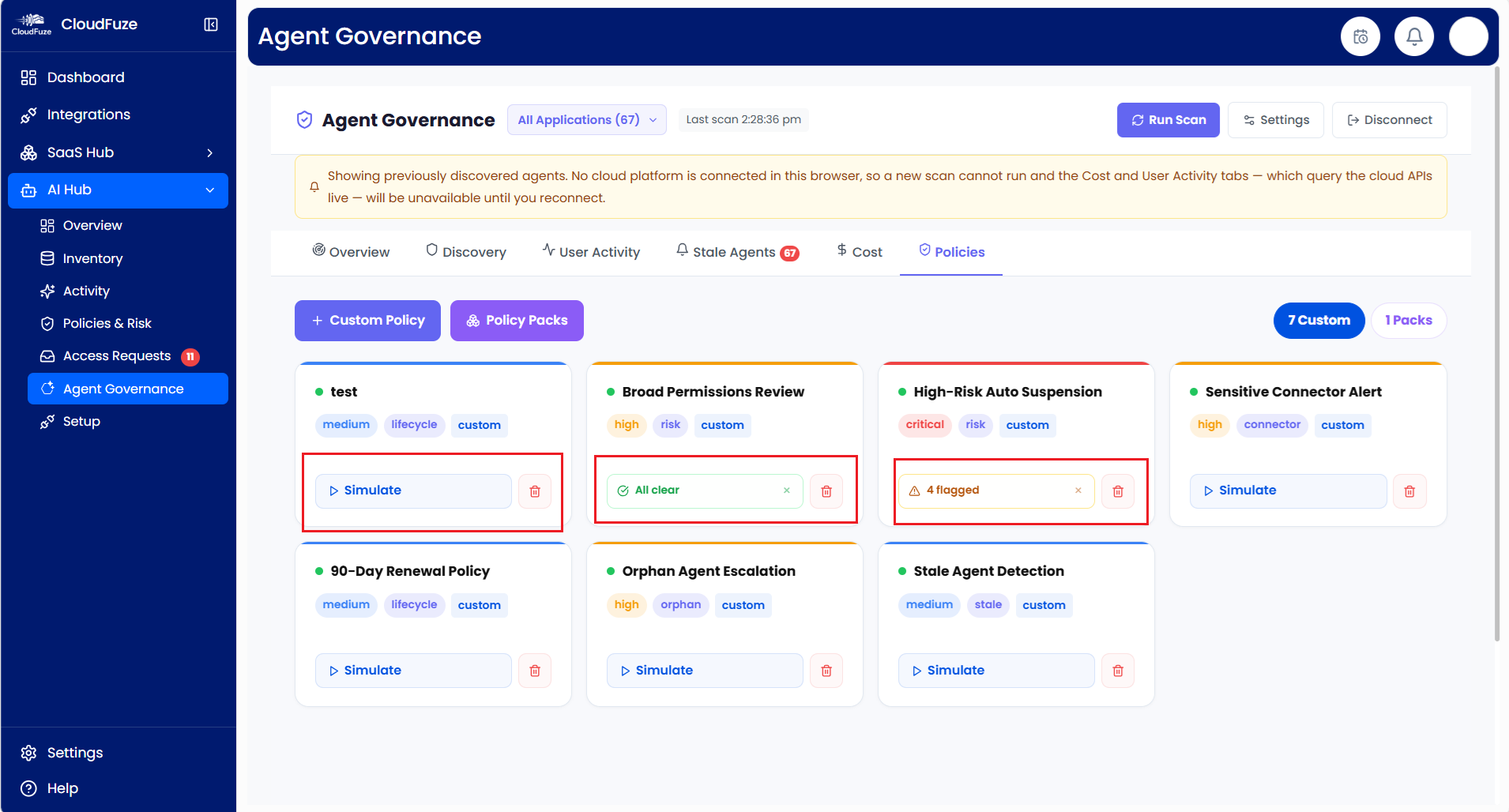
This helps organizations proactively detect broad permissions, stale or orphaned agents, sensitive connector risks, as well as other governance violations before they become compliance issues.
This helps regulated enterprises continuously monitor governance status, enforce compliance policies at a single click, and demonstrate that AI governance controls are not just documented but actively enforced.
Turn AI Governance into a Competitive Advantage with CloudFuze Manage
Whether your enterprise is preparing AI audits, addressing shadow AI, or implementing controls aligned with frameworks such as HIPAA, SOC 2, NIST AI RMF, and ISO/IEC 42001, comprehensive visibility of AI systems is necessary.
CISOs and compliance teams that invest in these capabilities can innovate safely while leveraging AI for larger business objectives.
Frequently Asked Questions
1. Explain AI governance in regulated industries.
AI governance in regulated industries refers to the policies, controls, and human oversight processes for AI systems to operate in a secure, responsible, and compliant manner. It helps organizations manage data security risk, maintain accountability, and demonstrate compliance during audits.
2. What industries require strong AI governance controls?
Industries such as financial services, healthcare, legal services, insurance, and government/government agencies typically require stronger AI governance controls. They manage sensitive data and operate under strict regulatory obligations.
3. Why is AI governance important for regulated industries?
AI governance helps regulated organizations adopt AI safely and ensures it aligns with industry regulations and internal governance requirements. This reduces compliance risks, protects sensitive data, and maintains visibility into AI applications and agents.
4. What are the key components of an AI governance framework?
An AI governance framework includes AI discovery, AI inventory management, risk assessments, governance policies, and continuous monitoring. All these capabilities work together to help organizations govern AI usage and maintain compliance.
5. How can regulated businesses identify and manage AI risks?
Organizations can identify AI risks by effectively discovering AI applications, maintaining an AI inventory, and conducting regular AI governance assessments. Continuous monitoring of AI activity also helps detect emerging risks and enforce governance controls.
About the Author: Bhuvaneswari Gireesh


