
Find Your AI Blind Spots: An AI Governance Assessment Plan for CISOs
An AI governance assessment checks AI tools, agents, permissions, data exposure, and governance controls, helping CISOs tackle blind spots in AI governance. Employees adopt new AI tools, and approved SaaS apps introduce new AI feature updates by default.
AI agents may access business data with permissions that are pending review. This gives rise to the need for an AI governance assessment. According to Gartner research, more than 40% of global organizations are expected to suffer security and compliance incidents due to the use of unauthorized AI tools by 2030.
This blog post will help CISOs with the basics of AI governance assessment.
Key Takeaways
What Is an AI Governance Assessment and Why Do CISOs Need One
AI governance assessments give CISOs a clear roadmap to evaluate AI visibility, ownership, security controls, compliance readiness, and overall AI governance maturity. According to an IBM report on data breaches, 68% of enterprises that experienced a data breach had no AI governance in place, and shadow AI agents were involved in 43% of them. This highlights the importance of AI governance assessments for enterprise IT and security teams.
CISOs can see who owns each AI tool and agent, the strength of security controls, and assess compliance readiness. They do not have to rely on assumptions anymore but can obtain a fact-based view of where AI is running, what it can reach, and where the governance gaps are.
A regular AI governance gap analysis delivers three clear advantages for CISOs:
- They can see security risks before attackers or auditors do.
- Fixes can be ranked by impact instead of guessing.
- It provides clear evidence to justify governance budgets and headcounts.
What Should an AI Governance Assessment Measure
A suitable enterprise AI governance assessment investigates every detail of AI agent activity; it is not just governance policies on record. Here are features or measures to check for your AI governance assessment plan.
| Feature | Questions to ask |
|---|---|
| Full visibility | Can a CISO check every AI tool, AI agent, and AI feature switched on inside approved SaaS apps? |
| Data exposure | What types of sensitive data can each AI tool or agent reach, and do these flow into prompts or file uploads? |
| Access & OAuth grants | Do AI tools and agents retain only the access they need? Are unused OAuth grants checked and removed? |
| Agent ownership | Does every AI tool and agent have a named, accountable owner? |
| Policy enforcement | Are AI policies enforced automatically, or are they written down but not implemented? |
| Audit evidence | Is it possible to prove compliance at any time, for a regulator, auditor, or the board? |
Shadow AI is usually the hardest to tackle for CISOs. To track shadow AI, they must look beyond the approved app list-check sign-ins through the identity provider, connected apps and OAuth grants, browser activity, and expense records for all AI subscriptions.
Note that the audit evidence feature also doubles as an enterprise AI compliance assessment, since proof is what regulators ask for first.
Understanding the basics of AI agent governance can help CISOs get started with AI agent governance assessment. Explore our guide.
A Step-by-Step Approach to AI Governance Assessment
An AI governance assessment works best as a sustainable, repeatable process. These five steps give CISOs a clear scope, a complete AI inventory, a maturity score for each step, and a risk-ranked list of security gaps.
The following five-step framework helps CISOs overcome AI governance challenges and conduct a structured AI governance assessment. They can then act on these findings to implement measurable governance improvements.
1. Define Governance Scope, Goals, and Compliance Needs
Decide which business units, AI platforms, and regulations the assessment covers, and what a good result looks like. Define goals such as improving visibility, reducing compliance risks, preparing for audits, or aligning with frameworks like ISO 42001, NIST AI RMF, the EU AI Act, or internal governance policies.
2. Discover the AI Agent Environment
Build and document a full inventory of AI tools, agents, and embedded AI features, including shadow AI, along with owners and access for each agent.
3. Score Each Governance Area on a Maturity Scale
Evaluate key areas of AI governance such as AI visibility, risk management, security, data governance, compliance, and monitoring using a maturity scale that clearly states what the Ad Hoc, Developing, Managed, and Optimized categories are.
4. Fix AI Governance Gaps Using Risk Ratings First
Rank each AI agent governance gap by the sensitivity of the business data involved and the impact in case an event occurs. This ensures that high-risk AI use gets addressed in the beginning.
5. Reassess and Set up a Continuous Monitoring Process
A complete AI governance assessment at least once a year is needed, with regular quarterly AI agent activity checks. AI developments are faster than most annual review cycles.
This will assure CISOs that governance controls are always effective and aligned with changing business and regulatory requirements.
How CISOs Can Turn Assessment Feedback into Action
Once enterprise CISOs receive feedback from regular AI governance assessments, they can take corrective action on AI agents when needed. An AI governance gap analysis helps with the following-
1. Fix the Critical Governance Gaps First
Remove risky access, revoke unused OAuth grants, and assign owners to any AI tool or agent that doesn’t have one. Redundant ownership can be reassigned as well.
2. Report Governance Progress
Share governance maturity scores before and after, the reduction in security risk, and audit readiness with leadership and the board.
3. Automate Manual Governance Reviews
CISOs can remove manual AI activity reviews and replace them with continuous AI agent discovery, real-time governance policy enforcement, and automatic evidence capture, so the same gaps don’t reopen.
This systematic approach helps enterprises identify governance gaps, reduce risk, and build a scalable, audit-ready AI governance program.
Partnering with a suitable enterprise AI governance platform is a good place to get started.
How CloudFuze Manage Helps CISOs With Robust AI Agent Governance Assessment
When CISOs choose an AI governance assessment tool, they should look for automatic discovery of AI agents, live security risk scoring, real-time policy enforcement, and built-in audit evidence.
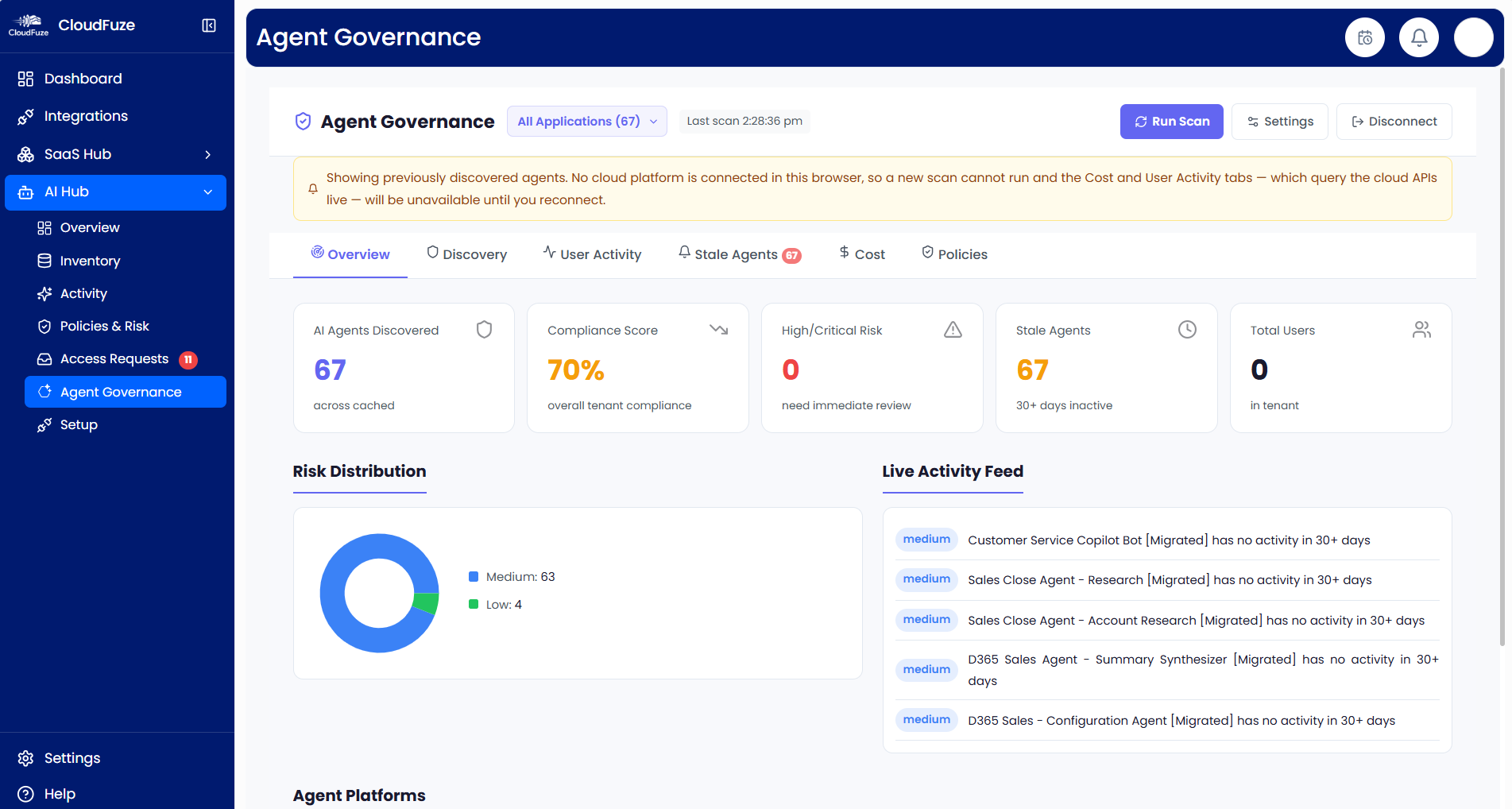
CloudFuze Manage covers each of these six areas from a single platform-
1. Visibility & Assigning Ownership
AI Registry in the enterprise merges discovered AI agents, endpoint security scans, AI agent usage activity, and sanctioned decisions into one inventory. This is mapped with the owner, risk level, and status of every AI system. Security admins can approve or block entries directly.
2. AI Agent Governance
CISOs can discover AI agents across various cloud platforms like Microsoft 365, Google Workspace, and Power Platform, and give agent activity a risk score based on permissions, ownership, staleness, and consent scope.
This feature can automatically flag, escalate, suspend, or archive risky AI agents.
3. Business Data Exposure
AI Activity tracks unwanted prompts, file uploads, and risk detections across browsers, desktop apps, and network traffic. Copilot Readiness scans Microsoft SharePoint, OneDrive, Teams, and Exchange for any data oversharing before Copilot can surface it.
4. Per-employee Risk Score
The employee risk score highlights users with repeated policy violations, shadow AI use, or any unusual spikes in AI agent activity.
5. Policy Enforcement and Audit Evidence
Compliance Policy Packs that are built-in can deploy customized rules across GDPR, HIPAA, SOC 2, CCPA/CPRA, the EU AI Act, ISO/IEC 42001, and NIST AI RMF in one step. An impact simulator displays what each pack would have blocked before it goes live.
6. Controlling Exceptions for Blocked Agent Access Requests
Employees can request blocked AI tool access, with time-boxed approvals that expire automatically.
An AI governance assessment helps CISOs stay ahead of an ever-evolving AI environment that changes every week.
Build a Continuous, Audit-Ready AI Governance Assessment Plan with CloudFuze
CloudFuze Manage helps make AI governance assessments continuous and always current, so CISOs can find gaps, close them, and gather audit proof.
Regular AI governance assessments provide visibility to CISOs. They can investigate AI tools, agents, permissions, and data access before these AI agents create security, compliance, or operational risks.
Combining application discovery, security risk scoring, policy enforcement, and audit evidence helps CISOs move from reactive oversight to continuous AI governance.
Frequently Asked Questions
1. Which enterprise leader must own an AI governance assessment in an enterprise?
The CISO or a compliance and risk leader usually takes charge, with input from IT, legal, privacy, and business owners. Clear leadership is essential; one person should own the results and the action plan, even when multiple employees or users are involved.
2. How is an AI governance assessment different from an AI readiness assessment?
An AI readiness assessment checks whether an organization has the people, processes, technology, and data required to adopt AI successfully. An AI governance assessment checks deployed AI tools, agents, and AI-powered features to ensure they operate in a secure and compliant manner, as per governance policies.
3. What shows the effectiveness of an AI governance assessment?
CISOs must track the share of AI tools and agents with named owners, shadow AI found and resolved, unused OAuth grants revoked, time to close high-risk gaps, and movement up the maturity scale between governance assessments.
4. How can one differentiate between an AI governance assessment and an AI audit?
A governance assessment is an internal health check that finds gaps and sets priorities. It is a formal, mostly independent review that tests whether controls meet specific standards or regulations.
5. What are common roadblocks in AI governance assessment plans?
Enterprises assessing only approved tools, ignoring AI features inside SaaS apps, skipping OAuth and agent access, and relying on self-reported answers. Most of all, treating the assessment as a one-time project rather than a recurring check is a challenge.
About the Author: Bhuvaneswari Gireesh


