
Enterprise AI Governance Challenges & How IT Can Solve Them
AI governance challenges result in shadow AI, limited visibility into AI usage, unclear ownership, data security risks, compliance complexity, AI agent sprawl, and uncontrolled expenses. All the above quietly increase enterprise risk and operational costs.
Meanwhile, Gartner predicts that over 60% of enterprises that ignore challenges in overall AI governance will fail to govern AI by 2027.
In this blog post, let us discuss why enterprises fail at AI governance, the challenges, best practices, more importantly, management of shadow IT, and finally, how CloudFuze Manage can help.
Key Takeaways:
What is the Importance of AI Governance in Enterprises?
Traditional AI governance methods built around spreadsheets, email threads, and policy documents can no longer keep pace with the scale and speed of AI adoption. However, with AI deeply embedded in your business operations today, the risks associated with unchecked AI usage continue to grow.
Today, governance is the control layer that decides whether AI drives value or quietly drives risk in your enterprise. Compliance teams therefore have begun to create AI governance frameworks but without knowing regulatory & globally accepted standards like the EU AI Act and ISO/IEC 42001.
These policies may be comprehensive but can be hard to enforce manually.
Note that a Reuters report states that while half of enterprises have strategies and 71% include ethical principles, a major execution gap still exists.
Proper AI governance requires clear accountability, control, continuous monitoring, and ` close collaboration with business, technical, IT security, and compliance functions throughout the AI lifecycle.
7 AI Governance Challenges and How IT Can Solve Them
For enterprises to establish effective oversight, they must first identify the governance challenges that most commonly hinder the scalable and responsible adoption of AI. AI governance challenges are recurring obstacles that slow enterprise AI adoption and increase AI-related security risk.
1. Shadow AI
Employees often adopt AI tools on their own to improve their productivity, creating blind spots for your enterprise IT and security teams. Without shadow AI detection, enterprises face increased risks of data security breaches, compliance violations, and policy violations. IT teams fix Shadow AI issues by:
- Discovering enterprise AI tools continuously from sign-in, app, and usage data.
- Categorizing every tool as approved/under review/blocked and sending out the approved list.
- Suggesting alternative AI tools for those that are not approved by IT teams.
2. Data Privacy and Security Risks
Employees may inadvertently share sensitive business information with AI tools that lack proper AI measures. Without clear AI governance policies and monitoring, enterprises risk data overexposure. IT teams can fix data privacy and security issues by:
- Mapping confidential data first and fixing overshared folders and sites.
- Restricting access to AI tools and agents in sensitive locations.
- Monitoring file activity by AI applications/agents and setting up alerts on breaches
3. Improper Ownership and Accountability
AI governance frequently spans multiple departments, such as IT, security, legal, compliance, and business operations. When there is no clarity in responsibilities, decision-making becomes fragmented, and your enterprise’s governance efforts lose effectiveness. IT teams can fix ownership and accountability issues by:
- Tracking live inventory of every agent/owner, the AI model used, and its permissions.
- Mandate a named owner for every agent and reassign ownership when people leave.
- Retire agents that are idle for 30 to 60 days.
4. Growing Regulatory and Compliance Complexities
Effective AI governance and compliance programs require centralized visibility, documented policies, and clear ownership. Disconnected AI governance policies, along with manual processes, make compliance difficult to maintain and audit, especially in large enterprises. IT teams can tackle regulatory challenges by:
- Turning each policy rule into an automated control, e.g., an alert when an agent’s risk score crosses a set limit.
- Auditing for unsanctioned AI periodically.
- Routing alerts to a recognized owner with a specific response time.
5. Untracked AI Expenses and Tool Redundancy
Different teams within an enterprise often purchase AI solutions independently, leading to duplicate tools, inconsistent AI usage, and unnecessary AI licensing & token costs.
Enterprises need centralized AI oversight; otherwise, it becomes tough for them to optimize AI investments and maximize value. IT teams can handle untracked AI expenses by:
- Tracking AI licenses, token-based agent costs, and AI subscriptions in one view.
- Comparing license counts with actual usage and reclaiming subscriptions of inactive users before renewal.
- Consolidate duplicate tools that different teams purchased for the same job.
6. Unauthorized Data Access due to Incomplete Offboarding
Enterprises build offboarding checklists for email and core apps but miss the AI tools and agents employees use on their own. So, when an employee exits, their AI accounts, prompt history, files, and agents remain active. IT teams can fix data access issues by:
- Tying your AI tools and agents to automated offboarding workflows to revoke access immediately after employee exit.
- Transferring files and agent ownership to a manager, then reclaiming specific licenses.
7. No Centralized AI Inventory
Nowadays, AI capabilities sit across numerous SaaS applications, making it difficult to track where and how AI is being used. Without a centralized AI inventory, enterprises struggle to govern AI consistently. IT teams can handle AI inventory issues by:
- Uniting AI tools, agents, access, data activity, and spending on a single dashboard.
- Setting up regular reports for security, compliance, and leadership.
Enterprises do not have to guess where their AI risks lie anymore. Here is our free AI readiness assessment test to help you get started.
How Can CloudFuze Manage Help Enterprises Handle AI Governance Challenges?
Enterprises that stay in control treat AI governance as an ongoing IT activity. CloudFuze Manage helps enterprises by bringing AI governance capabilities into one platform for SaaS apps, AI tools, and AI agents, ensuring that IT and security teams are also on the same page.
Let us look at how CloudFuze Manage features help enterprises deal with AI governance challenges.
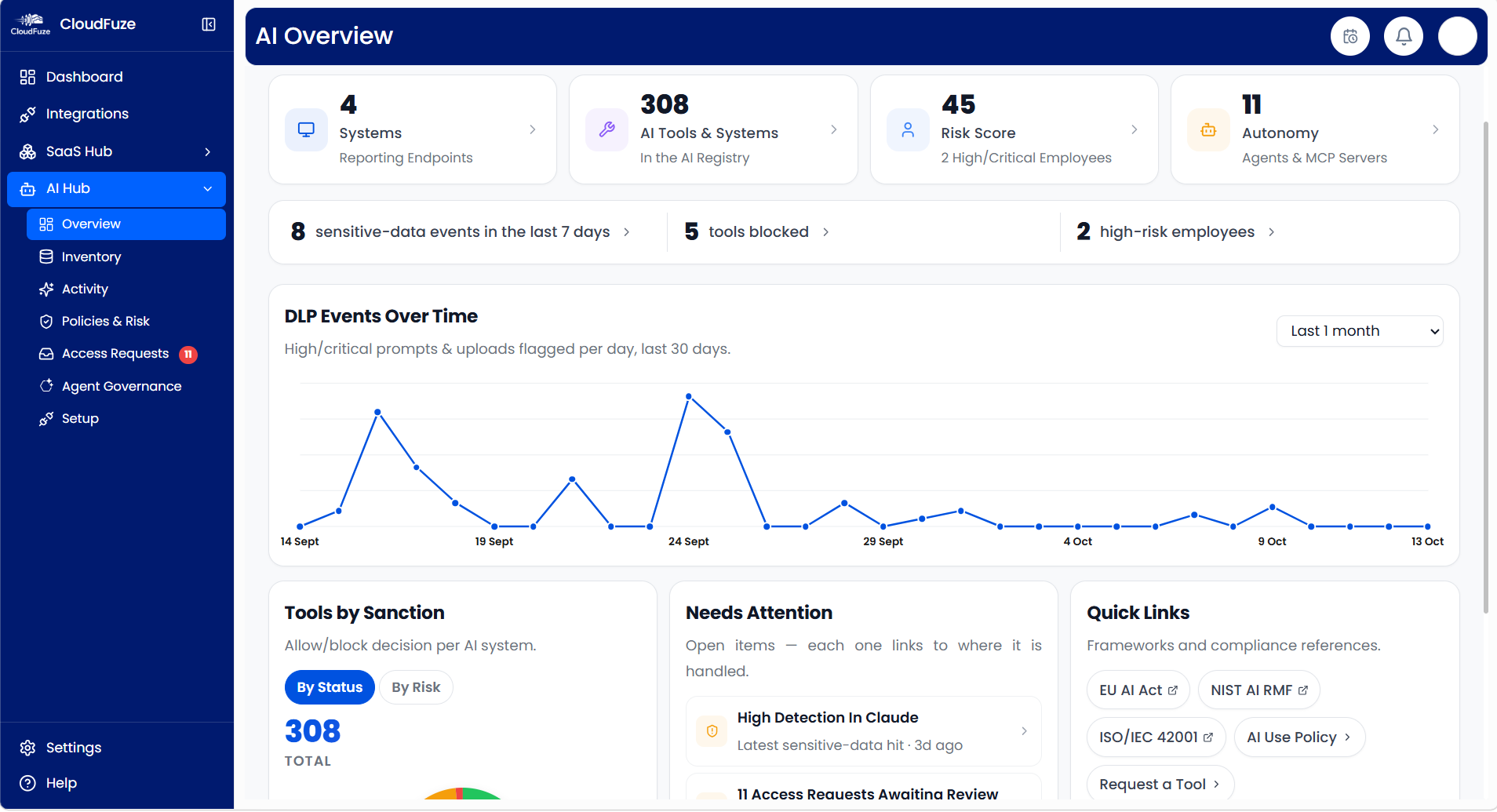
- AI Overview: All stakeholders can see all AI tools, AI agents, risk levels, high-risk users, blocked tools, and sensitive data alerts on one screen; they can now learn where the biggest AI risks are and what to fix first.
Here is a screenshot that explains this.

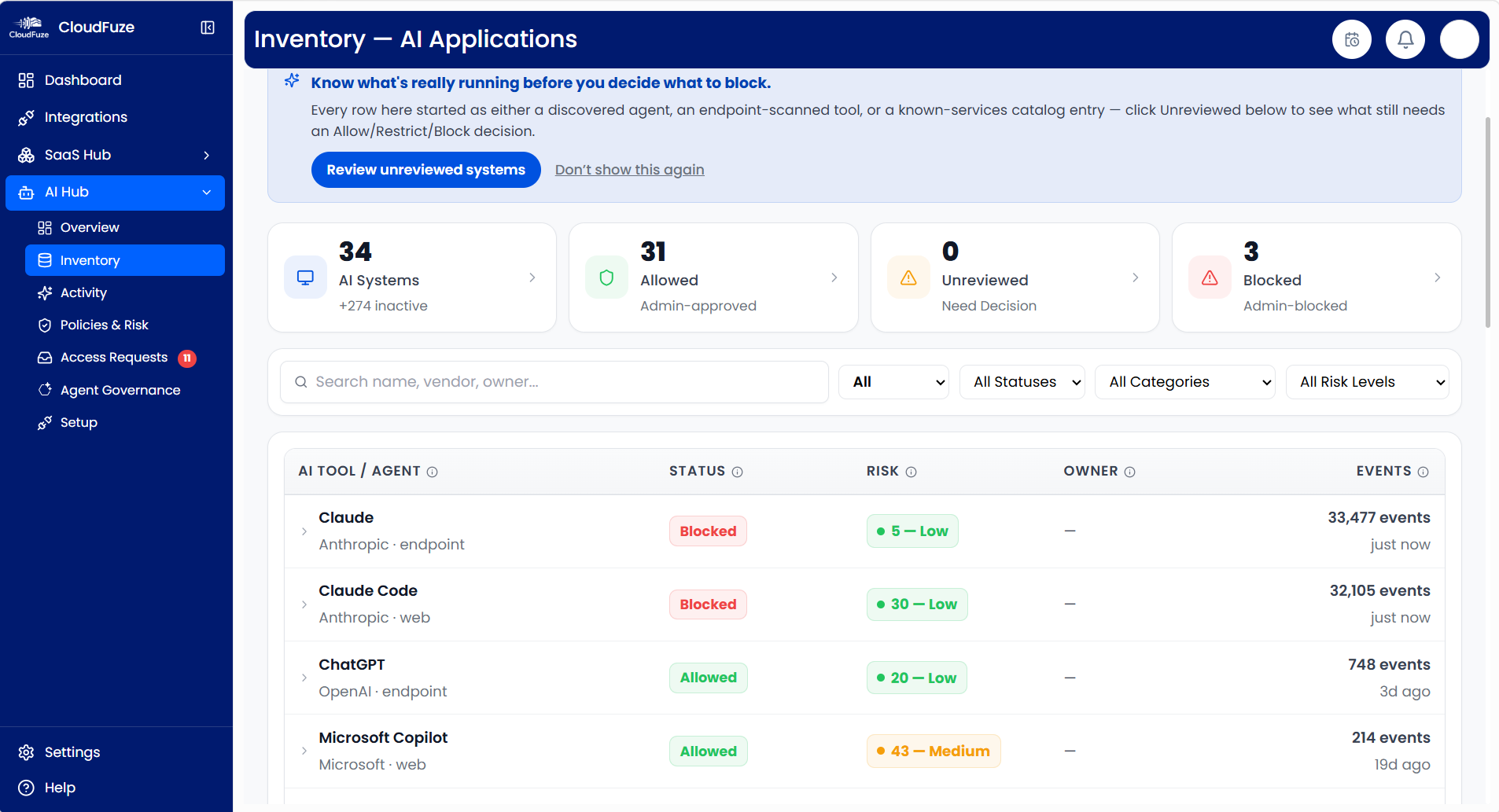
- Inventory: IT teams can easily track AI tools used, check who owns them, the risk factor, etc. They can also check the frequency of usage, and hence IT admins can decide what to allow or block based on real usage. Check the screen below

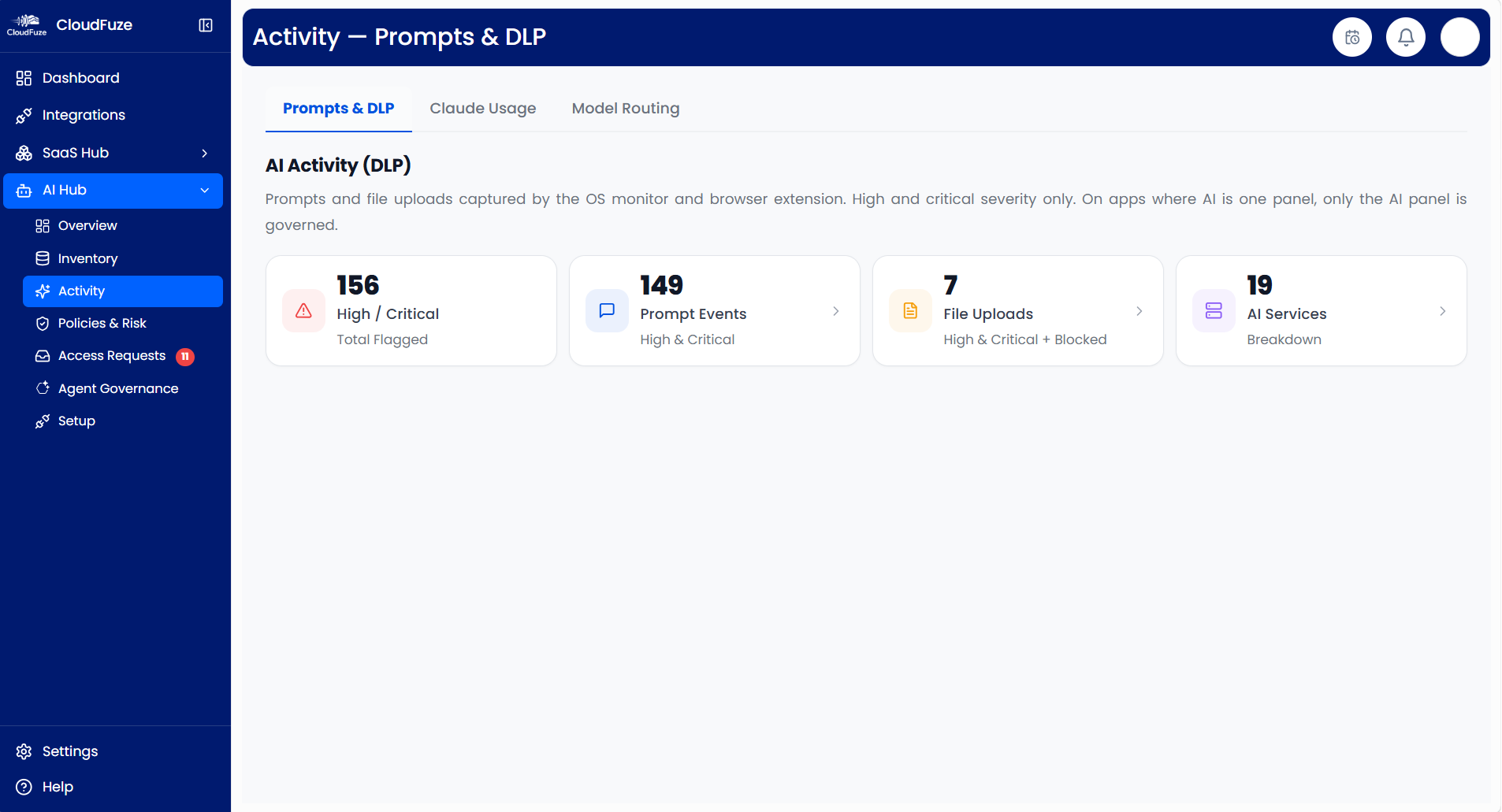
CloudFuze Manage enables visible, controlled, and measurable AI adoption without slowing down the teams that depend on it. - AI Activity: Track what employees key into AI tools and the files they upload, on both desktop apps and browsers, so it is easy to stop sensitive company data from leaking into AI.

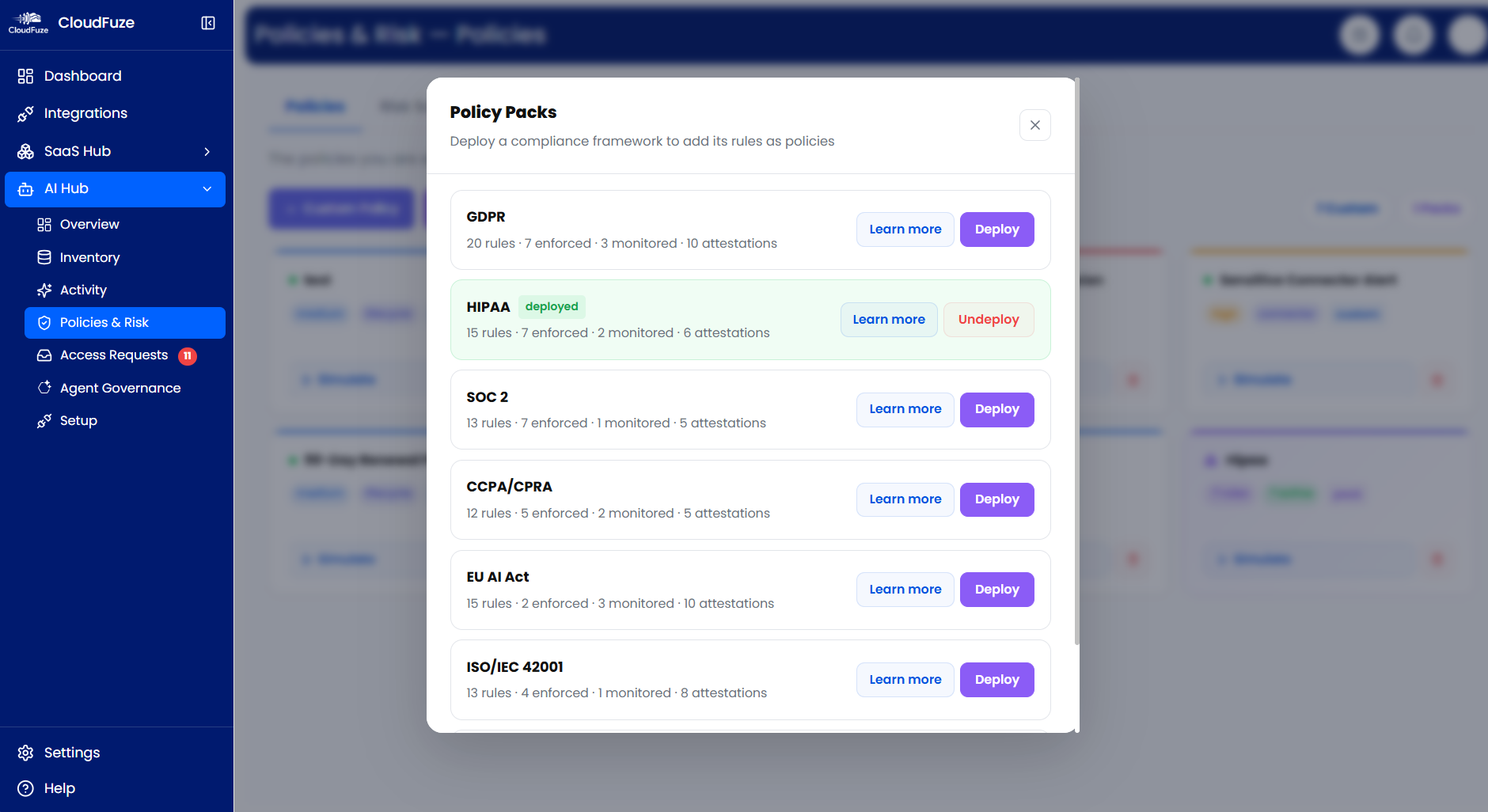
- Policy Enforcement and Risk Management: Ready-made rules for GDPR, HIPAA, SOC 2 Type are visible and accountable, and ISO/IEC 42001 can be turned on in one click. Now your enterprise-wide AI use follows the regulations you need to meet without having to write policies on your own.

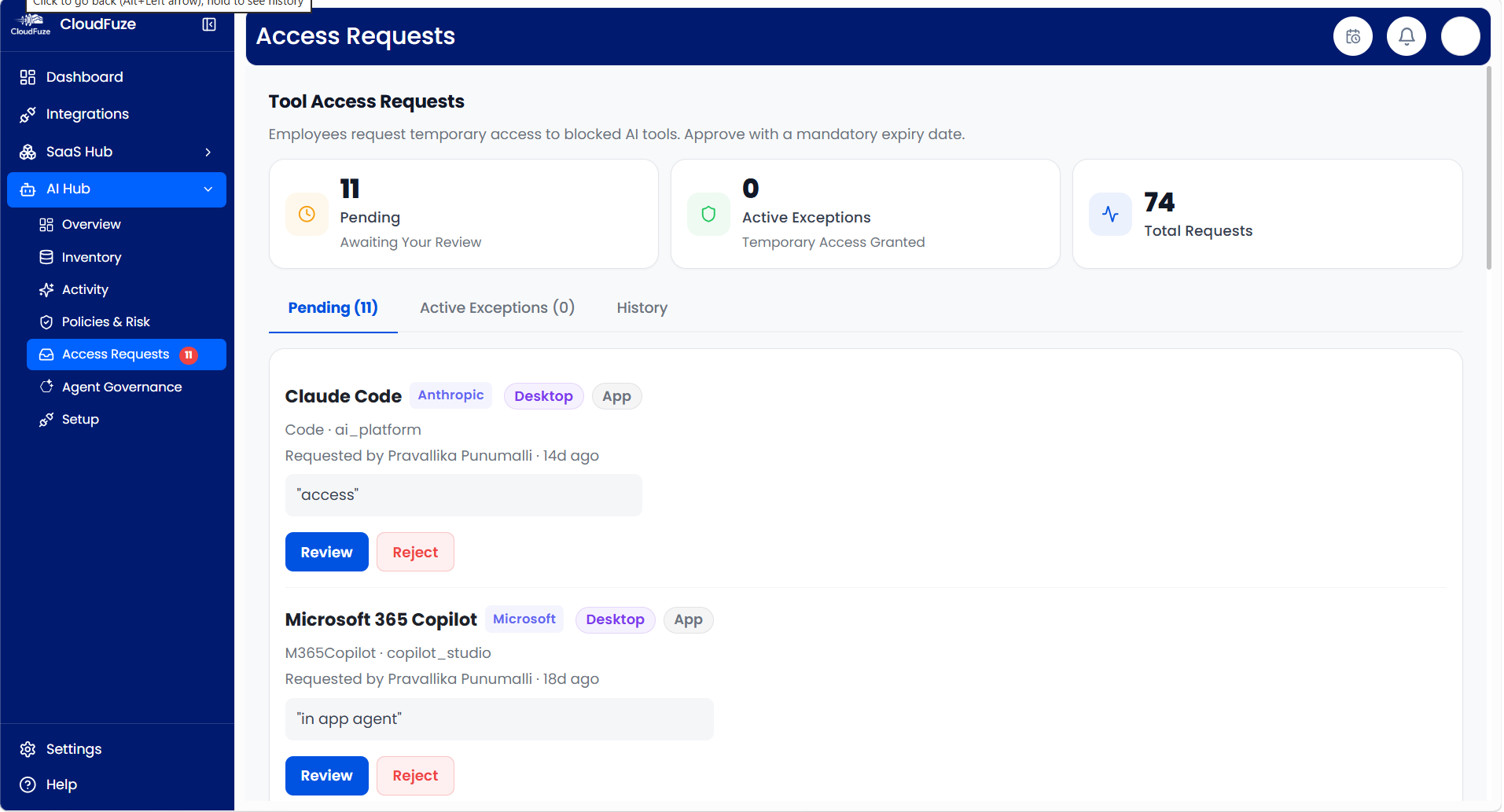
- License and Policy Enforcement and Risk Management: Employees will need to request access specifically to automatically blocked AI tools. IT teams may approve this request for a limited time only, so employees can continue to innovate using AI apps without leaving any permanent security gaps.

AI Governance Best Practices for Enterprises
The right AI governance framework ensures that AI tools, applications, and agents visible, accountable, and are continuously governed across the enterprise. These AI governance best practices help enterprises get started.
| Best practice | Steps |
|---|---|
| Discover first | Find every AI tool, AI feature and agent before writing a rule for AI governance |
| Assign clear ownership | Name an accountable owner for every AI tool, application and agent |
| Apply risk-based policies | Match controls and risk profile of each AI use case |
| Monitor continuously | Track access, usage, data exposure and costs across AI apps and agents |
| Evaluate vendors and models regularly | Check that AI vendors and models meet security, privacy, compliance and business requirements |
| Integrate, don’t isolate | Use platforms like CloudFuze Manage to build AI oversight into existing risk, security and compliance programs. |
Choose CloudFuze Manage as Your Comprehensive AI Governance Platform
Our SaaS and AI app management platform, CloudFuze Manage, enables enterprises to bring AI applications, agents, users, and governance controls together in a single view, enabling more secure, compliant, and scalable AI adoption.
Frequently Asked Questions
1. What are common AI governance challenges faced by enterprises?
Common roadblocks include Shadow AI, sensitive data exposure, AI agents without owners, unenforced policies, untracked AI spend, access that remains after employees leave, and scattered reporting that slows audits.
2. Which is the ideal tool to manage AI governance risks in enterprise environments?
Look for a platform that discovers AI tools and agents automatically, audits data access, enforces policies with alerts, tracks AI spend, and handles access through the employee lifecycle. CloudFuze Manage is built to do all of this in a single window.
3. Why is AI governance critical for enterprises?
AI is spreading faster than most enterprises can govern it. Employees adopt new AI tools and agents every week, often without IT teams knowing it, and the risk is already showing up in breach of data.
4. What software helps manage AI governance risks in enterprise environments?
A platform that discovers AI tools and agents automatically, audits data access, enforces policies with alerts, tracks AI spend, and handles access through the employee lifecycle is ideal. CloudFuze Manage handles all of this from one place.
5. What steps should enterprises take to assess their AI governance challenges?
Start with an inventory of the AI tools/agents and data access for each. Also check which ones have owners, which policies are enforced, and what the AI costs are. Score each to prioritize fixes accordingly.
About the Author: Bhuvaneswari Gireesh


