
The CIO’s AI Governance Checklist for Secure AI Adoption
An AI governance checklist guides CIOs in securely adopting AI platforms, agents, and language models. It also helps CIOs verify that every AI asset in their enterprise has clear human owners, visibility and monitoring controls, and audit-ready documentation.
When CIOs use this AI governance checklist along with SaaS and AI app management software such as CloudFuze Manage, it gives them complete visibility and AI governance control across their entire AI ecosystem.
This blog post offers CIOs a detailed AI governance checklist.
Key Takeaways
What Is an AI Governance Checklist and Why It Matters for Secure AI Adoption?
An AI governance checklist is a set of IT and security governance guidelines that every AI application, AI agent, or large language model must meet before and after deployment in your enterprise. It helps CIOs implement AI governance frameworks and policies into actual practice.
Note: An AI governance framework defines the rules, but an AI governance checklist ensures those rules apply to every AI tool, copilot, and agent adopted enterprise-wide.
Meanwhile, AI-related security risks continue to grow as your employees increasingly subscribe to AI platforms through free trials, embedded copilots, and autonomous agents that often bypass your company’s formal IT review processes (Shadow AI). This rise in shadow AI also creates serious governance gaps.
In fact, IBM’s data breach report states that 63% of breached organizations lacked a proper AI governance policy. On the other hand, regulations such as the EU AI Act, NIST AI Risk Management Framework, and ISO/IEC 42001 push AI governance toward risk-based, auditable controls.
These data breach statistics and new AI governance frameworks also highlight the need for a comprehensive AI governance security checklist to reduce AI-related security risks across your enterprise.
Without detailed AI governance guidelines, secure AI adoption becomes an inconsistent process in enterprises.
Enterprise AI Governance Checklist for CIOs: Necessary Controls for Secure Adoption
A strong AI governance checklist spans the entire AI lifecycle, from AI application discovery and data management to agent monitoring and audit readiness.
CIOs can use the following AI governance checklist to standardize AI oversight, reduce AI-related security risk, and support compliant AI adoption across their enterprise:
-
Gain Complete Visibility into AI Usage Across Your Enterprise
Every CIO must maintain a single inventory of every AI tool, copilot, agent, and model in use, including shadow AI adopted without IT approval.
-
Assign Clear Human Ownership to Every AI System
Enterprise CIOs must assign a designated business or technical owner to each AI application their teams use and make them accountable for the particular application’s compliance and performance.
-
Classify AI Systems by Risk Level
CIOs should categorize AI apps, copilots, and agents based on their impact on data security, compliance, customer outcomes, and business operations. Higher-risk AI systems should be subject to stricter controls, approvals, and monitoring requirements as per the EU AI Act.
-
Assess AI Vendors Before Adoption
Chief Information Officers should evaluate each vendor’s security controls, data retention policies, compliance certifications, and AI transparency before approving new AI-powered tools for enterprise use.
-
Apply Least-Privilege Data Access Controls
Every CIO must verify that every AI platform, agent, and user has access only to the data and functions required for approved business purposes.
-
Validate How Your AI Systems Access And Process Sensitive Enterprise Data
CIOs must confirm that their enterprise’s customer, employee, financial, and proprietary business information is protected and accessed only through automated policy controls.
-
Define Human Oversight Requirements
CIOs should determine where human review, approval, or intervention is required before AI systems or autonomous agents can make decisions, access confidential business data, or perform business-critical actions in their enterprise.
-
Monitor AI Costs and License Utilization
IT teams must track all AI subscriptions, token consumption, and overlapping AI tools, and report these details to CIOs to prevent budget sprawl and maximize the value of their enterprise-wide AI investments.
-
Monitor AI Behavior and Security Risks
CIOs should instruct IT and security teams to monitor for AI policy violations, unapproved data access, unusual AI usage patterns, and behavioral drift in agents that could pose severe IT operational or security risks.
-
Maintain Audit-Ready Documentation
Enterprise CIOs should keep records of each and every data access approval, policy review, risk assessment, and model configuration change to support regional compliance and regulatory requirements.
-
Regularly Review and Strengthen AI Governance Controls
Every CIO should reassess security risk levels, data access permissions, governance policies, and application monitoring processes as new AI tools, agents, and copilots enter the enterprise environment.
-
Operationalize AI Governance with Advanced SaaS Management Software
Use SaaS and AI app management platforms such as CloudFuze Manage to continuously discover AI applications, monitor their usage, enforce governance policies, and maintain centralized control across your AI ecosystem.
When CIOs run every AI system through the above checks, secure AI adoption becomes a simplified process.
Challenges Involved in Manually Implementing AI Governance Frameworks in Enterprises
When AI adoption increases enterprise-wide, CIOs often face serious AI and agent governance challenges when AI governance controls are implemented and tracked manually.
The table below discusses the challenges and impact CIOs experience:
| Challenge | Impact |
|---|---|
| AI Visibility gaps | Hidden AI platforms and agents cannot be governed. |
| Rapid AI adoption | AI adoption outpaces IT governance controls. |
| Fragmented AI stack | No unified AI inventory to track AI usage. |
| Ownerless agents | No clear named human for agent accountability. |
| Compliance readiness | Manual compliance audits are inefficient in the age of AI. |
AI Governance Best Practices for CIOs
An effective AI governance checklist goes beyond policy creation. CIOs must combine visibility, ownership, risk-based controls, and continuous monitoring to ensure AI tools and agents remain secure, compliant, and aligned with business objectives.
Discussed here are a few practices for implementing AI governance:
- Start by establishing complete visibility into all your AI tools, copilots, and agents before applying governance controls.
- Do not forget to apply risk-based governance to align each agent’s level of autonomy with its associated risk.
- Always assign clear ownership to ensure every AI tool and agent has a designated owner accountable for its data use and activities.
- Make sure to apply least-privilege data access to limit each AI system’s data and system access to only what it needs.
- Always use automated IT controls to maintain consistent governance as AI usage scales.
- Regularly review your AI behavior to detect any anomalous behavioral drift, security risks, and policy violations.
How Can CIOs Establish and Enforce AI Governance at Enterprise Scale?
Establishing written AI governance policies is straightforward. Enforcing them across many AI tools, agents, and users is where most enterprises stall. Spreadsheet-based AI governance controls and quarterly audit reviews cannot keep up with AI volatility.
Therefore, CIOs need a single platform to establish and implement AI governance at enterprise scale. CloudFuze Manage is the unified solution that offers SaaS and AI governance for CIOs on a single platform with flexible per-user pricing.
CloudFuze Manage operationalizes each control in the AI governance checklist, helping CIOs move from policy creation to automated AI governance control enforcement. Here is how CloudFuze Manage helps CIOs enforce their AI governance checklist:
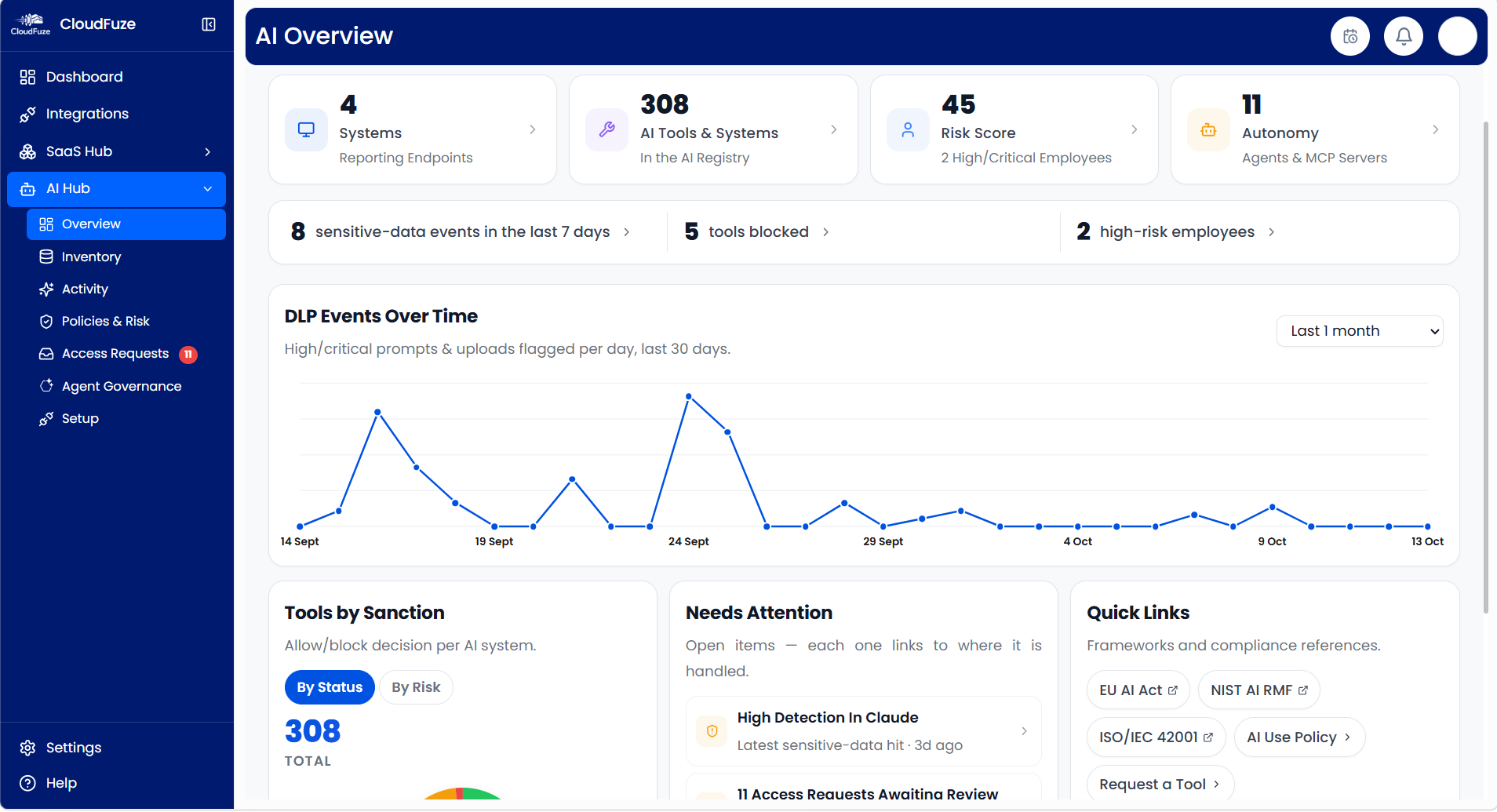
- Discovers every SaaS and AI application, system, agent, and copilot in use, including shadow AI adopted without IT approval.
- Assigns each agent an owner, a defined scope, and the access you determine, so nothing operates beyond its boundaries.
- Finds AI tools handling sensitive data before they become a compliance liability.
- Tracks AI token and SaaS spend, inactive license seats, and redundant tools from one governed view for continuous IT cost control.
- Provides full-stack visibility into AI ownership, security risks, application usage, and compliance status from a single dashboard.
- Keeps user logs and agent activity evidence audit-ready, so a compliance review finds proof already in place.
Simplify AI Governance Across Your Entire AI Ecosystem with CloudFuze Manage
An AI governance checklist turns AI governance policies into actionable IT and security controls. At the same time, CloudFuze Manage helps CIOs enforce those controls across every AI tool, copilot, and agent operating within your enterprise.
Frequently Asked Questions
1. What software solutions help CIOs manage AI governance and compliance effectively?
CloudFuze Manage is one of the software solutions that discovers every AI tool and agent, assigns ownership, enforces least-privilege access, tracks AI token spend, and maintains audit trails from a single, intuitive platform.
2. What are the important elements in a CIO’s AI governance checklist for secure AI adoption?
The critical elements of an AI governance checklist include application discovery and inventory, agent ownership and accountability, risk classification, vendor assessment, data access controls, human oversight, token cost and license tracking, and audit readiness.
3. How is AI governance different from agent governance?
AI governance oversees all AI systems, including large language models, copilots, and applications. Agent governance is a subset focused on autonomous agents that act independently and require additional security controls over their data access scope, action limits, and ownership, as they can operate without human intervention.
4. How do CIOs help enterprises secure AI adoption?
CIOs secure AI adoption by making AI governance the default, not an afterthought. They establish a checklist, discover all AI in use, assign designated owners, enforce least-privilege data access, monitor agent behavior continuously, and keep evidence audit-ready so that teams can adopt AI without unmanaged risk.
5. How can enterprises evaluate AI projects for compliance?
Enterprises evaluate AI projects by confirming that each AI app and agent has a named owner, classifying their security risk levels, assessing vendor controls, verifying approved data access, defining human oversight requirements, reviewing costs and licensing, and ensuring an audit trail is in place. AI projects that satisfy these requirements are better positioned for compliance and governance approval.
6. What is the difference between an AI governance framework and an AI governance checklist?
An AI governance framework defines the AI usage and governance policies, principles, and standards that guide AI adoption in an enterprise. In contrast, an AI governance checklist operationalizes those requirements through a repeatable set of controls that your IT and security teams apply to every AI system, copilot, model, and agent deployed across your enterprise.
About the Author: Rashmi Ramesh



