
SaaS License Optimization: Enterprise Guide to Reduce Waste
SaaS license optimization reduces license cost waste by matching your enterprise license needs to the licenses your employees actually use.
In 2026, most enterprises pay for software licenses nobody uses, and they cannot see it. SaaS license optimization using SaaS & AI app management software like CloudFuze Manage closes that visibility gap.
This guide covers what SaaS license optimization means and the best practices that reduce waste.
Key Takeaways:
What Is SaaS License Optimization and Why Is It Important for Enterprises?
SaaS license optimization is the process of continuously aligning your enterprise-wide paid software entitlements with real usage. It covers finding every license, measuring how each application license is allocated, and adjusting counts and tiers with actual license utilization. As a result, your finance team stops paying for unused license seats that nobody in your enterprise uses.
SaaS license optimization matters because license waste and unnecessary software spending are widespread across enterprises and often remain invisible. Meanwhile, Gartner Magic Quadrant reports that SaaS spend-per-employee is growing at roughly a 25% CAGR while up to 30% of licenses sit unused or underused, and most organizations are aware of only 30% to 50% of the applications in use. When you cannot see your entire enterprise app stack, you cannot optimize it. This visibility blind spot turns SaaS license waste into a recurring line item on every renewal.
Without an automated license tracking tool, your enterprise-wide license usage data remains invisible and leads to unnecessary software spend.
How SaaS License Optimization Should Work in Enterprises
In enterprises, SaaS license optimization works best as a continuous operating framework, not a one-time cleanup project. The software license optimization framework follows a simple cycle: discover, measure, act, and repeat.
The first step is centralized discovery, where IT and finance teams build a complete license inventory using SSO data, OAuth grants, and expense records. Next comes SaaS license tracking, which maps every license to a named user, department, cost center, and actual login pattern. The third step is license utilization analysis, which identifies inactive, underused, or over-provisioned seats across 30-, 60-, and 90-day usage windows.
Based on these three key insights, teams apply license rightsizing by reclaiming idle seats, downgrading users who do not need premium tiers, and consolidating overlapping tools. Finally, systematic renewal planning uses clean usage data to guide vendor negotiations, helping your enterprise buy only what real adoption supports.
When this framework is embedded into your standing IT, finance, procurement, and SaaS governance operating model, software license optimization becomes a repeatable enterprise discipline instead of a last-minute scramble before every renewal or invoice.
What Are the Challenges Involved in Manually Optimizing SaaS Licenses?
Optimizing software licenses at enterprise scale manually is a time-consuming and error-prone process. Enterprises that rely on shared spreadsheets for license usage tracking often end up with the following challenges:
1. Fragmented Application Data
Every SaaS application maintains its own admin console, usage criteria, and reporting format, making comprehensive enterprise-wide SaaS visibility difficult to achieve.
2. Rapidly Outdated Manual Reporting
Your manually aggregated license allocation data becomes obsolete almost immediately, preventing your IT teams from making decisions based on current license utilization.
3. Untracked Shadow IT Purchases
Licenses acquired through particular departmental budgets or corporate cards often remain outside your centralized IT oversight. This creates hidden licensing costs and compliance risks in your enterprise.
4. Inefficient License Reclamation
User accounts and licenses frequently remain assigned after employee departures, resulting in unused subscription expenses.
5. Limited Visibility into Usage Trends
Static spreadsheets cannot accurately track changes in user adoption, user-application engagement, or inactivity over time.
6. Growing License Waste at Enterprise Scale
Unused SaaS licenses and orphaned user accounts accumulate faster than manual audits can identify and recover them, driving unnecessary software spend.
Example: A 2,000-employee firm tracks licenses in a spreadsheet that was updated quarterly. Between two consecutive updates, 10 people left the company, three departments bought overlapping design (Canva) tools, and 300 total enterprise seats go dormant. By the next refresh, without an automated SaaS license management tool, renewals have already auto-charged without clearing up unused and underutilized licenses.
How Does Manual License Optimization Differ from Automated License Optimization?
The table below shows the four differences between manual license optimization and automated license optimization.
| Dimension | Manual Optimization | Automated Optimization (CloudFuze Manage) |
|---|---|---|
| Discovery | Partial, misses shadow IT | Continuous across SSO, OAuth, expense data (including shadow IT and AI) |
| License tracking | Spreadsheet and self-reporting license usage snapshots | Live seat-to-user mapping with automated user lifecycle workflows |
| Utilization data | Estimated or self-reported license allocation data | Measured from real license usage activity |
| Reclamation | Ad hoc, manual outreach | Workflow-driven, repeatable, and automatically reclaimed |
| Optimization Interval Timing | Quarterly or at renewal | Always on with AI-powered insights |
Best Practices for Optimizing SaaS License Usage in Enterprises
You can easily optimize your enterprise-wide software licenses using the best practices below:
- Use a SaaS and AI app management platform like CloudFuze Manage to centralize your SaaS license management in one dashboard.
- Monitor SaaS license usage regularly with an automated license tracking tool, making it easy to spot inactive SaaS users and redundant SaaS apps.
- Automate employee onboarding and offboarding workflows to ensure licenses are assigned and reclaimed in real time.
- Carry out a SaaS audit regularly. Quarterly audits can help you catch anomalies before they become costly penalties.
- Match your enterprise’s SaaS license requirements to your actual business needs.
- Make use of SaaS license usage data to modify your SaaS subscription tiers and optimize your SaaS costs.
How CloudFuze Manage Helps Enterprises Optimize SaaS Licenses
Our SaaS and AI app management platform, CloudFuze Manage, simplifies SaaS and AI license optimization and gives you complete control over your SaaS & AI spectrum.
We support 190+ SaaS and AI app integrations, including Google Workspace, Salesforce, Tableau, Mailchimp, BambooHR, ClickUp, Microsoft 365, OpenAI, Claude, and a lot more.
Here is how it maps directly to license optimization:
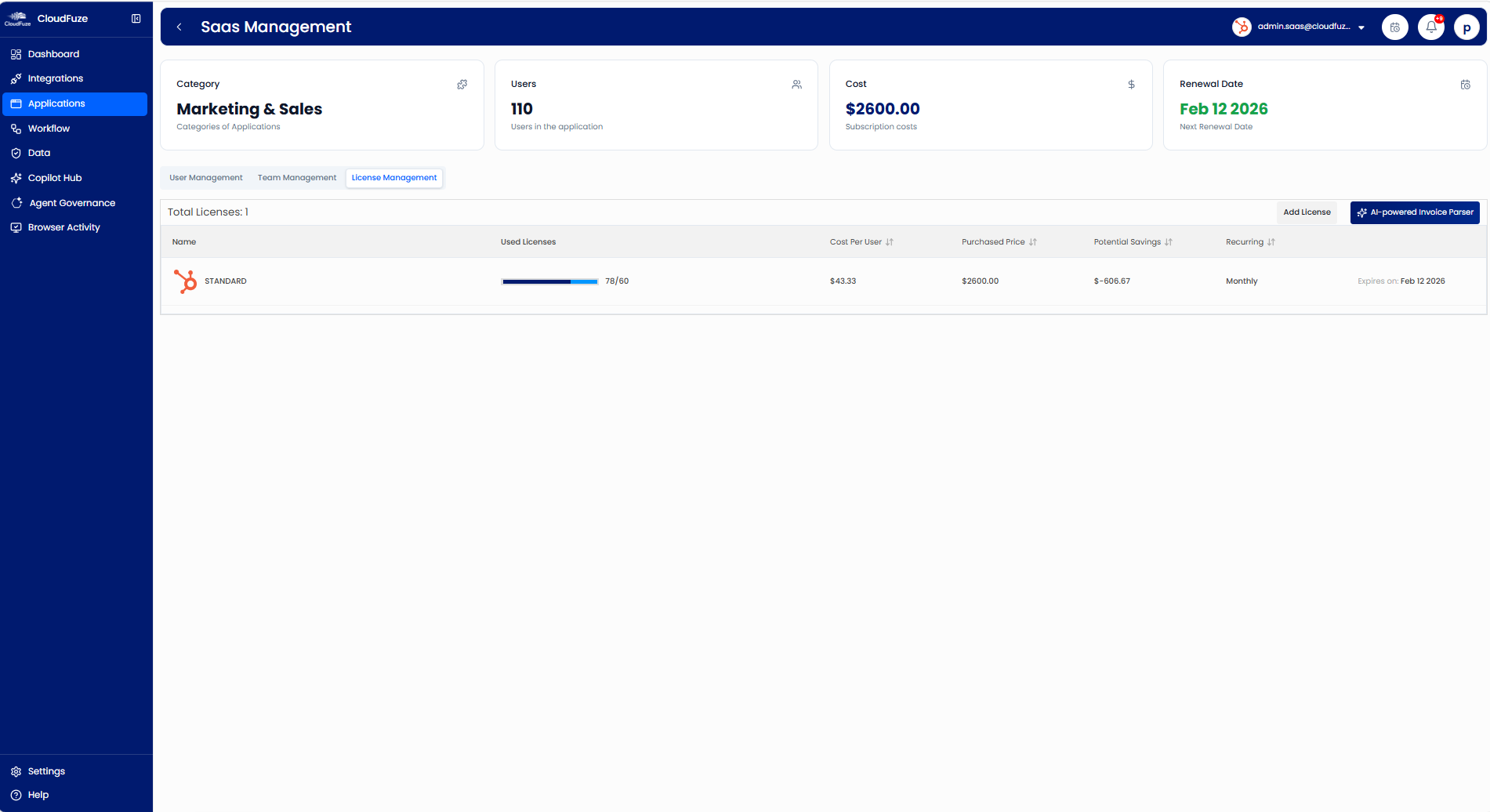
- Continuous multi-source discovery surfaces the apps and licenses you did not know you had, across SSO, OAuth, and expense data.
- License usage analytics, overlapping app report, and AI-powered cost-optimization insights uncover unused or duplicate licenses and optimize licensing costs.
- Automated user lifecycle workflows reclaim those unused licenses before the next renewal, along with automated prior renewal notifications to decide on modifying the particular subscription plan.
- Unified AI and license view, paired with AI and agent governance, keeps your licenses and AI token consumption monitoring in one place.
Use case: An enterprise struggling with rising license costs used CloudFuze Manage to identify inactive seats, duplicate tools, and over-provisioned users. It helped their IT team reclaim unused licenses, right-size underutilized subscriptions, and reduce SaaS spend before renewals.
Optimize Your Enterprise Licenses with CloudFuze Manage
SaaS license waste is what happens when spend grows faster than visibility. License optimization reverses that by making seat usage measurable and unused license reclamation routine.
CloudFuze Manage helps SMBs, MSPs, and large enterprises to right-size software licenses and track AI token consumption on a single, intuitive platform.
Want to see how license optimization works in your environment? Contact us for a free demo.
Frequently Asked Questions
1. What’s the difference between SaaS license optimization and SaaS license management?
SaaS license management is the broader practice of administering licenses, including provisioning, assigning, and tracking them. SaaS license optimization is the cost-focused subset that measures license seat usage and adjusts what your finance team pays for, reclaiming unused license seats and rightsizing subscription tiers.
2. How to reduce SaaS subscription costs through license optimization?
You can reduce SaaS subscription costs by discovering every license, measuring real usage to find idle seats, then reclaiming them, downgrading over-provisioned users, and consolidating duplicate tools. Also, bring that license usage data into renewals so you renew only what teams actually use.
3. How can organizations calculate the license utilization rate?
License Utilization Rate (%) = (Active Licenses ÷ Total Purchased Licenses) × 100
(Active licenses typically refer to users who have logged in or meaningfully used the application within a defined period, such as the last 30 days).
4. Best SaaS management platforms for license optimization and compliance 2026
CloudFuze Manage is one of the best SaaS management platforms that combines continuous discovery, license usage analytics, license reclamation workflows, and audit-ready reporting in one system.
5. How can businesses reduce wasted spend on unused SaaS subscriptions?
Businesses can reduce wasted spend on unused SaaS subscriptions by automating license reclamation with continuous discovery, inactive seat tracking, offboarding workflows, and duplicate tool elimination to avoid wasted renewals.
6. What are the SaaS license optimization metrics I can track with CloudFuze Manage?
You can effortlessly track metrics like license utilization rate (%), inactive license count, license reclamation rate, cost per active user, duplicate application spend, renewal optimization savings, and SaaS spend per employee using CloudFuze Manage.
About the Author: Rashmi Ramesh


