
How Can CISOs Choose a Scalable AI Agent Governance Platform
AI agents can read files, call APIs, update records, and perform actions on behalf of enterprise users. Without proper AI governance controls, many AI agents gain broader access and autonomy than intended.
Governing AI agents is now a security necessity, and it must be continuous. AI agent governance platforms help stakeholders reclaim control by monitoring every AI agent used and indicating what each user can access and perform. In short, an AI agent governance tool enforces policy in real time and gathers the evidence expected for an anytime audit.
The following blog post will help CISOs understand how to choose an AI agent governance platform.
Key takeaways
Why AI Agent Governance Is Now A CISO Priority
AI agent systems are different from AI tools that are monitored by governance frameworks used by enterprises today.
An AI assistant responds to a prompt and returns a relevant answer. In contrast, AI agents can autonomously plan tasks, select tools, execute multi-step tasks, and adapt their behavior in response to environmental feedback with different levels of human intervention.
Multi-agent architectures add another layer: an orchestrator agent that delegates subtasks to specialized subordinate agents. Many AI agents have access to external APIs, data stores, code environments, and communication apps your enterprise uses. This increases the governing complexity.
This turns AI agent security into a question of access, ownership, and accountability. For every agent, CISOs need clear answers to the following questions:
- What types of data access and exposure levels does this agent hold?
- What autonomous, permissible actions does this agent take?
- How is this agentic AI system behaving?
- What are day-to-day system-to-system agentic AI interactions?
Furthermore, AI agent governance must be operationalized through a system that connects AI use cases, data, models, and risk. AI governance applications must leverage policies to monitor decisions, enforce controls during execution, and guardrails to guide interactions between AI systems.
According to a Deloitte study, only 21% of enterprises have mature governance in place to manage agentic AI risks. A mature enterprise AI governance platform that operates continuously and adapts to system behavior in real time is essential to manage risks at enterprise scale.
7 Features Every CISO Should Look for in an AI Agent Governance Platform
Some AI agent governance tools only list agents, while others can control them.
Every enterprise AI governance platform must include automated discovery & inventory (including shadow AI), in-house data residency, shared accountability with automatic ownership assignment, remediation, and rollback from unwanted AI or agent actions.
Let us go through these features in detail.
| Feature | Details |
|---|---|
| 1. Continuous agent discovery & inventory | Discovers every agent across platforms such as Copilot Studio, Agentforce, Gemini Enterprise Agent platform, ChatGPT, and Claude, with its owner, model, and permissions. |
| 2. Least-privilege access control | Limits each agent to the data, connectors, and OAuth grants needed, including Model Context Protocol (MCP) connections. |
| 3. Monitoring AI agents | Tracks agents’ access, data interaction, tools used, and actions they take in real time. |
| 4. Real-time compliance policy enforcement | Applies compliance rules automatically, raises alerts, and requires human intervention for high-impact actions. |
| 5. A unified governance model | All-round governance of agents, AI tools, AI features inside approved SaaS apps, and the apps themselves from one console. |
| 6. Agent Lifecycle & token cost management | Flags stale/orphaned agents, reassigns ownership, and tracks agent spend overall. |
| 7. Compliance evidence & audit | Records approvals, access changes, and agent activity, mapped to frameworks such as the EU AI Act and ISO/IEC 42001. |
A basic AI agent monitoring tool tracks only the AI systems that enterprises already know. In contrast, an enterprise-ready AI governance platform discovers shadow AI, assigns clear ownership, and keeps your data safe within your environment.
So, what are other questions a CISO must ask an AI governance platform vendor before taking the next steps?
8 Key Questions CISOs Must Ask AI Agent Governance Vendors
CISOs may ask these questions in demos or as a proof of concept to separate real AI agent governance from just a dressed-up AI agent activity dashboard:
- How quickly can your tool discover new AI agent activity?
- Can you track shadow agents that have never been registered with IT?
- How do you display and restrict individual agent permissions, connectors, or OAuth grants?
- Do you monitor agent activity closely?
- Can policies proactively alert and block or pause an agent in real time?
- What compliance frameworks are your policies and reports mapped to?
- Can your platform scale up and perform with thousands of agents?
- How long does deployment take, and is there a manual set-up involved?
Enterprise AI agent governance platforms help enterprises manage autonomous AI agents, they can monitor how AI agents access data, use tools, make decisions, and execute actions across applications.
Common Mistakes CISOs Make While Selecting an AI Agent Governance Platform
1. Focusing On Dashboards Instead of Controls
A governance tool that lists agents but can’t restrict or pause them won’t help enterprises tackle risk.
2. Choosing a Single-ecosystem Application
A single ecosystem application governing only one vendor’s agents leaves every other platform uncovered.
3. Missing AI Inside Approved Apps
AI features embedded in SaaS apps you already trust often bypass security review entirely.
4. Ignoring OAuth Grants & Connectors
AI agents keep the access they were given long after a project ends, unless cleanup is mandatory.
5. Relying on Self-reported Ownership
If compliance teams must register AI agents manually every time, shadow agents are likely to slip through.
6. Not Treating Compliance as a Priority
AI agent activity evidence should be captured as AI agents act, not assembled days before an audit.
In short, choosing a suitable AI agent governance platform starts with avoiding common mistakes CISOs most often make. Each mistake leaves AI governance gaps that only show up once agents are already functioning.
Handle AI Agent Governance Effectively with CloudFuze Manage
CloudFuze Manage is an enterprise AI governance platform that unites AI agents, AI tools, and SaaS apps into a single governance model.
This empowers security teams by helping them work with a single source of truth on the AI inventory. The features include:
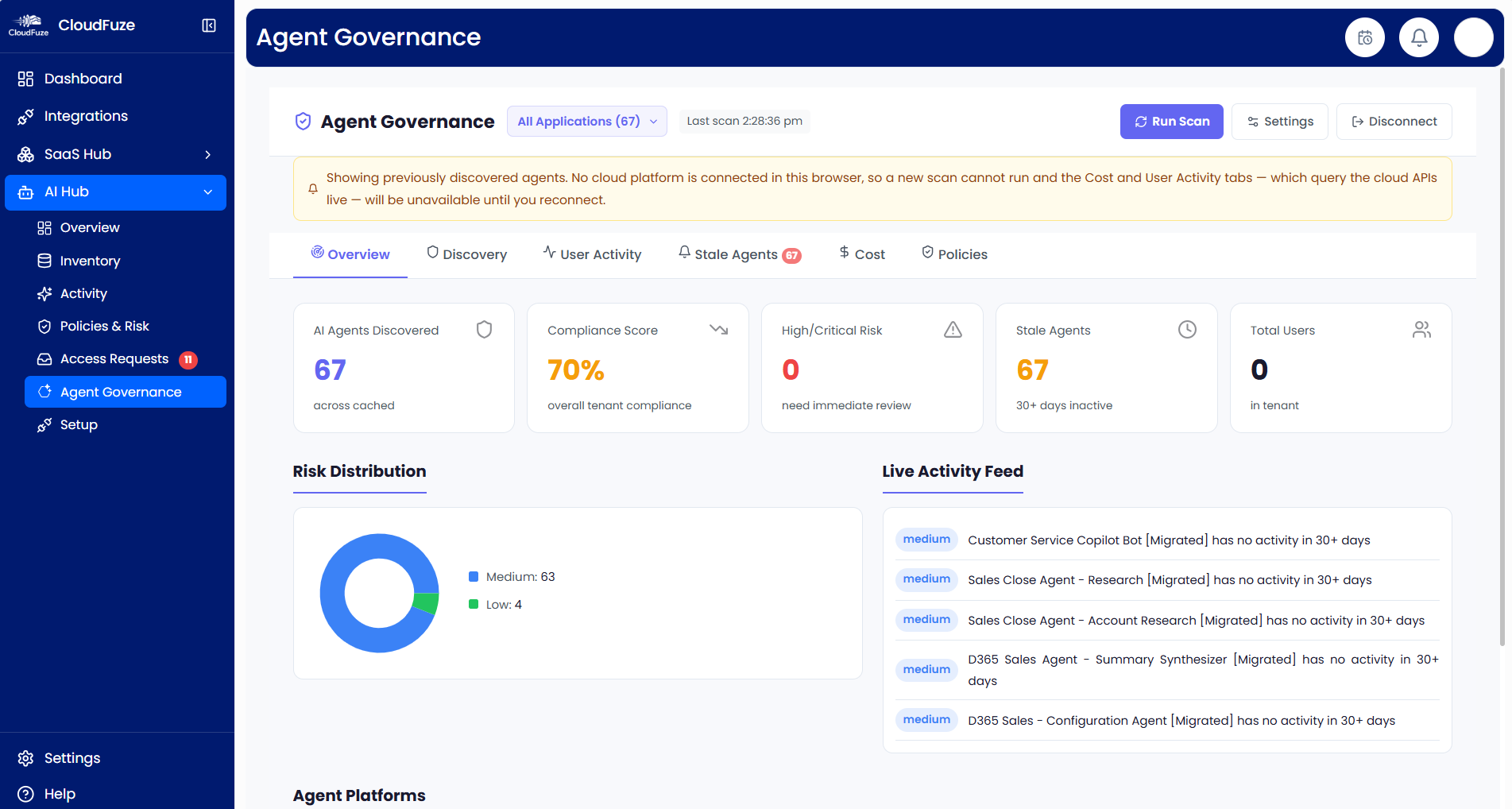
- 360-degree visibility across the entire AI environment-AI tools, agents, risk levels, and sensitive data alerts.
- Defined agent ownership indicating risk and usage, exposing shadow AI faster.
- Protecting data by tracking prompts and file uploads across applications, identifying leaks faster.
- Prebuilt policy templates aligned with major security frameworks-Updated drafts of GDPR, HIPAA, SOC 2 Type 2, CCPA/CPRA, the EU AI Act, and ISO/IEC 42001 that can be added with a single click.
- Time-bound access requests that allow teams to use restricted tools without leaving gaps.
Enterprise CISOs have fewer blind spots, faster answers for auditors, and scalable AI without losing control. On that note, let us have a quick look at some slip-ups committed by CISOs while choosing an AI governance platform.
Your AI Agents, Fully Governed by CloudFuze Manage
With an expanding AI estate, your controls need to expand with it, without additional manual effort for your security team. CloudFuze Manage is a natural fit for CISOs who need AI agent governance that covers and scales with a growing enterprise AI infrastructure.
Take the first step toward completing AI agent governance with CloudFuze Manage.
Evaluating AI agent governance platforms? Talk to our AI governance experts to get started. Contact us today.
Frequently Asked Questions
1. Which approach is better? Cloud-based vs. on-premises AI governance systems?
Cloud-based platforms usually update automatically and scale easily as the number of agents grows. On-premises options give stringent control over data residency but take more time to roll out and maintain. Most enterprises choose cloud-based platforms unless strict regulations require otherwise.
2. How does an AI agent governance tool support EU AI Act and ISO/IEC 42001 compliance?
The EU AI Act requires enterprises to implement risk management, transparency, oversight, and accountability measures for applicable AI systems. The ISO/IEC 42001 specifies requirements for establishing, implementing, maintaining, and improving an AI system. A governance platform provides an entire log of AI systems, risk classification, named owners, human oversight for high-impact actions, and audit trails that serve as ready evidence.
3. What are enterprise-grade AI safety and governance tools?
Platforms built for large enterprises that discover AI tools and agents automatically, enforce policy in real time, protect sensitive data, integrate with existing security tools, and produce audit-ready evidence across many vendors and clouds.
4. What is a unified governance model for AI agents?
A single approach that governs AI agents, AI tools, AI features inside SaaS apps, and the apps themselves with the same inventory, risk classification, policies & reviews, instead of separate controls for each platform.
5. How is AI agent governance different from governing AI tools?
AI tools reply to prompts, and AI agents act. Governing AI agents means controlling permissions, connectors, and autonomous actions; periodically monitoring behavior; and managing each agent’s lifecycle. This does not just mean approving which tools employees can use.
6. How can CISOs take measures to detect shadow AI agents?
Using a comprehensive AI governance platform that discovers agents automatically must be the first choice of a CISO. These applications find agents through identity providers, SaaS admin APIs, and connected apps, rather than relying on teams to register them. New agents should appear in the inventory without manual effort.
About the Author: Bhuvaneswari Gireesh


