
AI Governance & Shadow AI Statistics 2026: Voice of IT Leaders
Key findings from CloudFuze’s AI Governance & Shadow AI Report 2026: Voice of IT Leaders
CloudFuze’s AI Governance & Shadow AI Report 2026: Voice of IT Leaders show that problems like shadow AI, unmanaged SaaS licenses, and incomplete offboarding shows up as live, recurring problems.
Shadow AI has overtaken Shadow IT as the top concern, driven by employees signing up for AI tools like ChatGPT, Claude, Gemini, etc, with business emails. SaaS license waste and incomplete offboarding problems remain just as common, but they stay invisible to IT leaders until a renewal cycle or an internal audit brings up the question.
This new report draws insights and findings from live and unscripted conversations CloudFuze had with more than 100 IT leaders representing organizations (primarily US-based) across healthcare, manufacturing, education, MarTech, finance, and staffing throughout 2026.
Key Takeaways:
Methodology
In 2026, CloudFuze’s sales and product specialists held live product conversations with more than 100 IT leaders evaluating CloudFuze Manage. These were not scripted survey responses but more of open discussions where IT leaders asked questions, raised objections, and described their actual environments.
The industries represented include healthcare and insurance, manufacturing and rail, K-12 education, MarTech (marketing technology) and SaaS, financial services and telecom, consumer goods, and IT staffing. Company names and identifying details have been kept confidential.
Finding 1: Shadow AI Has Overtaken Shadow IT as the Top IT Concern
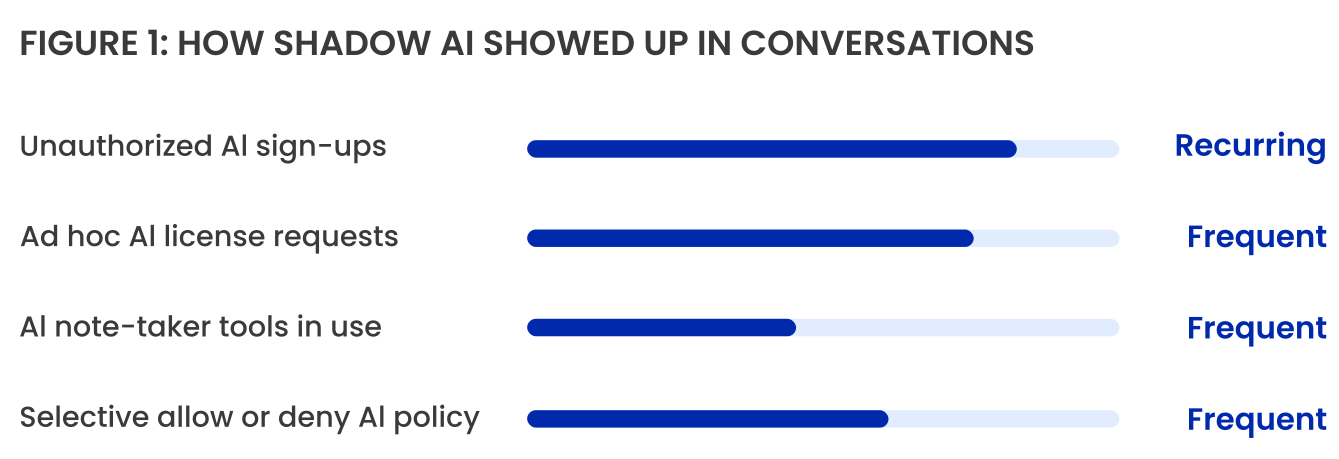
Shadow AI refers to AI tools such as ChatGPT, Claude, Gemini, AI meeting note-takers, etc. that employees adopt with company data, without IT’s knowledge or approval. It came up in nearly every conversation we reviewed.
- Employees are signing up for AI tools using their business email addresses, often invisible to IT until a browser extension or login log surfaces it.
- Departments are requesting AI licenses in bulk outside normal procurement. One MarTech leader described fielding requests for dozens of AI seats within a single renewal conversation, with no proper governance plans in place.
- AI note-taking tools are joining meetings and ingesting sensitive content and business information without going through the same compliance review given to core business applications.
- IT leaders are not trying to ban AI outright. They are trying to decide which AI tools are trusted with company data and which are not.
Finding 2: SaaS License Waste Stays Invisible Until Renewal
Almost every IT leader we spoke with described the same pattern of unused or underutilized software licenses only getting noticed when a renewal deadline hits, or an internal audit raises the question.
The gap is not about IT leaders not caring about license costs but about the fact that most environments have no continuous way to see usage. Data lives scattered across dozens of individual admin consoles and reconciling it manually takes time, which, in turn, requires significant IT resources.
- Purchased license seats consistently outpace actively used seats on common applications, and the gap is usually invisible without manually exporting data.
- IT leaders repeatedly asked for an idle user threshold, commonly 30 to 60 days without login, as a trigger to reclaim or downgrade licenses.
- Teams often only compare annual spend against real usage at year-end review, by which point the money is already spent.
- In the conversations, a three-tiered view of active, idle, and inactive users came up again and again as the model IT leaders actually want rather than a simple licensed or non-licensed option.
| What IT Teams Have Today | What IT Teams Asked For |
|---|---|
| License usage discovered at renewal or audit | Continuous real-time usage visibility |
| Data scattered across separate admin consoles | One unified view across all applications |
| Binary licensed or unlicensed status | Active, idle, and inactive user segmentation |
| Manual spreadsheet reconciliation | Automated savings and utilization reporting |
Finding 3: Offboarding is a Security Event, Not Just an IT Task
In sectors with more stringent security requirements, offboarding came up unprompted as one of the top priorities. IT leaders framed it in terms of breach risks.
Manufacturing and infrastructure IT leaders wanted confirmation that offboarding an employee leads to revocation of access across every connected system.
Healthcare and insurance leaders raised it as a compliance issue first. One of the healthcare IT leaders said, “Leftover access after departure is a breach risk and not just wasted spend.”
Two offboarding features came up repeatedly as must-haves:
- Approval-gated workflows before access is revoked
- Automatic ownership transfers of files and shared drives so nothing gets orphaned
Lean IT teams, including organizations where one person handles all of IT, described manual onboarding and offboarding as cumbersome.
Finding 4: Governance Pressure Looks Different by Sector
The same three problems: Shadow AI, license waste, and offboarding gaps show up everywhere. But which one leads the conversation and is more of a high priority depends heavily on the industry.
| Sector | Governance Priorities |
|---|---|
| Healthcare and insurance | Compliance and breach exposure from leftover access and unreviewed AI tools |
| Manufacturing and rail | Complete deprovisioning across every connected system on employee termination |
| MarTech and SaaS | AI tool requests outpacing procurement and renewal cycles |
| Financial and telecom partners | Vendor and invoice-driven licensing with direct usage visibility |
| Staffing and startups | Single-person IT teams needing governance without added headcount |
Finding 5: What IT Leaders Actually Want from a Governance Platform
Across every sector, the same requirements keep surfacing, regardless of company size or industry. These include:
- Minimum scope, read-only access by default, with full transparency into exactly what permissions are being requested before any application is connected.
- One unified view across every SaaS and AI application to replace manual exports from dozens of admin consoles.
- Real-time alerts when a new shadow AI or shadow ID application is detected, instead of a static report reviewed only during audits.
- Workflow automation for user onboarding and offboarding that triggers directly from existing systems, with no custom engineering required.
- A renewal calendar that surfaces upcoming SaaS and AI commitments well ahead of time, instead of reacting at the renewal stage.
Instead of more dashboards, IT leaders want fewer blind spots delivered continuously instead of during license renewals or audits.
How CloudFuze Manage Addresses These Gaps
The pattern in this report points to the conclusion that IT leaders want proactive visibility rather than reacting after oversight turns into incidents. CloudFuze Manage is built to address these exact gaps.
1. For Shadow AI:
CloudFuze Manage discovers AI agents and tools across Gemini Enterprise Agent Platform, Copilot Studio, Azure AI Foundry, and other agent platforms, and flags unauthorized sign-ups before they become a compliance issue.
2. For SaaS License Waste:
Manage provides IT teams with a real-time view of active, idle, and inactive users to help avoid renewal confusions with continuous visibility and clear savings projections.
3. For Offboarding:
CloudFuze Manage automates full deep provisioning across connected apps and tools, with approval-gated workflows and ownership transfers, so no access or data gets left behind.
4. For Industry-Specific Governance:
Whether it’s about compliance in healthcare, budget constraints in education, or lean IT teams at startups, the CloudFuze Manage platform is built to work seamlessly. It provides discovery and ROI forecast in minutes, not days!
In short, CloudFuze Manage turns the exact gaps IT leaders describe in this report into a single governed system, so the next audit or renewal cycle is well-planned and strategic, not reactive.
Interested in seeing it in practice? We would be happy to show you a live demo to help you understand how it works in real-world scenarios and what type of SaaS management and AI governance benefits it can provide to your organization. Contact us today!
Frequently Asked Questions
1. How is Shadow AI different from Shadow IT?
Shadow IT refers to unauthorized applications, primarily standard SaaS applications like CRM tools, HR tools, etc. On the other hand, Shadow AI is specific to unauthorized AI tools where adoption is often driven by individual employees signing up independently without standard IT or security procurement.
2. What is an example of shadow AI?
Here is a simple example. Let’s say an employee wants to use ChatGPT with his or her work email. And he or she signs up for it without informing the IT team.
What starts as a free trail later turns into a paid subscription that not only adds to AI spend of the organization but also raises security risks as it was never reviewed for security or compliance. Now that itself doesn’t make ChatGPT a shadow AI tool but with the way in which it was procured.
3. Why do organizations discover SaaS license waste so late?
Most organizations rely on individual admin consoles for application with no unified usage view, so unused or idle licenses only surface when a renewal deadline hits or when an internal audit is conducted.
4. Which shadow AI statistics can help IT teams prepare better?
This CloudFuze’s AI Governance & Shadow AI Report 2026: Voice of IT Leaders cover solid ground and present real-world insights that can help IT teams prepare better for shadow AI and overall AI governance. The report draws insights from live and unscripted conversations with 100+ IT leaders across various industries.
About the Author: Pankaj Rai



