
Close SaaS Gaps in FedRAMP Audits with CloudFuze Manage
SaaS application and cloud service providers that are pursuing FedRAMP certification mostly focus on the product they want to certify. They spend months hardening their infrastructure and documenting their controls.
But the internal SaaS stack gets neglected. And that’s where the chances of rejections get higher.
In this guide, we have explained the importance of closing gaps in the internal SaaS and AI stack for proper FedRAMP SaaS compliance.
Key Takeaways:
Why Internal SaaS Compliance is a Must for FedRAMP Audit and Certification?
CISOs (Chief Information Security Officers) of SaaS application and cloud service companies must understand that FedRAMP auditors not only evaluate your company’s products and services. They also assess your entire organizational security posture, including how you govern the SaaS and AI applications that employees use every day.
Auditors can ask questions such as:
“Who has access to your internal SaaS applications?”
“What authorized applications are running in your environment?”
“Can you show a complete log of user provisioning and deprovisioning activity?”
These are not edge-case questions. They are core FedRAMP access control requirements. And it goes without saying that these questions expose security and compliance gaps in unmanaged SaaS environments.
Getting FedRAMP certified is not just about what your company’s product or service is. It is also about proving how secure your organizational operations are at every level.
SaaS Management and AI Governance Gaps that Derail FedRAMP Audits
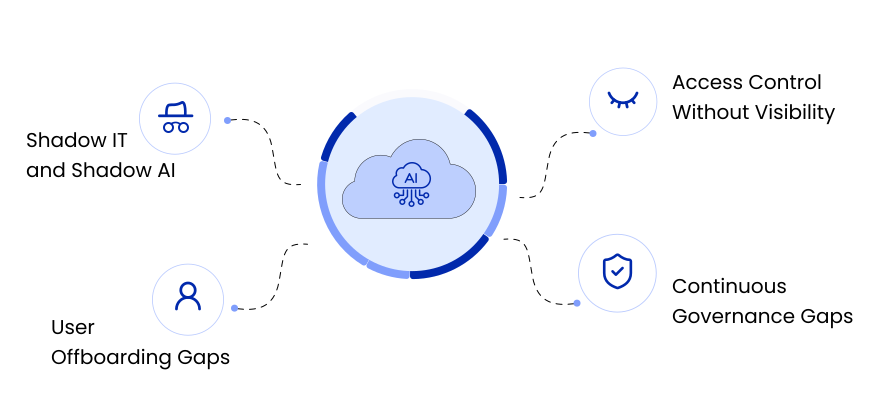
When pursuing FedRAMP certification, many companies underestimate how exposed their internal SaaS environment actually is. Here are some of the common SaaS management and AI governance gaps that create friction in FedRAMP approval:
1. Shadow IT and Shadow AI
One of the most important requirements of FedRAMP audits is to maintain precise control over which applications are processing or interacting with federal data. If unauthorized applications are in the picture, it becomes a huge red flag.
Therefore, it is important to identify all the unauthorized apps that have not gone through the standard IT procurement process. CloudFuze Manage streamlines this with Shadow IT and Shadow AI detection and control.
2. User Offboarding Gaps
FedRAMP requires strong user lifecycle management. And the core part of it is verified and timely removal of licenses when employees and contractors leave. However, this is not always the case in internal SaaS environments as licenses and permissions stay active even long after employees exit.
To close this gap, it is important to move away from manual offboarding to automated user offboarding workflows that allow IT to set up certain governance policies, such as reclaiming licenses whenever users are offboarded.
3. Access Control Without Visibility
FedRAMP requires SaaS application and cloud service providers to manage user accounts actively and review their access rights on a regular basis. However, this is not put into practice in many organizations.
By using a dedicated SaaS management and AI governance tools like CloudFuze Manage, cloud service providers can get a detailed overview of the entire health of the SaaS environment, including the total number of apps connected, overpermissioned accounts, stale permissions and content, duplicate files, public links, external sharing, and more.
4. Continuous Governance Gaps
FedRAMP’s continuous monitoring requirements do not pause between formal assessments. This essentially means that security and IT teams need to respond to unauthorized application integrations, policy violations, and access anomalies as soon as they occur.
Without having a certain level of automation, it becomes nearly impossible to remediate in near real time with a manual process. This is where CloudFuze Manage bridges the gap. It provides an ongoing visibility layer that helps ensure issues are surfaced as soon as they occur, or for the better part, prevent them from occurring in the first place.
Close SaaS Compliance Gaps and Achieve FedRAMP Certification
When you close all SaaS and AI compliance gaps in your organization’s cloud environment, clearing FedRAMP audits and achieving the certification becomes easier. CloudFuze Manage closes the SaaS gaps that FedRAMP auditors are trained to find.
Interested in learning more about CloudFuze Manage’s access management and AI governance processes that help close compliance gaps for FedRAMP audits? Talk to us today!
Frequently Asked Questions
1. Does FedRAMP require a SaaS management platform?
FedRAMP does not mandate a SaaS management tool. However, it does require documented evidence of access control, user lifecycle management, shadow IT governance, and continuous monitoring.
Organizations that don’t use a dedicated SaaS governance tool typically produce this evidence manually, which is slower, more error-prone, and harder to defend under audit scrutiny.
2. How does shadow IT affect FedRAMP compliance?
Unauthorized SaaS applications expand your authorization scope and introduce uncontrolled access vectors. FedRAMP requires organizations to maintain a clear boundary around systems interacting with federal data. Shadow IT blurs that boundary and creates direct audit risk.
3. How does CloudFuze Manage support FedRAMP audit readiness?
CloudFuze Manage covers the entire SaaS compliance layer by providing SaaS discovery, Shadow IT and AI control, automated user lifecycle management, on-demand audit reporting, and more. This helps organizations close their SaaS compliance gaps and improve their FedRAMP audit readiness.
About the Author: Pankaj Rai



