
1. Introduction
Migrating from Dropbox to Google Workspace means moving your organization’s files, folders, permissions, sharing settings, version history and metadata from Dropbox cloud storage environment into Google Drive, Shared Drives, and the broader Google Workspace ecosystem.
The process involves three main components: premigration planning, the actual data transfer, and post-migration tasks like delta syncing, validation, and user onboarding. For most organizations, this is a project that spans several weeks and months depending on data volume and complexity.
This guide covers everything I think the admins need to plan, execute, and complete a Dropbox to Google Workspace (formerly G Suite) migration successfully.
You can also watch our migration video to quickly understand the overall process:
2. Why Organizations are Moving from Dropbox to Google Workspace
Dropbox is a capable file storage platform, but many organizations reach a point where staying on it no longer makes strategic sense. The reasons vary by company, but these are the most common ones driving migrations:
A) Cloud consolidation:
Many organizations run Dropbox alongside Google Workspace and end up paying for two overlapping platforms. Consolidation into Google Workspace eliminates that redundancy.
B) Cost savings:
Google Workspace bundles storage, email, collaboration, and productivity tools into one license. Separate Dropbox Business or Business Plus licenses on top of that add up. Moving everything to Google Drive simplifies the fee structure and often reduces total spend.
C) AI readiness:
Google Workspace now integrates Gemini across Docs, Drive, Sheets, and Meet. Organizations moving toward AI-assisted workflows find that consolidating files in Google Drive make those files immediately accessible to Gemini for summarization, Q&A, and content generation.
D) Cloud governance and admin control:
Google Workspace gives IT admin centralized control over file access, sharing policies, and user provisioning. Organizations that need tighter data governance often find Google Workspace’s admin console more mature for enterprise needs.
E) Security reinforcements:
Google Workspace’s security features, including advanced DLP, vault for eDiscovery, and context-aware access controls, are attractive for compliance-heavy industries like healthcare, education, and financial services.
F) Mergers and Acquisitions:
When two organizations merge and one is on Google Workspace, consolidating the acquired entity’s Dropbox environment into Google Workspace is one of the first ID tasks undertaken.
3. Dropbox vs Google Workspace: Feature and Usability Comparison
Understanding the core differences between Dropbox and Google Workspace and having clarity on what changes after migration helps with both planning and user adoption. Here is how the two platforms compare on dimensions that matter most during a migration decision:
| Features | Dropbox | Google Workspace |
|---|---|---|
| Core use cases | File storage and sync | Integrated productivity suite |
| Storage included | Plan-dependent (2TB to unlimited) | Plan-dependent (30GB to unlimited) |
| Real-time collaboration | Via Dropbox Paper and integrations | Native in Docs, Sheets, Slides |
| Not included | Gmail included | |
| Video conferencing | Not included | Google Meet included |
| AI assistant | Dash AI (limited) | Gemini across all apps |
| Admin control | Dropbox Admin Console | Google Admin Console |
| eDiscovery and compliance | Limited | Google Vault (Business Plus and above) |
| Desktop sync | Dropbox desktop app | Google Drive for Desktop |
| Third-party integrations | 100,000+ apps | Extensive via Google Workspace Marketplace |
| Shared drive support | Team folders | Shared Drives |
NOTE: The comparison information is based on publicly available information as of June 2026 data. It may change when Dropbox and Google update the products.
The biggest practical difference for end users is that Google Workspace is a complete work platform, not just a storage tool. Users gain access to Gmail, Calendar, Meet, Chat, and deep AI integration by moving to Google Workspace. Files stored in Google Drive also open natively in Google Docs, Sheets, and Slides without conversion in most cases.
4. Components Involved in a Dropbox to Google Workspace Migration
A complete Dropbox to Google Workspace migration involves more than just copying files. These are the main components that need to be addressed:
A) Files and Folders:
All file formats need to be transferred, including Microsoft Office files (Word, Excel, PowerPoint), Google native formats, Dropbox Paper documents, and any other file types stored in Dropbox.
B) Permissions and sharing settings:
View-only and edit permissions, shared folder permissions, and external collaborator access, all need to be preserved in Google Drive and Shared Drives during migration.
C) Version history:
Files in Dropbox often have multiple saved versions. A capable migration tool preserves version history, so users can roll back to earlier versions after migration if needed.
D) Timestamps:
File creation and modification timestamps should be preserved, so the file history in Google Drive reflects the actual history.
E) Embedded and shared links:
Files shared via Dropbox links and files that contain embedded links pointing to other files need to be migrated without link breakages.
F) Dropbox Paper documents:
Dropbox Paper is a collaborative document format that needs to be converted and migrated to Google Docs or another Google compatible format.
G) Nested folder structures:
Google Drive supports up to 20 levels of nested folders. If your Dropbox structure has folders nested deeper than that, they need special handling during migration.
5. Potential Challenges and How to Address Them
Every Dropbox to Google Workspace migration project will have at least a few of these challenges. Knowing them in advance is to plan around them.
A) Deep folder structure complexity
Google Workspace now supports up to 100 levels of nested folders for both My Drive and Shared Drives (updated by Google in July 2024, up from the previous 20-level limit on Shared Drives).
While this removes a hard technical barrier, very deep folder hierarchies can still cause navigation and search issues for users after migration.
Solution: CloudFuze’s long file name feature handles any deep nesting edge cases and preserves the folder structure.
B) Preserving permissions at scale
Migrating hundreds and thousands of users means mapping tens of thousands of permission relationships. Sub-folder level permissions are often the hardest part. Tools that only migrate root-level permissions will leave your Google Drive and Shared Drives with incorrect permissions.
Solution: CloudFuze migrates permissions at both the root folder level and the subfolder level and preserves the full access structure as it existed in Dropbox.
C) Migrating large data volumes
Organizations with terabytes and petabytes of data cannot afford to pause operations during migration. Performing the migration in a single go creates risk of data loss and downtime.
Solution: CloudFuze runs a full one-time migration while users continue working in Dropbox, then follows it with delta migrations to sync incremental changes made during the one-time migration window.
D) Preserving hyperlinks
Files that contain embedded links pointing to other files will have broken links after migration because the URLs change. This is one of the most underestimated problems in Dropbox to Google Workspace migrations and requires a dedicated hyperlink preservation tool.
Solution: CloudFuze Hyperlink Fixer is purpose-built to handle embedded link migration at scale to ensure the links do not break post-migration.
E) Dropbox Paper conversion
Dropbox Paper documents do not have a direct Google equivalent. They need to be converted to Google Docs format during migration, and the conversion needs to preserve formatting, embedded media, and comments.
Solution: CloudFuze supports Dropbox Paper migration. It converts Dropbox paper documents to.docx documents while preserving content and rich metadata. Most migration tools skip Dropbox Paper entirely and leave that content behind.
F) Special characters in file names
Google Drive does not support certain special characters that Dropbox allows in file names. Files with those characters will fail to migrate unless the migration tool handles automatic character replacement.
Solution: CloudFuze automatically replaces special characters with either a hyphen or an underscore and ensures all files and folders with unsupported characters are transferred without any errors.
G) User account mismatches
When Dropbox and Google Workspace accounts use different email addresses, auto mapping will not work correctly. Unresolved mismatches result in the file landing in the wrong accounts or not migrating at all.
Solution: CloudFuze offers a CSV mapping option that lets you define custom source-to-destination email pairs for every user. This option gives you full control over user mapping when email addresses do not have an exact match.
6. Dropbox to Google Workspace Migration: Trends and Use Cases
The decision to migrate from Dropbox to Google Workspace is readily made in isolation. It is usually driven by a broader organizational shift. These are the trends and news cases that are pushing more companies to make the move in 2026:
A) AI adoption and Gemini integration
One of the strongest drivers in 2026 is Google Workspace’s deep Gemini integration. Files stored in Google Drive are immediately accessible to Gemini across Docs, Sheets, Slides, and Meet.
Organizations that want to make the most out of their internal documents and overall institutional knowledge through AI-assisted summarization, search, and content generation are finding that keeping files in Dropbox creates a barrier.
Dropbox’s own AI tool, Dash, offers some functionality, but it does not match the depth of Gemini’s native integration across a full productivity suite. For IT and business leadership, prioritizing AI readiness, consolidating files and folders into Google Drive and Shared Drives is a foundational step.
B) Mergers and acquisitions
M&A activity is one of the most common triggers for a Dropbox to Google Workspace migration. When an acquiring organization runs on Google Workspace and the acquired entity runs in Dropbox, consolidating into a single platform is typically one of the first IT integration tasks.
Migration speed matters in these situations because duplicate platforms mean duplicate cost and fragmented collaboration between teams that need to work together quickly.
C) Cloud consolidation
Many organizations end up running Dropbox alongside Google Workspace for email and communication tools without ever making a deliberate decision to do so. Over time, the redundancy becomes expensive and hard to govern.
Consolidating into Google Workspace eliminates the overlap, simplifies licensing, and gives the IT team a single admin console to manage users, access, and security policies.
D) Security and governance mandates
Compliance-heavy industries, including healthcare, financial services, education, and government, are migrating away from Dropbox as their governance requirements become more demanding.
Google Workspace’s admin controls, Google Vault for eDiscovery, context-aware access, and DLP capabilities provide a more mature compliance posture. Organizations preparing for audits or expanding into regulated markets often require a migration as part of that readiness work.
7. Benefits of Moving from Dropbox to Google Workspace
While the decision to migrate is often triggered by a specific business event or trend, the benefits that follow are brought across the organization on an ongoing basis.
A) One platform for everything
After migration, users work inside a single environment for email, file storage, documents, spreadsheets, presentations, video calls, and chat. IT manages one single admin console instead of two separate platforms. New employee onboarding becomes faster because there is only one system to provision and train on.
B) Immediate access to Gemini AI
Once files land in Google Drive and Shared Drives, Gemini can work with them right away. Users can ask Gemini to summarize documents, extract key points from lengthy reports, draft responses based on stored content, and serve relevant files through natural language search. This is not a feature that requires additional setup. It is built into the platform and available to all users.
C) Simplified and lower licensing cost
A Google Workspace Business Standard or Business Plus license covers storage, email, productivity tools, and AI capabilities in one subscription. Eliminating a separate Dropbox Business or Business Plus license on top of that typically reduces total software spend, particularly for organizations with large user counts.
D) Stronger compliance and security
Google Vault provides eDiscovery, retention policy management, and audit capabilities that Dropbox’s admin console does not match. Context-aware access, DLP rules, and endpoint management give security and compliance teams granular control over how data is accessed and shared.
E) A better foundation for future growth
Google Workspace scales cleanly across acquisitions from new geographies and growing headcounts. Its multi-domain management capabilities and centralized admin structure make it easier to absorb and align with new teams and entities without creating governance gaps.
8. Choosing a Dropbox to Google Workspace Migration Tool
Manual migration is not a realistic option for many organizations with more than a handful of users. Copying files manually means losing permissions, version history, timestamps, embedded links, and more. For a complete migration that preserves everything, you need a dedicated migration tool.
Here are the factors to check when choosing a migration tool:
- Metadata and context preservation: Does the tool migrate permissions at both the root folder level and subfolder level? Does it preserve timestamps, external shares, in-line comments, version history, and shared links?
- Embedded links migration: does a tool migrate embedded links (hyperlinks)? Or will you end up with broken links post migration?
- Scale and performance: How quickly can the tool migrate terabytes and petabytes of data? What is the migration vendor’s track record with migrations at your scale?
- Delta migration: Can the tool perform delta migration to capture the incremental changes made during the one-time migration?
- AI readiness focus: Can the tool migrate data in an AI-ready state so as to enable a clean slate in Google Workspace for secure and compliant AI adoption?
CloudFuze is highly suitable for Dropbox to Google Workspace migrations of all sizes and complexities. As a Google Cloud Partner, CloudFuze has enabled many companies of the likes of The Washington Post, National Geographic Society, Intuit, and more, migrate and achieve their end goals.
9. CloudFuze vs Competitor Migration Tools: Feature Comparison
Out of several Dropbox to Workspace migration tool options available, CloudFuze has more edge as it covers a broader migration scope. Here is the comparison:
| Migration Features | CloudFuze | Competitors |
|---|---|---|
| One-time migration | Yes | Yes |
| Delta Migration | Yes | Yes |
| Root folder permissions | Yes | Yes |
| Subfolder permissions | Yes | No |
| Root file permissions | Yes | Yes |
| Versions | Yes | Yes |
| Selective Versions | Yes | No |
| Timestamps | Yes | Yes |
| Dropbox Paper | Yes | No |
| Long Folder Path | Yes | Yes |
| Special Character Replacement | Yes | No |
| Suppressing Email Notifications | Yes | No |
| Comparison Delta | Yes | No |
| External Links | Yes | No |
| Shared Links | Yes | No |
| Embedded Links | Yes | No |
10. Dropbox to Google Workspace Migration Case Studies
CloudFuze has supported migrations for thousands of organizations ranging from mid-market companies to Fortune 500 enterprises. Here are the two examples of large-scale Dropbox to Google Workspace migration cloud which has completed.
Intuit:
The financial software company needed to consolidate from multiple cloud platforms, including Box, Dropbox, and NFS, into Google Workspace. Server overloads and platform-specific limitations made the process complex. CloudFuze managed the entire migration with zero data loss. Read the full Intuit case study.
The Washington Post:
The Washington Post needed to migrate more than 1,500 users and 240 TBs of data from Dropbox to Google Workspace. The scale of the migration, combined with the need to preserve complex metadata and context across a large user base, made it one of the more demanding content migration projects CloudFuze has undertaken.
The migration was completed successfully without any data loss or disruption to operations. Read the full Washington Post case study.
11. Planning Dropbox Data Migration to Google Workspace
Proper planning lays the foundation for a complete migration success. Make sure to dedicate ample time and resources for planning out the entire migration strategy and the overall roadmap and timeline.
1) Pre-Migration Analysis
The first step of planning the migration is to perform a deep pre-migration analysis of the source cloud (Dropbox). Analyze key aspects, such as the data sharing between individual users and their teams, storage usage, third-party app integrations, and more. These insights will help your team prepare a proper scope of migration.
2) Preparing the Scope of Work
The next preparation stage is to prepare the scope of work. It includes everything that needs to be migrated from Dropbox to G Suite, including user accounts, files, folders, and more. Add these action items to the migration scope:
- The total number of users to be migrated
- The total size of files and folders to be transferred
- The types of features to preserve during the migration
3) Creating a Communication Plan
Create a proper communication plan to ensure that you are in constant contact with the migration vendor. Schedule meetings and choose communication approaches, such as online video conferences, in-person meetings, etc., as part of planning the communication strategy.
Also, communicate about the Dropbox to Google Workspace migration to the end-users and highlight the use case and benefits of making the switch. Keep stakeholders informed and include them in migration reports sharing to keep them updated about the ongoing project.
12. Preparing for the Migration
Proper preparation helps your team ensure complete success regardless of the scale of the migration. Here are some of the essential preparation steps to take:
1) Choose a Dropbox to Google Workspace Migration Tool
It can either be next to impossible or can cost a lot of time and money for organizations to move all files from Dropbox to G Suite with a manual approach. Transferring millions of files/folders and re-adding their properties, such as permissions, becomes a highly time-consuming process with high-security risks.
So, to migrate all Dropbox files of different formats, such as Word, Google Docs, Excel, Google Sheets, PowerPoint, Google Slides, and Dropbox Paper, along with permissions, versions, comments, timestamps, passwords, shared links, and embedded links, it is critical to use a reliable and high-performance third-party migration tool like CloudFuze Migrate.
At CloudFuze, we have designed our tool to migrate all Dropbox files to G Suite without missing a single permission, version, timestamp, embedded link, and more, with zero downtime and no data loss, regardless of the data size.

2) Map User Accounts
Map user accounts from Dropbox to Google Workspace properly. We recommend using the CSV mapping method to create proper mapping paths that ensure 100% accuracy of migration. Our tool also offers the auto-mapping option that automatically maps user accounts based on their email aliases.
3) Prepare Login Details
Have login details of both Dropbox and Google Workspace admins ready. Doing this will help ensure the cloud authentication process becomes smooth.
13. Steps to Migrate from Dropbox to Google Workspace
To give you an idea, below are the 16 simple steps to move Dropbox data to Google Workspace.
1. Log into CloudFuze
The first step to test copy Dropbox filesand folders to Google Workspace is to create a CloudFuze account. Visit CloudFuze webapp and create an account for free.
You can contact us for an assisted demo of our migration tool.
We also provide a product tour or customized enterprise trial for IT admins with large data migration needs.

2. Add Dropbox for Business Account
Locate the Dropbox logo seen in the business clouds list. Since it is a business migration, avoid adding Dropbox to the list of personal clouds.
Clouds in the personal section don’t support multi-user data migration.

3. Authorize the Dropbox Account
Enter your company’s Dropbox admin login credentials and click on the Sign-in button. This will complete the Dropbox cloud-adding process.

4. Add G Suite
Find the G Suite logo in the list of business clouds. Click on it and enter the G Suite admin login credentials.

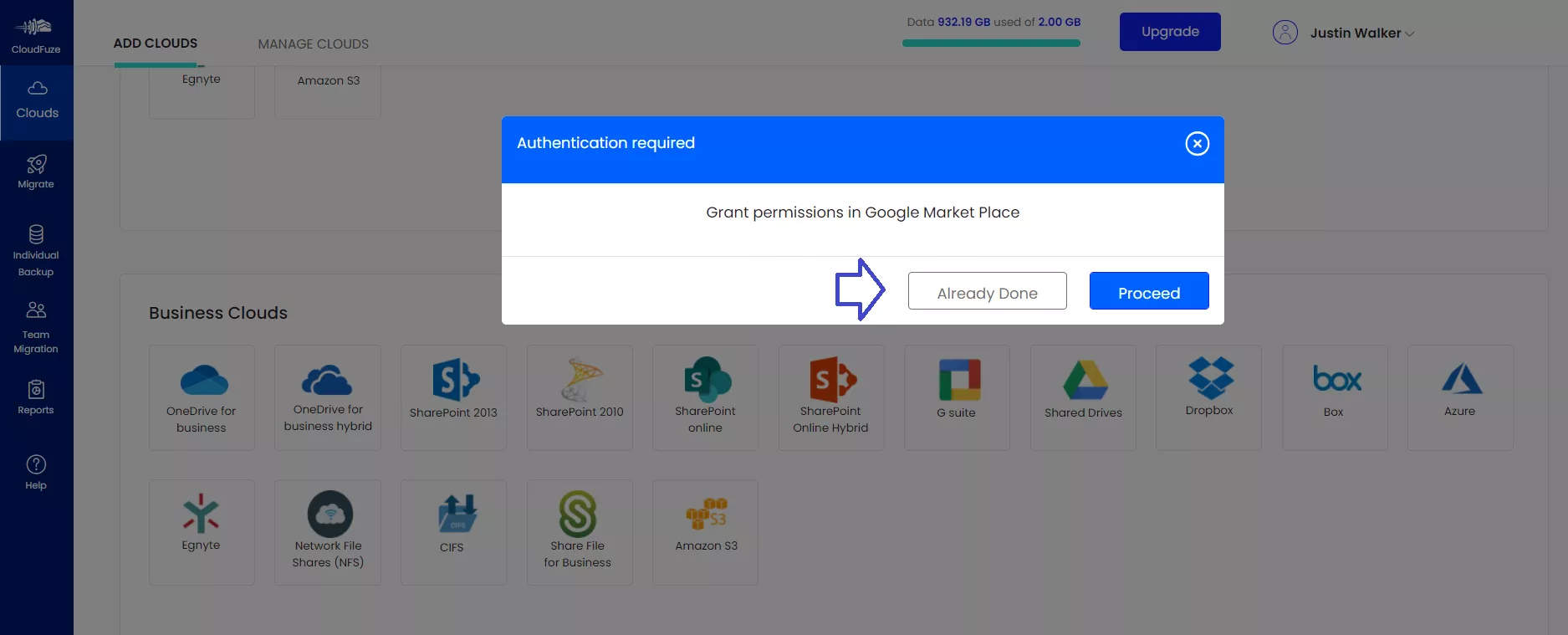
5. Add CloudFuze from G Suite Marketplace
CloudFuze requires you to add its app in the G Suite marketplace to facilitate migration. Click on the Proceed button.
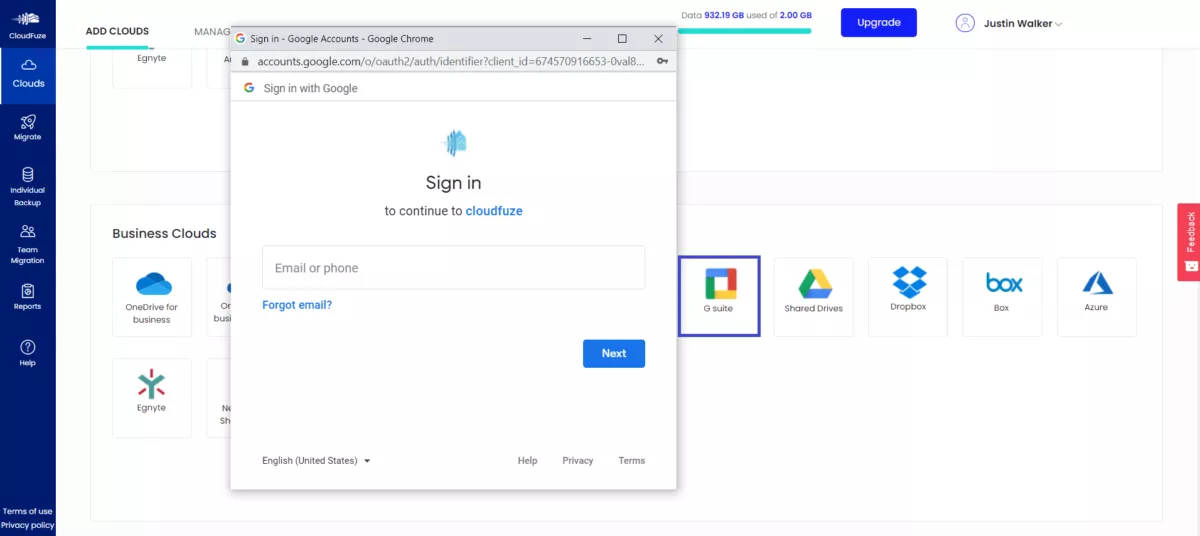
6. Enter G Suite Login Details
Now enter your company’s G Suite admin login details and click on the Next button.
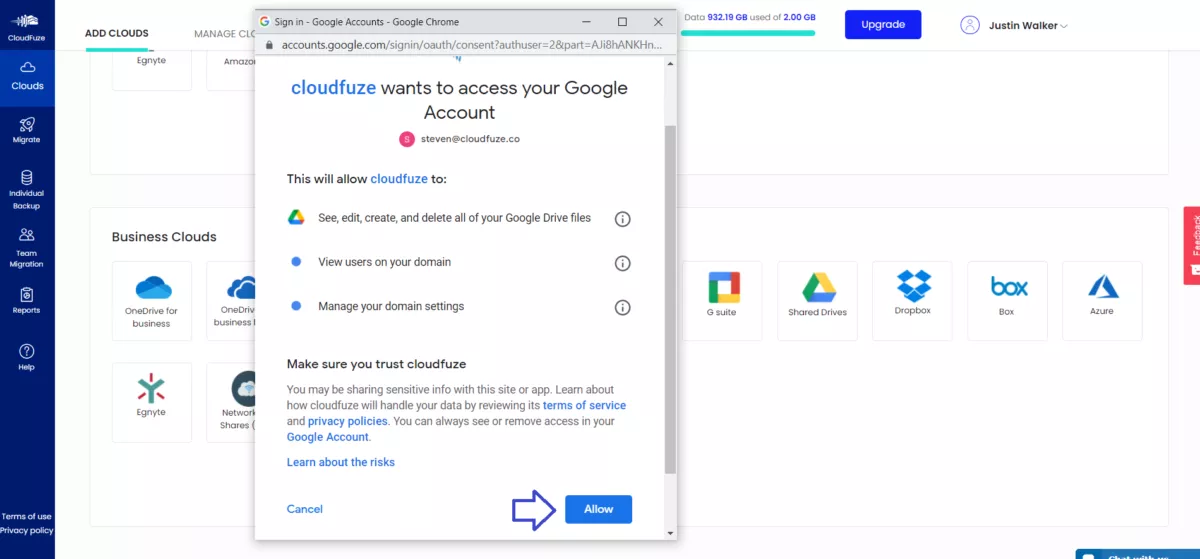
7. Provide Access
Click on the Allow button to complete the G Suite cloud addition process.
8. Check Whether Clouds Added Successfully
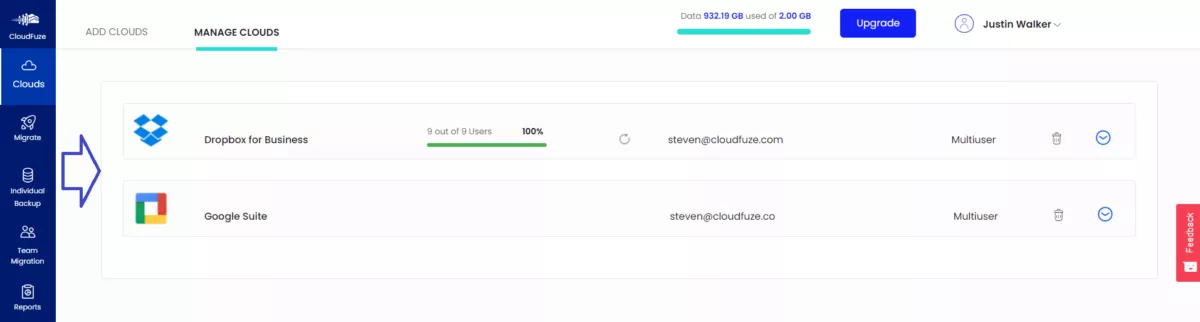
Go to the Clouds section in the webapp and click on the Manage Clouds tab. You should be able to see both Dropbox and G Suite added there. If you find one of the two clouds missing, repeat the cloud addition procedure with the steps given above.
It is critical to get the clouds addition process right to successfully transfer files from Dropbox to Google Workspace.
9. Team Migration to Proceed to Dropbox to Google Workspace Migration
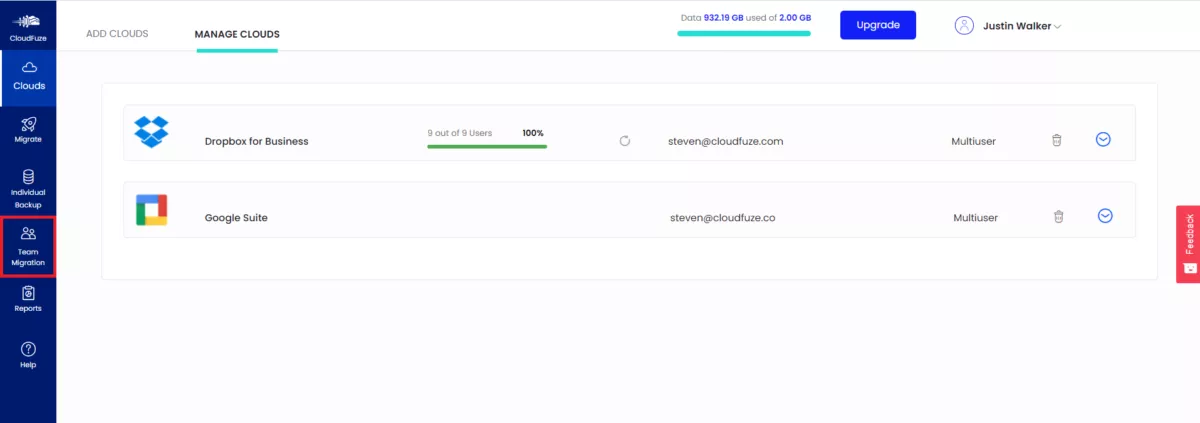
Click on the Team Migration icon. This will not start the actual process of copying Dropbox files and folders to G Suite. You need to configure a few more options to start the migration.
10. Select Source and Destination Cloud Accounts
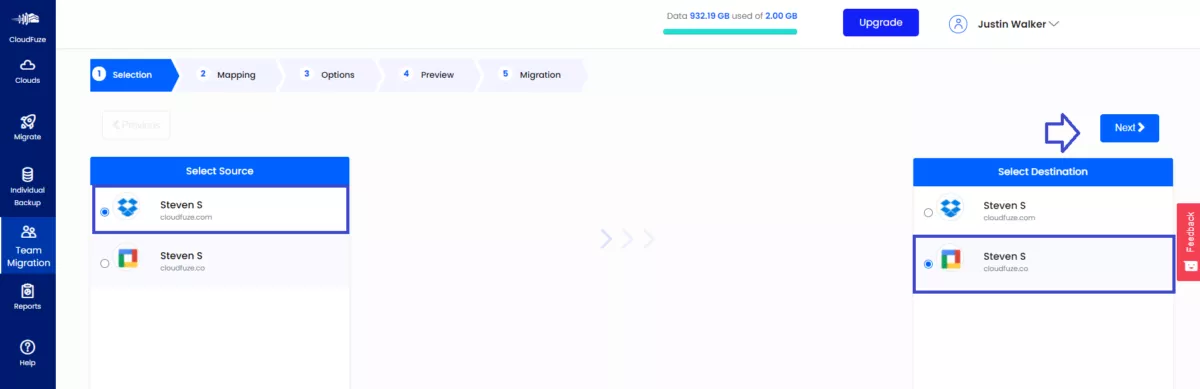
Choose Dropbox for Business as the source and G Suite as the destination cloud to transfer files from Dropbox to G Suite and not the opposite way.
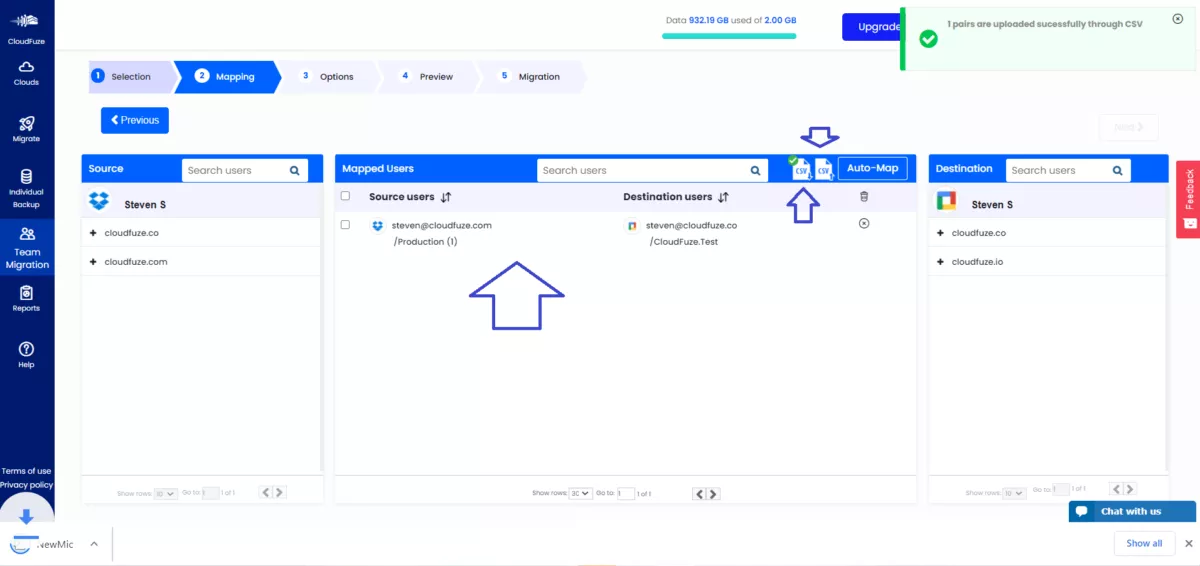
11. Map Users for Migration
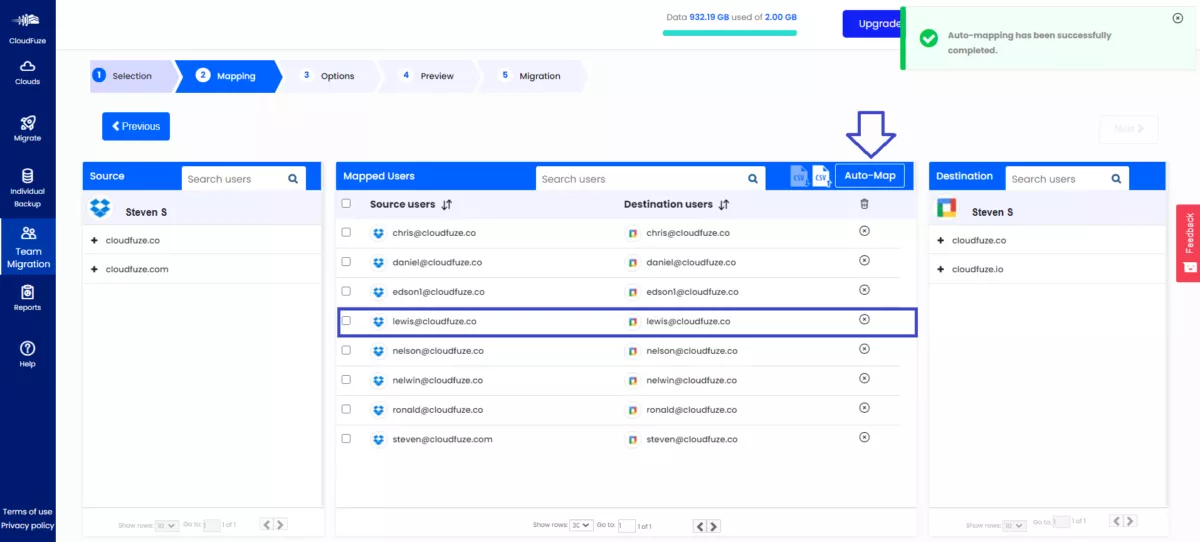
CloudFuze has an Auto-map feature that maps all the users in source and destination based on the email aliases.
You can delete the users from the Auto-map list by clicking on the small delete icon.
12. CSV Mapping Method
Apart from auto-mapping, CloudFuze also supports manual mapping via a CSV file. Upload a CSV file with the list of users to the CloudFuze webapp. The app then fetches the user mapping information to copy files and folders from Dropbox to Google Workspace.
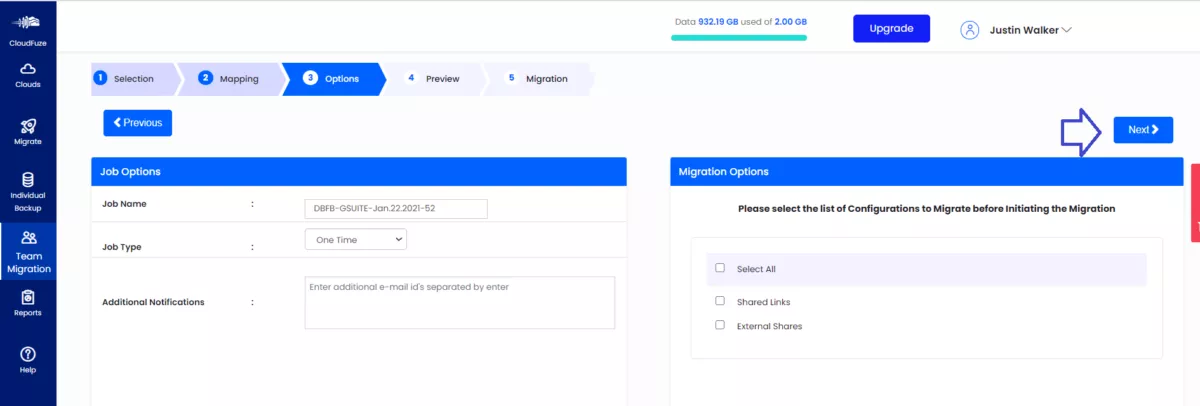
13. Select Dropbox to G Suite Google Workspace Migration Options
You can select a few options on this page, such as naming the migration, providing additional emails for notifications, etc. Most of these settings can be left to default when performing a basic test to transfer files from Dropbox to Google Workspace.
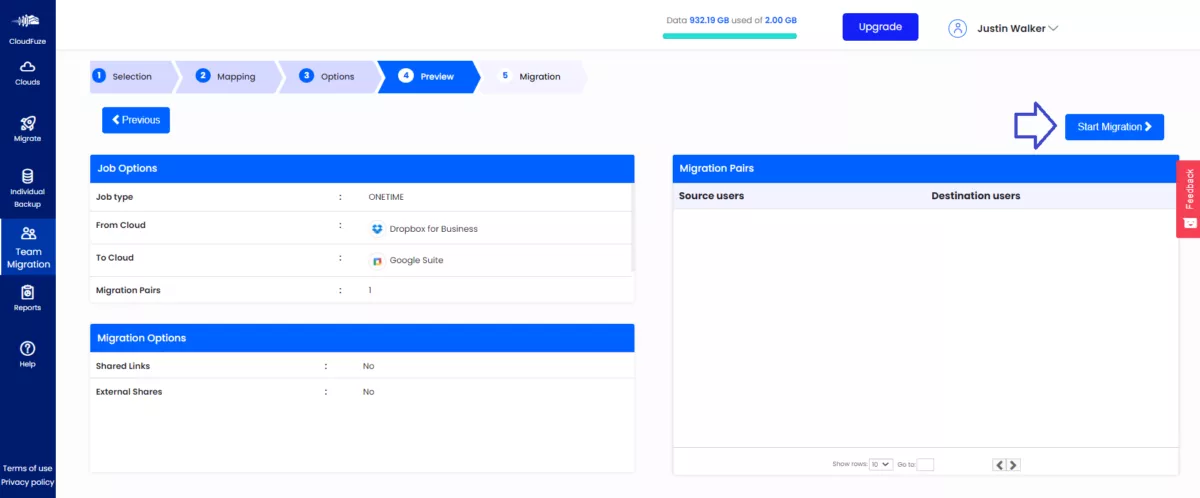
14. Preview and Initiate the Migration
Preview your migration job once and click on the “Start Migration” button. This will migrate data from Dropbox to Google workspace.
15. Migration Is in Progress
When transferring files and folders from Dropbox Business to Google Workspace, CloudFuze displays the status as In-Progress.

16. Dropbox to Google Workspace Migration Has Been Completed
If you would like to migrate content from Dropbox to Google Workspace in a high volume for your organization, please contact our business migration team for a quote or a demo.

If you would like to migrate content from Dropbox to G Suite, please contact our business migration team for a quote or demo.
14. Post-Migration Tasks
After the one-time migration gets completed for all the user batches, make sure to perform a couple of mission-critical post-migration tasks.
1) Delta Migration
Incremental changes accumulate in Dropbox when users continue working on their files and folders during the one-time migration. Transfer these incremental changes by performing one or more delta migrations.
2) Migration Validation
Validate the one-time and delta migrations by checking the migration reports. Our tool generates detailed migration reports that help you check all the key parameters, such as data size, user accounts, start and end date and time for the migration, and more.
3) User Onboarding and Go Live
Provide the users with proper training to use Google Workspace. Once they are ready, start the onboarding process. And after configuring all the administrative parameters, deploy the cloud suite across the company and make it live.
Conclusion
With the right strategy, you can ensure a complete Dropbox to Google Workspace migration success for your company. Schedule a free and no-obligation demo of our tool to understand its capabilities. Contact us today!
Frequently Asked Questions
1. What is Dropbox to Google Workspace migration?
Dropbox to Google Workspace migration is the process of moving and organizing files, folders, and rich metadata and context from Dropbox to Google Drive and Shared Drives. IT teams are primarily responsible for planning the migration and choosing a suitable migration tool. Preparing the scope of work, mapping users, validation, and post-migration integration are additional priorities in the migration project.
2. How does Dropbox compare to Google Workspace in terms of features and usability?
Dropbox is a dedicated file storage and sync platform. Google works with a full productivity suite that includes Gmail, Drive, Docs, Sheets, Slides, Meet, Chat, and Gemini AI. For organizations already on Google Workspace, Dropbox usually becomes a redundant storage running alongside Google Drive. Google Workspace replaces multiple tools with one unified platform.
3. What long-term advantages can organizations expect after migrating from Dropbox to Google Workspace?
Organizations gain a unified platform with one admin console, native Gemini access across all Drive files, reduce licensing costs by eliminating Dropbox, stronger eDiscovery through Google Vault, and more. User onboarding becomes faster because all tools sit within one platform.
4. How do I migrate Dropbox files to Google Workspace?
Use a third-party migration tool. The process involves:
- Connecting both accounts to the tool
- Mapping users
- Configuring migration options
- Running the one-time migration
- Performing delta migration to capture incremental changes
- Validating results before cutover
CloudFuze handles the entire scope of migration while ensuring optimal performance and enterprise-grade security and compliance.
5. What is the difference between migrating to G Suite and migrating to Google Workspace?
There is no difference. G Suite was Google’s original branding for this cloud productivity suite before Google re-branded it to Google Workspace in October 2020. A Dropbox to G Suite migration and a Dropbox to Google Workspace migration refer to the same process and the same platform.
6. How long does the Dropbox to Google Workspace migration take?
The time to migrate from Dropbox to Google Workspace depends on data volume, user count, folder complexity, and the migration infrastructure. Small migrations of a few hundred GB can be completed in a couple of days.
Enterprise Dropbox files migration to Google Workspace, spanning multi terabytes of data with thousands of users, typically takes several weeks to months, accounting for planning the one-time migration, delta migration, and validation phases.
7. Can users keep working in Dropbox during migration?
Yes. CloudFuze runs the migration process in the background which enables users to keep working in Dropbox. All the changes and new files users create when they are working on Dropbox will be transferred through a single or multiple delta migration after the one-time migration completion.
About the Author: Pankaj Rai



