
Control Content Sprawl with Governance Policies | IT Guide
As businesses grow their SaaS and AI application stack, content and permissions are bound to sprawl. And uncontrolled content sprawl not only drives up costs but also raises security and compliance risks, especially when AI tools and agents are deployed.
The key is to ensure continuous governance over file sharing and setting up content cleanup policies that help avoid redundant data accumulation and risky sharing.
In this guide, we have shared several governance strategies that can help you control content sprawl and improve your company’s overall security posture.
Key Takeaways:
What is Content Sprawl?
Content sprawl is the uncontrolled growth of files, duplicates, and scattered data across an organization’s cloud ecosystem. It occurs when there are no governance policies that define how files and folders are shared internally and externally. As a result, they multiply without IT oversight.
Content sprawl then leads to permission sprawl. Files get shared broadly, duplicates carry over inherited permissions, and over-permissioned content becomes harder to track and govern.
What are the Risks and Impacts of Content Sprawl?
Content sprawl and permission sprawl aren’t some minor issues that IT teams can ignore. When left unchecked, they can lead to several security and compliance issues, such as:
- Sensitive files being accessible to unauthorized users
- Uncontrolled data sharing leading to GDPR and other violations
- External file sharing leading to external data exposure
The risks are amplified when AI assistants (e.g., Copilot, Gemini, etc) and agents are deployed in an organization’s cloud ecosystem. When content and permissions sprawl are not cleaned up, AI assistants and agents can access sensitive information and inadvertently surface them in their natural language responses.
Years of overshared folders, anybody can access links, some broken inheritance chains; these aren’t necessarily mistakes as such, they just accumulate over time. And they come under active exposure points the moment AI enters into the picture.
– Pranavi Manthena, Product Manager, CloudFuze.
According to an IBM report, over 97% organizations reported AI-related security incidents and lacked proper AI access controls. The same report also highlights that 63% of organizations lack proper AI governance policies.
How to Control Content Sprawl?
The efficient and proven way to control content sprawl and permission sprawl is to set governance policies on how users can access and share files internally and externally.
With CloudFuze Manage, organizations and their IT teams can set specific governance policies and enforce them across the entire lifecycle of each user. This way, continuous governance starts from the moment a new user is onboarded to the cloud environment.
Governance Policies to Control Content and Permission Sprawl
Follow the steps to set specific governance policies in CloudFuze Manage, through which you can control content sprawl, oversharing, and risky external sharing.
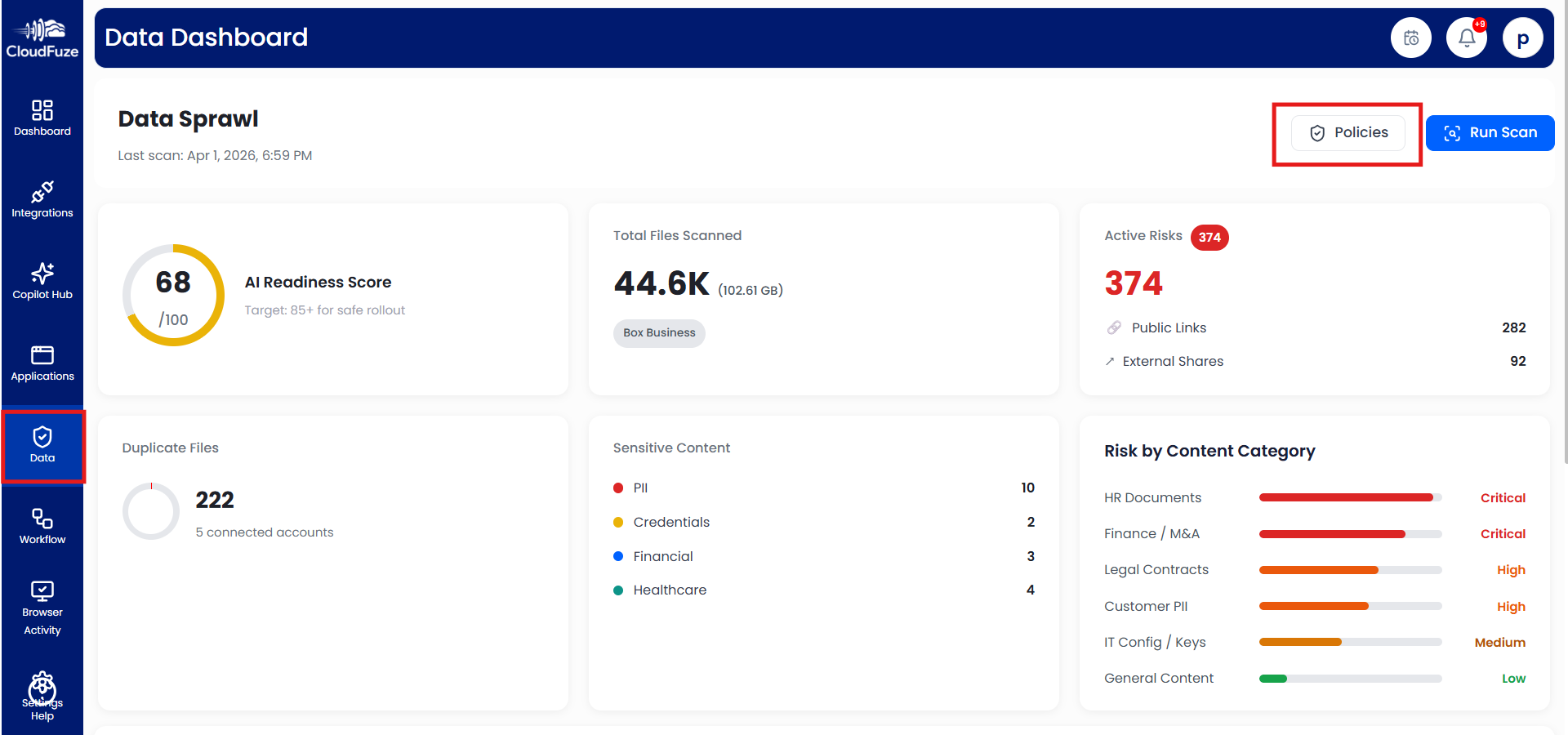
To get started, open the “Data Dashboard” in CloudFuze Manage platform and click on “Policies.”
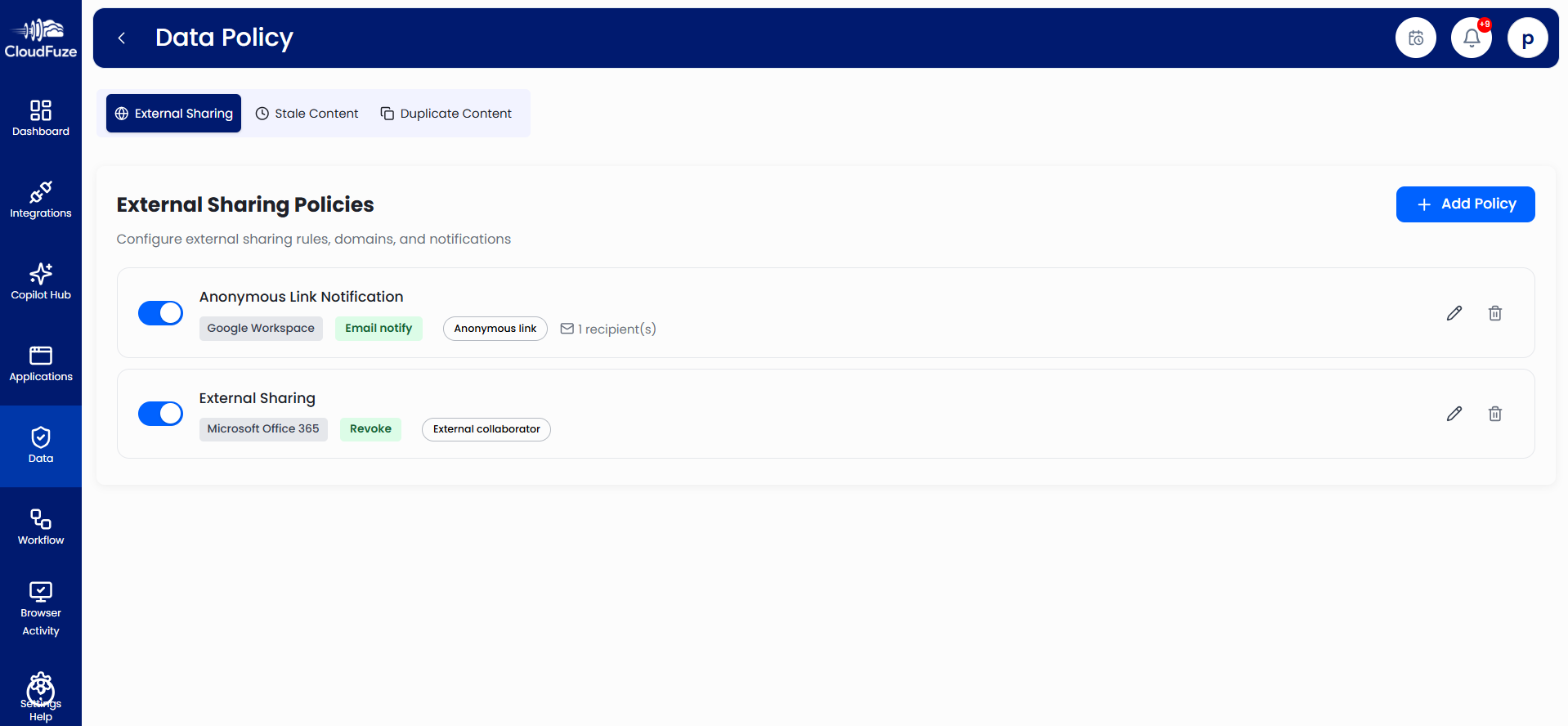
1) Set Governance Policies for External Sharing
You can set up various types of external sharing policies to establish governance over unauthorized external sharing. For example, you can create and set up a governance policy to revoke external collaborations in Microsoft 365 or Google Workspace.
Click on “Add Policy” to create a new policy.
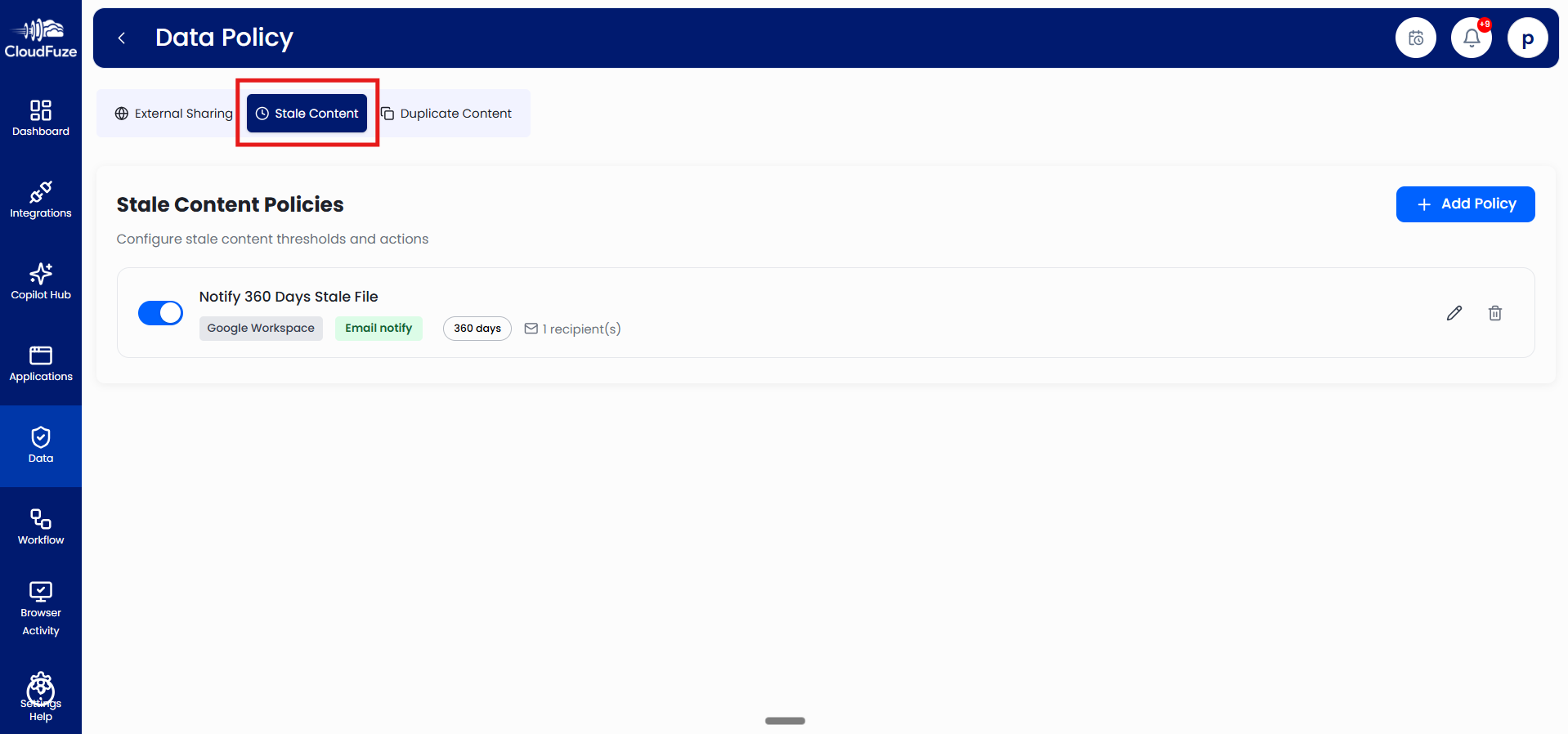
2) Set Governance Policies for Stale Content
Switch to the “Stale Content” tab. There, you can set governance policies for stale content. For example, if files have been stale and unused for 360 days, 180 days, or 90 days, you can set a policy for email notifications to be automatically sent.
This way, IT teams can analyze unused files and clean them up if they are not required.
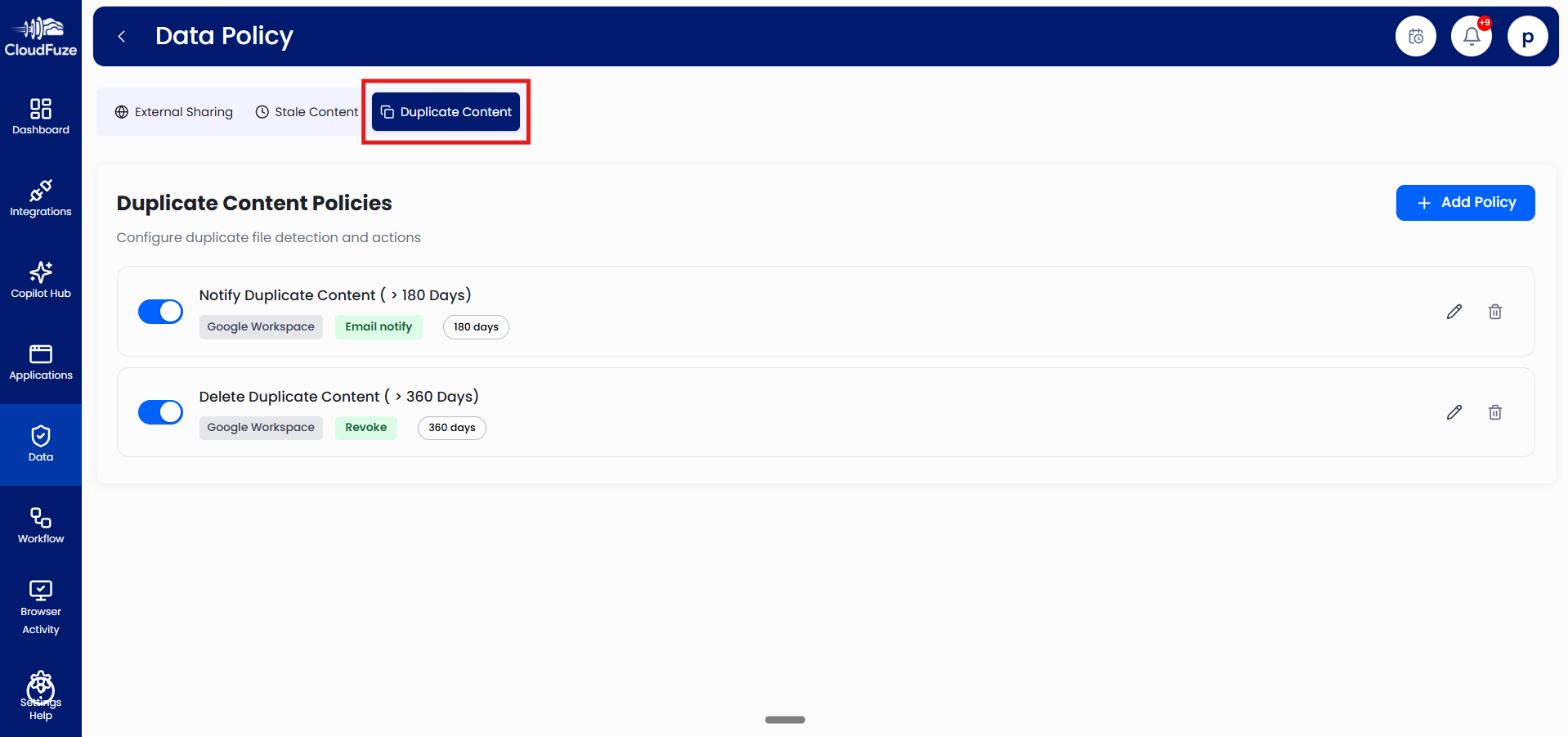
3) Set Governance Policies for Duplicate Content
Similarly, you can set governance policies for keeping duplicate content in check. For example, you can set a policy to either notify admins or remove duplicate content after 90 days, 180 days, or 360 days.
Perform Pre-Migration Cleanup When Consolidating SaaS Stack
The root of content sprawl is migrating duplicate and redundant data when consolidating cloud ecosystems, such as consolidating into Microsoft 365. It is important that you avoid duplicate data during migration and consolidation by performing a thorough pre-migration cleanup.
With CloudFuze Manage, you can clean up data before migrating and consolidating into a cloud environment and start with a clean slate post migration. This approach also helps streamline continuous governance of files, users, AI usage, and more.
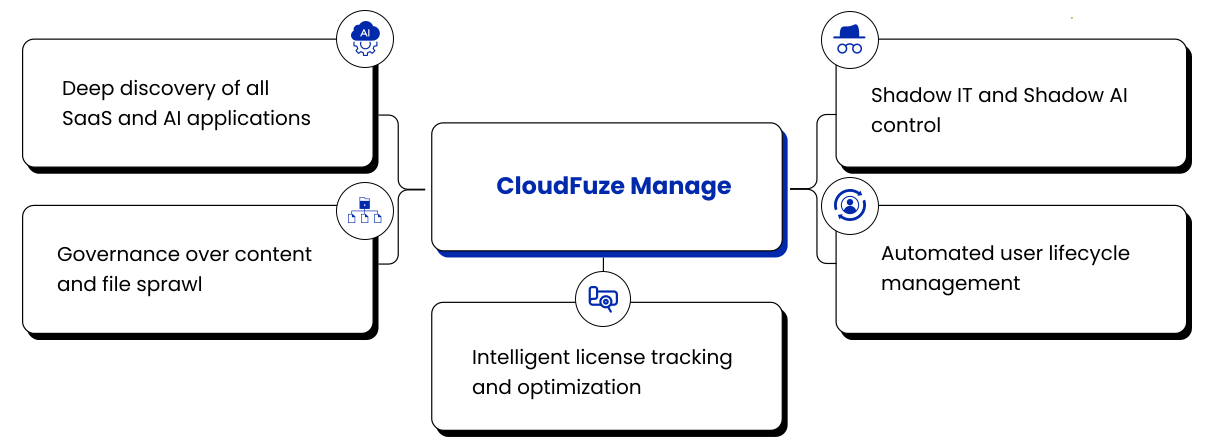
Establish 360° Governance Over Content Sprawl with CloudFuze Manage
Leverage CloudFuze Manage to curb content sprawl and govern it continuously in your organization’s SaaS and AI application stack. The tool also helps you automate user lifecycle management, streamline cost management, and do a whole lot more to be in total control of your SaaS and AI stack.
Contact us today for a free and no-obligation demo of CloudFuze Manage.
Learn more about managing and governing SaaS and AI apps in our recent webinar:
Frequently Asked Questions
1. What are the main components of effective governance strategies?
Having proper visibility over app and data usage patterns, setting policies, creating alerts and automations for certain processes, etc., are some of the main components of proper SaaS governance strategies.
2. How can organizations effectively implement governance strategies in 2026?
Using governance frameworks and setting policies through SaaS and AI app governance tools like CloudFuze Manage is one of the best ways for organizations to seamlessly implement governance strategies in 2026.
3. What are the best software tools for implementing governance strategies?
CloudFuze Manage is one of the best software tools for implementing strategic and proven governance processes in SaaS and AI app stacks of all sizes and complexities.
About the Author: Pankaj Rai


