

1. Introduction
Box to SharePoint Online migration is the process of transferring files, folders, users, permissions, embedded links, timestamps, file versions, external shares, shared links, in-line comments, and more.
It is one of the most in-demand enterprise cloud migrations today, driven by AI readiness, cloud consolidation, and the need for tighter integration with tools like Microsoft Teams, Outlook, and Copilot.
This guide covers all the important aspects of Box to SharePoint migration, including the challenges involved, how to plan and prepare, how CloudFuze’s migration solution works, real-world case studies, and ensuring Microsoft 365 Copilot readiness along the way.
To get started, you can also watch our tutorial on migrating data from Box to SharePoint with our tool:
You can also check out this Box to OneDrive migration guide if your company is planning to consolidate into Microsoft 365 completely.
2. Box to SharePoint Migration Trends and Use Cases
Over the years, businesses across industries have moved away from standalone cloud storage tools like Box and toward consolidating into a single cloud suite like Microsoft 365.
The reasons are consistent:
- Simplifying license and costs
- Strengthening security
- Improving data governance
- Reducing the complexity of managing multiple platforms
In 2026, the dominant driver behind Box to SharePoint and overall Microsoft 365 migration is AI adoption, specifically Microsoft 365 Copilot adoption.
Why Copilot is accelerating box to SharePoint and Microsoft 365 migrations
Microsoft 365 Copilot is an AI assistant built into Teams, Word, Excel, Outlook, SharePoint, and OneDrive. For Copilot to deliver accurate and contextually relevant responses, it needs to index your organization’s data inside Microsoft 365.
When that data lives in Box storage, Copilot cannot reach it. Migrating to SharePoint removes that blocker. Organizations that complete the migration and bring their metadata along with it are positioned to activate Copilot faster and more effectively.
This is why Copilot readiness has become a primary migration trigger in 2026, alongside traditional drivers like mergers and acquisitions, cloud consolidation, IT simplification, and license rationalization.
3. Box vs. SharePoint
Both Box and SharePoint Online have business-focused functionalities such as native and third-party app integration, enterprise-grade security, content sharing, and automation. However, when it comes to company-wide collaboration, SharePoint Online has the edge over Box as it is a centralized storage point and an intranet.
Companies planning to migrate data from Box to SharePoint can benefit from SharePoint Online’s integration with Microsoft 365 in various ways, including:
- Integration with Copilot AI for AI-powered search, collaboration insights, content creation and enhancement, and more.
- Adding shortcuts of SharePoint Online files and folders to OneDrive for Business
- Seamless native integration of SharePoint Online with Outlook and Yammer
- Sharing of OneDrive files and folders through SharePoint links
- Sharing of SharePoint and OneDrive files and folders on Microsoft Teams
Check out a detailed comparison in our Box vs. SharePoint comparison guide.
Here is the side-by-side comparison of Box and SharePoint Online across the features that matter most for enterprise IT teams:
| Features | Box | SharePoint Online |
|---|---|---|
| Primary use case | Cloud file storage and collaboration | Intranet, document management, and team collaboration with Microsoft 365 |
| Microsoft 365 integration | Limited (via third-party connectors) | Native and deep across Teams, Outlook, OneDrive, and Copilot |
| Microsoft 365 Copilot | Not supported | Natively supported |
| Intranet and communication sites | Not available | Built-in |
| Native documents | Box Notes (proprietary format) | Microsoft Word |
| Compliance and governance | Box Shield | Microsoft Purview and Microsoft 365 compliance tools |
| Pricing model | Separate subscription | Included in Microsoft 365 business and enterprise plans |
The most significant difference for organizations evaluating a move in 2026 is the Copilot dimension. SharePoint Online is the foundation that Microsoft 365 Copilot is built on.
4. Box to SharePoint Online Migration Challenges
As an IT admin/manager, you may already know that the manual method to migrate from Box to SharePoint Online is out of scope. This method is not feasible for migrating TBs/PBs of data while preserving sharing permissions, hyperlinks, timestamps, versions, Box-specific features such as Box Notes, etc.

Here are some of the major challenges businesses of all sizes face while migrating data from Box to SharePoint.
- Transferring large data (often in TBs and PBs) in a fast and secure way
- Avoiding hyperlinks from breaking when migrating files
- Migrating file and folder-sharing permissions of users across the organization
- Conversion of Box features such as Box Notes to relevant formats in SharePoint Online, e.g., .docx.
- Migrating external shares, shared links, timestamps, file version history, etc
- Tracking and monitoring the migration project status, especially if the data to be migrated is large.
- Planning the timeline for the entire SharePoint migration
- Risk of downtime during migration.
The proven way for organizations of all sizes to move data from Box to SharePoint while overcoming all the technical and process-related challenges is to partner with a trusted migration solutions provider, such as CloudFuze.
5. Roles and Permissions You Need to Perform Migration from Box to OneDrive
It is important to understand the types of privileges you need to have to be able to perform the migration smoothly. Here’s what’s typically required:
- Admin accounts – You need admin accounts of both the source and destination cloud for the cloud authentication process. It’s only through the highest admin’s privileges of enabling read/write access to each user account that it becomes possible to migrate entire data.
- Ample availability of API calls – Ensure your company’s Box account has sufficient API calls needed for the migration. Our team can help you analyze the required API calls so you can prepare accordingly.
6. CloudFuze’s Crucial Role in Box to SharePoint Migration
At CloudFuze, our cloud data migration platform is built for companies of all sizes, especially large enterprises that need to migrate large volumes of users, data, and metadata between leading cloud storage and collaboration services like Box, SharePoint, OneDrive, Dropbox, Google Drive, etc.
Our migration teams have 12+ years of experience in helping businesses move files and folders from Box to SharePoint in the most secure way. With our proven methodologies, we have been able to create success stories for global businesses with varying Box migration to SharePoint use cases.
With our solutions, businesses do more than just copy files from Box to SharePoint. They can also accurately transfer the features associated with the user data to ensure complete replication of the Box environment in SharePoint Online.
With the capabilities to migrate sharing permissions of internal and external users, version history, timestamps, in-line comments, and Box-specific features, we cater to all types of Box to SharePoint Online migration and overall Box to Microsoft 365 migration needs.

7. Box to SharePoint Online Migration Case Study
Over the years, we have helped some of the biggest and most renowned organizations move from Box to Microsoft 365, including SharePoint Online and OneDrive, securely and successfully. Here’s an example from a case study:
Case Study Highlight: Warner Bros. Discovery, one of the most popular media and entertainment conglomerates, needed to migrate to Microsoft 365. Given the large scale of the migration and complexity associated with the diverseness of user departments, the journey was riddled with many challenges. However, with our advanced migration solutions, proven methodologies, and white glove service, they were able to achieve all their migration goals with a resounding success!
Our leaders, Ravi Poli, Founder and CEO, and Anthony Raymond, Head of Sales and Strategic Partnerships, conducted a deep technical talk session with Warner Bros. Discovery representatives, including Amanda Pierce, VP of Modern Work Platforms and Application Development, and Vikrant S., Technical Architect. The session, held at the 2024 Microsoft 365 Community Conference event, explores the intricacies of the large-scale migration and helps you understand the strategies and solution implementations that go into making such a challenging IT project a complete success. Watch the full video below:
Check out other case studies to learn how our migration solutions and methodologies have created migration success stories for some of the world’s largest companies.
8. CloudFuze vs Competitors’ Migration Features Comparison
At CloudFuze, we stand out in the Box to SharePoint migration space with extensive support for accurate metadata preservation (e.g., permissions migration) along with user and data migration. This brief comparison highlights the edge our migration tool has over others in this migration segment:
| Migration Features | CloudFuze | Competitors |
|---|---|---|
| One-time migration | Yes | Yes |
| Delta migration | Yes | Yes |
| Root folder permissions | Yes | Yes |
| Root file permissions | Yes | Yes |
| Subfolder permissions | Yes | No |
| Inner file permissions | Yes | No |
| Versions | Yes | No |
| Timestamps | Yes | No |
| External shares | Yes | No |
| Shared links | Yes | No |
| Embedded links | Yes | No |
| In-line comments | Yes | No |
| Long folder path | Yes | No |
| Special characters replacement | Yes | No |
| Suppressing email notifications | Yes | No |
| Comparison delta | Yes | No |
9. Planning Box to SharePoint Online Migration
A proper migration plan helps you lay down the groundwork for smooth, secure, and AI-ready data transfer. Here are some of the most important areas to focus on when planning the migration journey:
1) Pre-Migration Analysis
Start the planning process by performing an in-depth pre-migration assessment. Identify all the users, data, and collaboration structure in the source cloud (Box) and determine what needs to be migrated.
2) Scanning and Assessing Box Data Before Migration
When scanning your Box data prior to migrating data to SharePoint, there’s a process to follow. Although it can be done manually, it is best to use a migration tool, like ours, that has a pre-migration scan feature. With this feature, you can scan all Box data without spending a lot of time.
Based on the pre-migration scan reports, you can decide the types of number of files, folders, and other data types to migrate from Box to SharePoint Online.
3) Planning the Scope of Work
After gaining insights on the source cloud structure, plan the scope of work accordingly. The scope of work must include all everything you need to migrate from Box to SharePoint, including:
- The total number of users
- The total size of files and folders
- Type of servers needed
- Type of migration support needed
- Any tool customization needed
4) Planning the Roadmap and Timeline
Based on the scope of work, coordinate with the migration vendor to plan the roadmap and timeline accordingly. A clear roadmap and timeline will help you visualize the migration journey while structuring every aspect of it.
10. Preparing for the Migration
Once you are done planning the entire migration, ensure proper preparedness before kicking off the project. Here are some of the most important preparation steps to take:
1) Choosing a Box to SharePoint Migration Tool
The first step of ensuring proper preparedness is choosing the right Box to SharePoint Online migration tool. Factor in your company’s entire migration needs to choose a tool accordingly.
It is equally important to consider the security of the migration tool. Make sure it meets industry-standard regulations like SOC 2 Type 2 and ISO 27001 certification and GDPR. Also, check the metadata preservation capability, scalability, and pricing model of the tool.
2) Creating User Mapping
Another important preparation area to focus on is creating user mapping. With migration partners like us (CloudFuze), you get two user mapping options: auto-mapping and CSV mapping.
Auto-mapping maps users via their email aliases and is suitable if you want a straightforward mapping. However, if you require customized user mapping paths, CSV-based mapping is the best option for you. Our migration team can help you create accurate CSV user mapping paths before starting the migration.
3) Performing a Test Migration
It’s always best to perform a test migration before starting the actual migration to analyze how the tool performs in real-world scenarios. Create a pilot batch of a few users with real file and folder sharing structure between them. Perform the test migration in a non-production environment and validate the results accordingly.
4) Readying Admin Credentials
Authenticating the source and target clouds, Box and SharePoint, is the first important step of the actual migration. Therefore, make sure to have admin login details of both clouds with your team to streamline the cloud authentication stage.
5) Preparing for Copilot AI Adoption
If your company is planning to adopt Microsoft 365 Copilot post-migration, the quality of the data you bring into SharePoint matters as much as the migration itself. Copilot indexes what it finds in Microsoft 365, so migrating stale files, over-permissioned folders, and redundant content means Copilot inherits that noise.
Before migrating, it is worth auditing your Box environment for sprawl, ungoverned content, and shadow IT and shadow AI exposure. CloudFuze Manage gives IT teams that visibility before migration and enables them to arrive at SharePoint with clean, governed data that ensures secure and compliant Copilot deployment and usage.
11. Steps for Box to SharePoint Online Migration
You can use our Box to SharePoint migration tool to transfer your company’s entire users and data along with all the features. However, you need a CloudFuze account to access the webapp. Create a new account for free here.
Step 1: Log into CloudFuze

The process of initiating a swift and secure Box migration to SharePoint begins with accessing the CloudFuze migration webapp.
The first step is to log into the CloudFuze migration webapp after creating a free CloudFuze account.
Step 2: Add the Source Cloud, Box

Navigate to the Business Clouds section in the CloudFuze webapp dashboard and choose Box. Log into the Box account with admin credentials and authorize the cloud on the CloudFuze webapp.
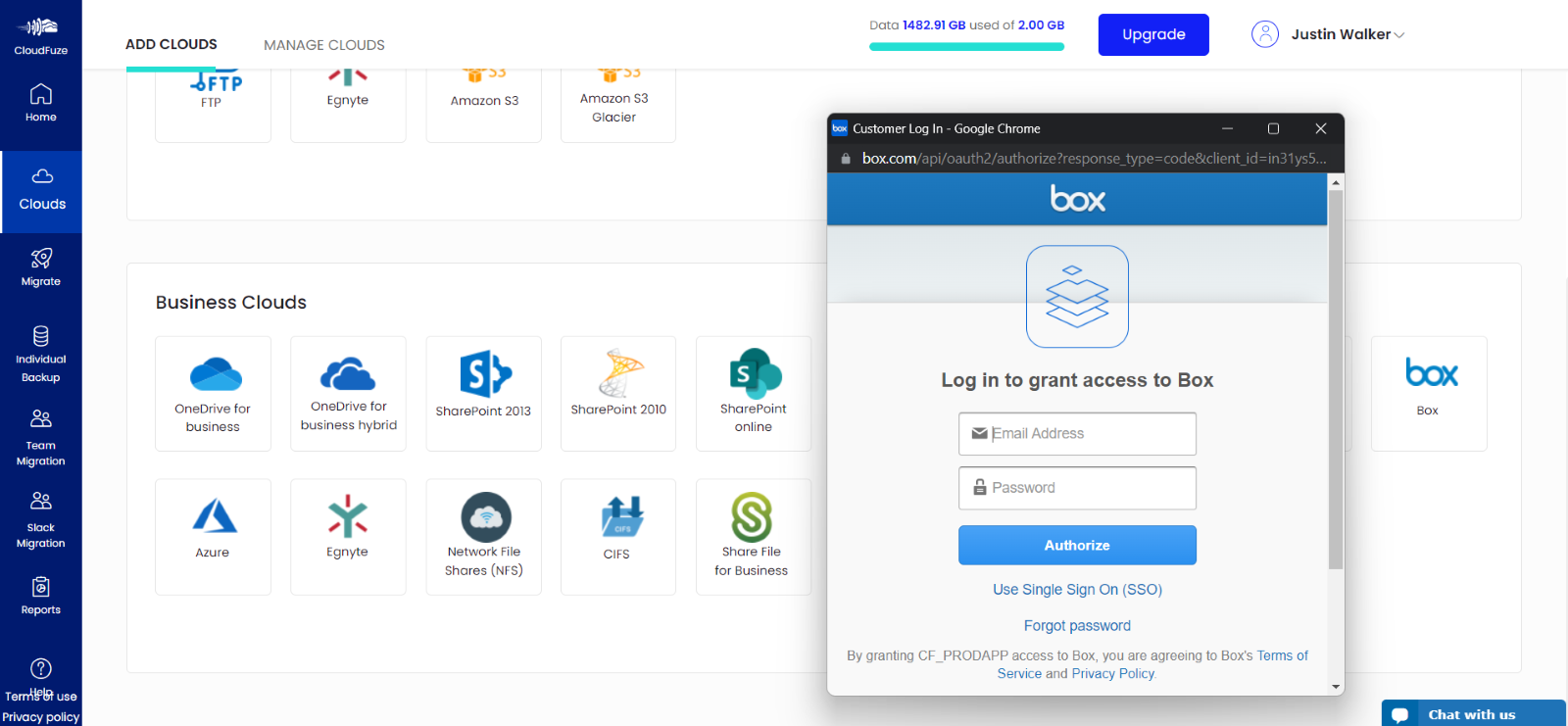
Step 3: Add the Destination Cloud, SharePoint Online
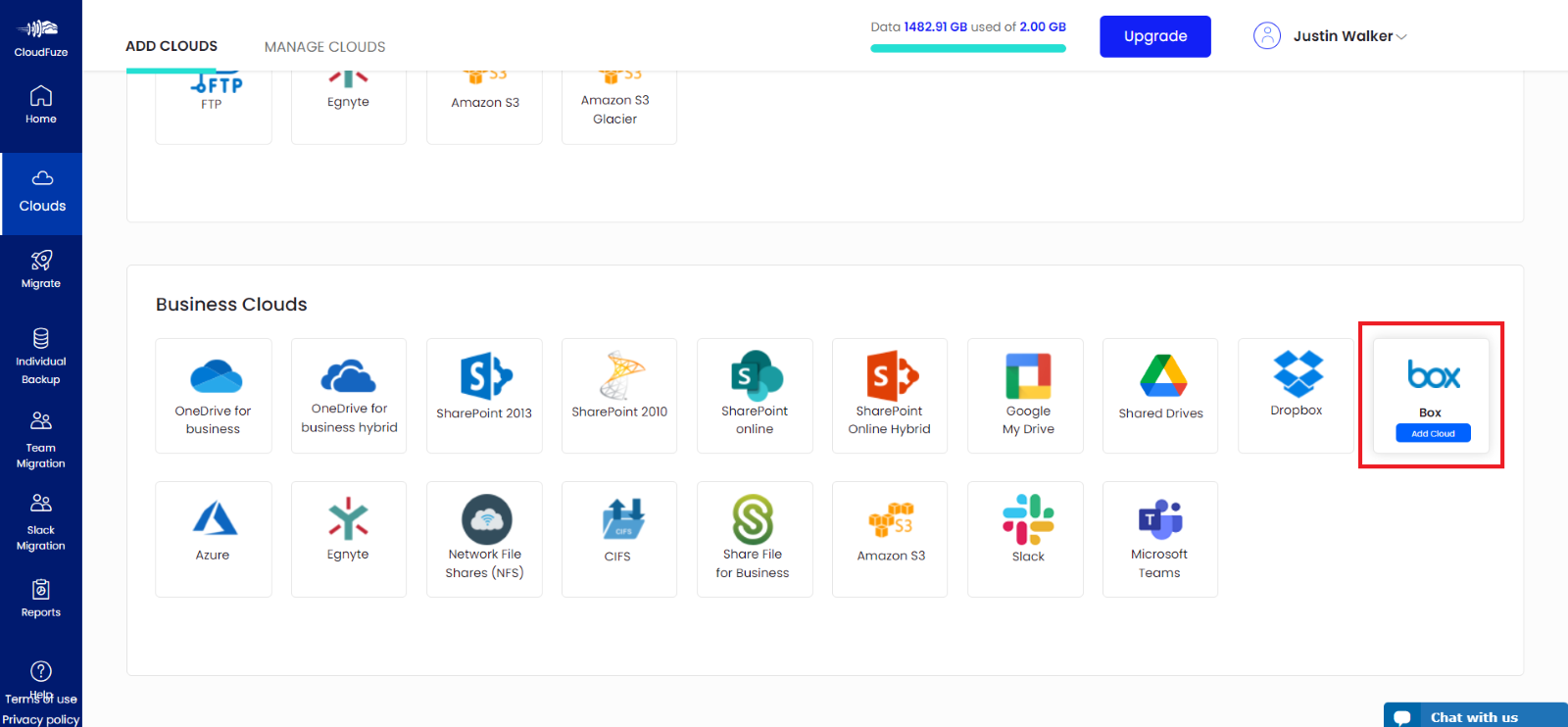
Under the same Business Clouds section, choose SharePoint Online and add it. Similar to authorizing Box, sign into Microsoft 365 with the Global Admin account and authorize the cloud on the CloudFuze webapp.

Step 4: Ensure Both Clouds Are Added Properly

Visit the Manage Clouds section and ensure that both clouds, Box and SharePoint Online, are correctly added. If one or both clouds are missing, you must re-add the clouds and authorize them properly to ensure a successful Box migration to SharePoint.
Step 5: Configure Source and Destination Clouds
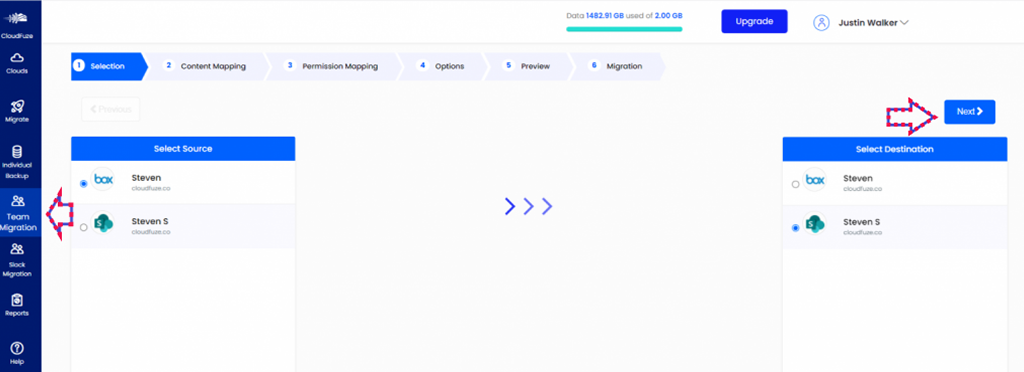
Click on Team Migration from the left-hand pane. Select Box as the source, SharePoint as the destination to migrate Box to SharePoint Online, and not the opposite way. Click the Next button.
Step 6: Map Source and Destination Users
After clicking on the Next button, you will enter the Content Mapping page, which is the second step to initiate the migration and copy Box files to SharePoint seamlessly.
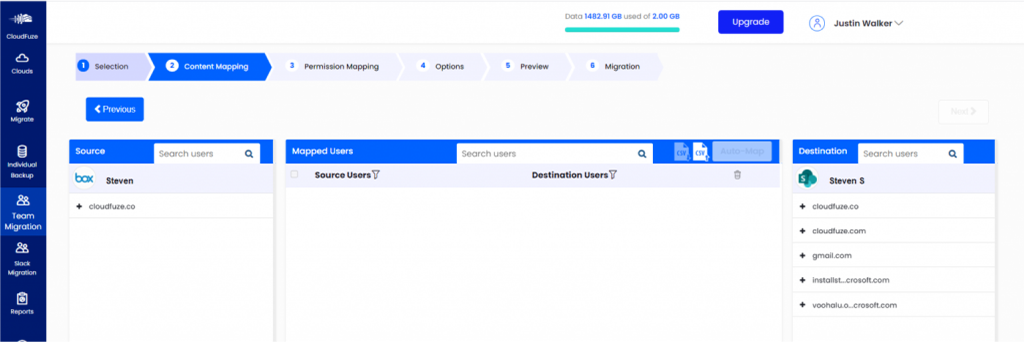
To migrate from Box to SharePoint Online, you need to map the source and destination users via a CSV file. There are three steps involved in this process:
- Mapping users in a CSV file
- Uploading CSV file
- CSV file validation & downloading the report
1. Mapping users in a CSV file
Create an Excel sheet and follow the column layout and syntax format as shown below.

Make sure to enter the names of the correct folders in the source and destination paths. Also, save the Excel sheet in CSV format.
2. Uploading CSV file
In the Content Mapping page, click on the right CSV icon with an up (↑) arrow indication.
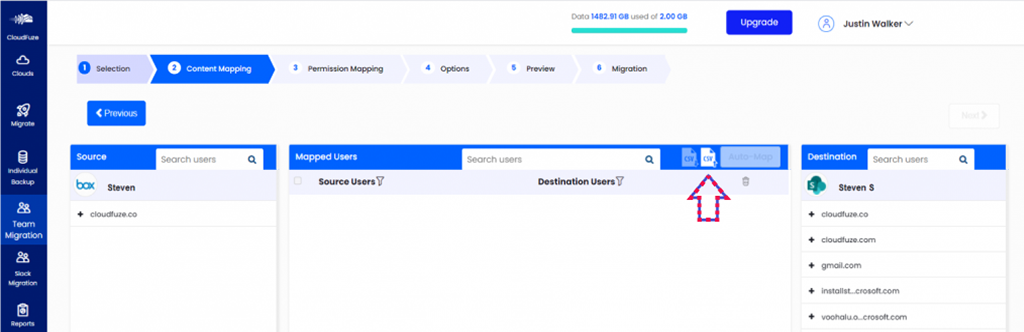
On clicking the CSV icon, a pop-up will be displayed. Browse the file from your saved location and select the file.

3. CSV File Validation
Once the CSV file is uploaded, the validation process will start. The time for validation depends on the number of mappings that are present in the CSV file.

After the validation is complete, the report will be automatically saved to your computer. You can manually download the validation report by clicking on the CSV icon with a down (↓) arrow.
Step 7: Customize Permissions Mapping if Needed

If you need to modify the permissions mapping from source to destination, you can do it during the Permissions Mapping stage.
Step 8: Choose the Metadata Types to Migrate

Choose the types of metadata that you need to migrate; they are listed under the Options stage of the webapp. As mentioned before, businesses planning to migrate from Box to SharePoint Online can have all the metadata transferred with our migration solution.
As an additional precautionary measure, be sure to make the right decision in choosing the number of versions to preserve when moving files from Box to SharePoint. Since each version doubles in SharePoint and OneDrive, the more the number of file versions you choose to migrate, the more the version doubling will occur, which will require two actions from your end:
- Checking the available storage space to accommodate doubling versions
- Adjust the pricing for the overage charges associated with the migration of doubling versions
Step 9: Preview the Final Options

Preview the final options and parameters, and ensure all the configurations are correct before you proceed to initiate the migration process.
Step 10: Start the Migration

Once everything looks good, click on the Start Migration button to initiate the actual migration process to copy files from Box to SharePoint along with users.
Step 11: Monitor the Migration Progress

After starting the migration, monitor the progress. CloudFuze’s migration platform shows the progress status as “In Progress” in the Reports dashboard.
Step 12: Check for Migration Completion Confirmation

The Reports dashboard displays the “Completed” status when all the data transfer processes are completed. You can download the migration report to validate the migration and the migrated users and data.
12. Migrate to Different Types of SharePoint Sites
Unlike migrating data to OneDrive for Business or other cloud storage, the steps to migrate Box to SharePoint Online can be quite different if you have created different types of SharePoint Online sites.
In this section, we have tried to address real-life SharePoint site migration needs that may resonate with your company’s requirements.
Below, we have covered the steps to copy files from Box to different SharePoint sites, e.g., the SharePoint Public site and the SharePoint Private site.
How to migrate content to the SharePoint Public site
Step 1: Create a CSV file in an Excel sheet. Use the column and syntax template shown below:

Step 2: In the source and destination path column, start with / and enter the folder or subfolder name.
Note: Path names should be upper case.
Step 3: Save the CSV file before uploading to make sure that all the entries are intact.
How to migrate content to a SharePoint Private site
Step 1: To migrate to any private site, the global admin of SharePoint should be a member of that site.
Step 2: CSV file creation processes are the same for the Private sites as for the Public sites.
How to migrate multiple Box users’ folders to one Admin site in SharePoint
When migrating from Box to a SharePoint admin site, source cloud users and paths can be different, but the destination cloud user and path (site) need to be the same.

How to migrate multiple Box users’ folders to multiple Admin sites in SharePoint
When migrating to multiple admin sites, source cloud users and paths can be different, and destination cloud users and paths (sites) can also be different.

13. Box to SharePoint Migration FAQs
It goes without saying that navigating the complexities and uncertainties of a mission-critical Box to SharePoint Online migration is not easy. Therefore, to help you out, we have shared an extensive list of frequently asked questions that may resonate with your doubts:
You can also contact us to understand how our solution can help you mitigate challenges and create your company’s migration success story.
SharePoint Online FAQ
1. How will Box Notes be migrated to SharePoint Online?
Box Notes will be converted into the Microsoft Word format (.DOCX) which will be available for use in SharePoint Online as well as OneDrive for Business.
2. Is it possible to migrate the in-line comments of every Box Notes document?
Yes, with CloudFuze Migrate, you can migrate all the in-line comments of Box Notes documents when migrating from Box to SharePoint Online.
3. Will Box to SharePoint migration be safe?
With a migration tool like CloudFuze Migrate, you can ensure a high level of data security when migrating to SharePoint Online from Box. Our migration tool uses industry-standard security protocols, including OAuth 2.0 for cloud authentication and an API-based approach for fetching data information.
4. What will happen to Google Docs, Google Slides, and Google Sheets created in Box?
All types of Google files created in Box will be converted into respective Microsoft files. For example, Google Docs will be converted into Microsoft Word, Google Slides will be converted into Microsoft PowerPoint, and Google Sheets will be converted into Microsoft Excel.
5. Are there any file size limits or unsupported files during migration from Box?
Although both Box and SharePoint have size limits per file, it shouldn’t be a concern. Box allows per file to be up to 15 GB in size while SharePoint supports sizes up to 250GB per file. But you must be careful about path length as SharePoint supports up to 400 characters. To migrate large sized files and adhere to path limits, you need a migration tool like CloudFuze Migrate.
6. Which is better: cut or copy files from Box to SharePoint?
Copy-and-paste action is always the right choice for almost all types of cloud migration. Compared to cut-and-paste action, there are many benefits that copy-and-paste action brings, including low risk of downtime, easier deployment of retry mechanisms, and full-fledged disaster recovery.
7. How does CloudFuze handle long paths?
The total path is limited to 400 characters in Office 365.
When CloudFuze comes across this type of situation, it creates a folder called “LongFileName” at the root of the SharePoint Online site.
8. Is there a risk of downtime during Box to SharePoint Online migration?
CloudFuze Migrate uses a copy-and-paste action and, therefore mitigates the risk of downtime which, otherwise, can disrupt operations. Once the users are properly mapped and parameters set, the migration tool migrates data as a background activity to ensure workflow isn’t affected.
9. How does CloudFuze handle special characters unsupported by Microsoft 365?
Following are the characters that are not supported by Office 365 in a file or folder name
” * : < > ? / \ |
Users can choose whether to replace the unsupported special characters with Underscore or Hyphen.
10. Is there a throttling risk when migrating high-volume data from Box to SharePoint Online?
Yes. Unfortunately, businesses can stand at throttling risk when migrating high-volume data not just during Box to SharePoint migration but also when migrating to other clouds. However, there are ways to mitigate the risks of API throttling by performing the migration in phases.
At CloudFuze, we follow industry-leading practices to keep the risk of API throttling at bay with approaches such as user batch segregation, auto-monitoring of the API calls used as per the API rate limit, and more.
11. Do I have to create sites before migrating Box data to SharePoint Online?
Yes, it’s only by creating sites first that you can make an informed decision as to which data goes where.
12. How are Box files comments migrated to SharePoint Online?
When there are any conversations on a file, Box will represent that in the following way.

When you click on the file, you can see the comments on the file on the right-hand side.

When a file has conversations, CloudFuze creates a CSV file with the same name.

On clicking the CSV file, all the comments will be displayed as follows:

13. What roles do I need to perform a migration from Box to another platform?
You must authenticate the Box cloud in our migration platform with the Enterprise Admin’s account login details. This is because only the highest admin levels have the privilege to transfer data and metadata of all user.
14. What is the process of assessing Box data before migration?
You can use our migration platform’s pre-migration assessment feature to assess Box data before planning the scope of work and starting the migration.
15. How to map users to ensure accurate migration of files and metadata?
You can map users in a CSV file with specific syntaxes that indicate the folder paths/locations and structure. Our tool will transfer the data and metadata to SharePoint accordingly.
About the Author: Pankaj Rai



