
What Is AI Management and Why Enterprises Need It in 2027?
Quick Answer: AI management is how you gain visibility into every AI platform (Claude, OpenAI, Copilot, Gemini, and more), language model, MCP server, and agent in your enterprise, and control the security risks they create. Enterprises need it in 2027 because AI adoption is outpacing IT oversight worldwide.
In this blog post, you’ll learn why AI management matters in 2027 and how CloudFuze Manage helps enterprises manage AI apps easily.
Key Takeaways:
What Is AI Management?
AI management refers to the centralized practice of overseeing how AI apps are deployed, utilized, and optimally governed in your enterprise.
For example, if your content marketing team uses Claude to create content assets, your web design team uses Gemini, and your software developers use GitHub Copilot, your enterprise ends up with fragmented AI tools. Now, AI management helps your C-suite executives ensure all AI apps are used securely and efficiently by your employees and are aligned with your enterprise budgets while maximizing your business value.
AI management rests on two pillars: AI asset management and AI risk management. Let’s learn about both of them in detail.
AI Asset Management: Knowing Every AI Tool, Model, and Agent Your Company Owns
Your teams adopt AI models, tools, MCP servers, and agents faster than your IT can track them. As a result, enterprises lose visibility and oversight of their AI assets. AI asset management gives enterprises complete visibility through a centralized, continuously updated live inventory of every AI asset in their IT environment. With this live inventory of every AI asset, enterprise IT can replace guesswork with complete visibility and control and see exactly where each AI asset exposes your enterprise data.
AI Risk Management: The Core of Enterprise AI Management
The visibility that comes from AI asset management is what makes AI risk management possible. When you use AI for risk management, you apply controls to the security risks AI creates, and AI in risk management only works when you assign every asset a responsible human owner. Listed below are a few risks that can easily be eliminated with proper AI risk management controls:
- Confidential Data Exposure and Shadow AI
- AI sprawl and Orphaned Agents
- Compliance and Audit Risk
The NIST AI Risk Management Framework serves as a solution to act on the risks mentioned above. It provides a practical framework for managing AI risk by defining human ownership, mapping AI usage, measuring potential security impacts, and implementing the right safeguards at the right time.
Why Enterprises Can No Longer Ignore AI Management in 2027
Today, artificial intelligence (AI) and agentic AI systems have moved from the pilot stage to production-scale deployment in many enterprise Ops. Meanwhile, research from McKinsey & Company shows that more than three-quarters of enterprises now use AI in at least one business function. This increased adoption of AI is making AI stack visibility and agent governance increasingly important for enterprises across various sectors (finance, logistics, IT services, and more).
As teams adopt AI apps like ChatGPT, Copilot, Gemini, and Cursor independently, enterprises face IT operational difficulties around rising AI token costs, fragmented AI usage, and shadow AI. On the other hand, according to IBM’s Report 2026, shadow AI was involved in 43% of organizational security breaches.
At the same time, regulations such as the EU AI Act and frameworks like the NIST AI Risk Management Framework are pushing enterprises to establish stronger AI oversight and agent accountability.
In 2027, successful AI adoption is no longer about deploying more and more AI tools. It’s about managing them effectively to control tokenization costs, reduce AI-related security risks, and maximize ROI on AI apps.
5 Signs Your Enterprise AI Management Is Ineffective
If your enterprise shows several of the signs below, your enterprise AI management is likely ineffective. They are:
Sign 1: If IT teams cannot clearly identify which AI applications employees use, visibility gaps already exist within your enterprise.
Sign 2: When your finance teams experience increased consumption-based AI token pricing, it often leads to AI budget overruns when AI usage is not actively monitored.
Sign 3: Your employees may adopt Shadow AI apps to speed up their work. This, in turn, creates enterprise-wide AI governance and IT compliance challenges.
Sign 4: Your leadership teams may find it difficult to determine which AI investments create higher return value without actual AI app usage and performance insights.
Sign 5: If your IT team relies on 4-5 shared spreadsheets as its primary enterprise AI management tool, CIOs/CTOs struggle with AI governance and compliance visibility, and agent oversight.
Limitations of Managing Your AI Stack in Spreadsheets
As AI usage and adoption increase across your teams and departments, spreadsheet-based tracking creates several drawbacks, which are presented in the table below, along with the impact they create:
| Limitation | Why It Matters |
|---|---|
| Manual Data Updates | AI usage and token cost data become outdated. |
| No Automated AI Monitoring | AI activity and its behavioural drift are harder to track. |
| Managing Multiple AI Tools | AI stack oversight becomes complex. |
| No Governance Controls | Increases AI governance and agent compliance risks. |
| No AI Performance Analytics | Makes AI ROI harder to evaluate and forecast. |
| No Shadow AI Detection | Unapproved AI apps go unnoticed with spreadsheets. |
How CloudFuze Manage Simplifies Enterprise AI Management
If your enterprise is experiencing the warning signs above and still relies on shared spreadsheets for AI management, it’s time to adopt a centralized AI management platform like CloudFuze Manage to manage your enterprise-wide AI usage, governance controls, and token spending.
Our solution, CloudFuze Manage, is an enterprise-grade SaaS and AI app management platform that provides a unified view of your enterprise AI environments through a single, intuitive dashboard.
What Enterprises Can Achieve with CloudFuze Manage
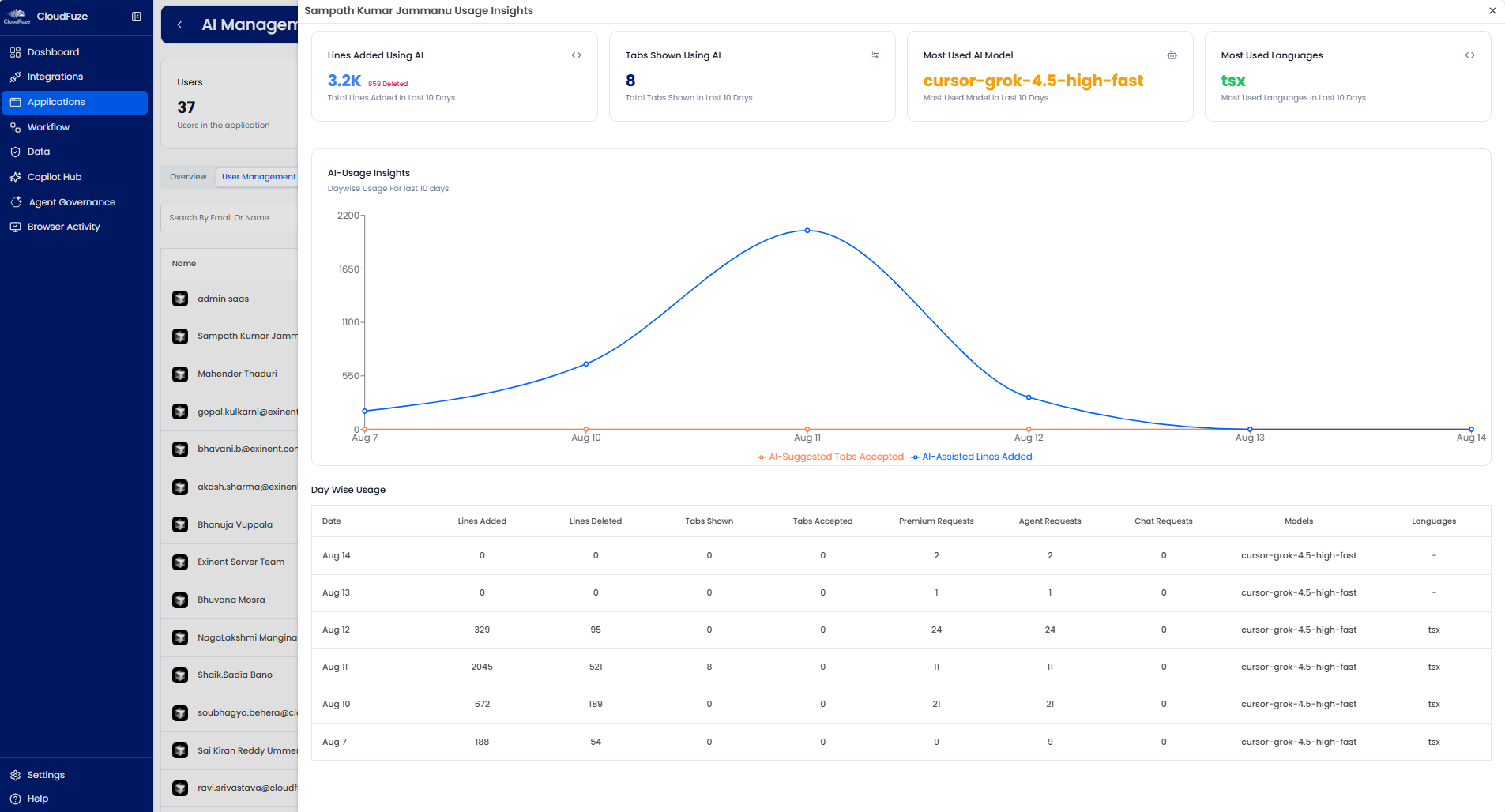
- Identify approved and unapproved AI applications across their teams.
- Monitor token consumption from an intuitive dashboard.
- Track AI adoption trends across their teams and departments.
- Measure employee engagement with AI platforms and their business impact.
- Detect shadow AI before it creates any compliance concerns.
- Enforce AI security policies and usage standards consistently.
- Consolidate SaaS and AI application management with agent governance into a single platform.
By bringing AI analytics, governance insights, and cost visibility together, CloudFuze Manage helps enterprises scale AI adoption with greater confidence and control.
5 AI Management Best Practices Every Enterprise Should Follow
In order to build a secure and cost-effective AI environment, enterprises must follow these 5 practices discussed below:
- Start by establishing an AI management framework that aligns with your enterprise’s AI governance requirements and regulations.
- Make sure to create a centralized source for your enterprise-wide AI usage, spending, and adoption data.
- Do not forget to monitor AI subscriptions and token consumption and analyze & optimize them with your employees’ AI usage trends.
- Detect and eliminate shadow AI by standardizing approved AI platforms and usage policies.
- Always track AI adoption and ROI enterprise-wide to measure your AI investment impact.
Effortlessly Streamline Your AI Management with CloudFuze Manage
Enterprises that invest in effective AI management today will be better positioned to scale AI initiatives, reduce AI-related security risks, and maximize their AI ROI value.
Our AI management platform, CloudFuze Manage, helps enterprises build a smarter, more sustainable AI strategy through complete AI stack visibility, intelligent AI governance insights, and live token cost monitoring.
Frequently Asked Questions
1. What are the biggest challenges in expanding AI initiatives across large enterprises?
The biggest challenges include zero AI stack visibility, rising token costs, shadow AI, agent governance gaps, meeting new AI compliance requirements, and measuring ROI. These issues often become more difficult to manage as AI adoption expands across multiple departments.
2. What features should I look for in AI management services?
You should look for features such as AI usage monitoring, token spend tracking, agent governance controls, shadow AI visibility, and adoption analytics before you select an AI management service. These capabilities help enterprises manage their expanding AI ecosystems more efficiently.
3. How to measure the value of your AI investment?
The value of your AI investment can be measured by tracking how your enterprise’s AI transformation drives user adoption, business productivity gains, cost & time savings, security risk reduction, and revenue impact against the total cost of its AI assets and governance efforts.
4. What is AI risk management?
AI risk management is the process of identifying, assessing, and controlling compliance and data security risks associated with your AI systems to ensure they comply with and align with your business objectives.
5. Which companies offer AI management platforms for enterprises?
Many vendors offer enterprise AI management platforms, but CloudFuze Manage is one of the best solutions powered by CloudFuze for monitoring AI app usage, implementing agent governance at scale, and improving AI stack visibility.
6. Can AI management platforms connect with my existing CRM tools?
Yes. AI management platforms like CloudFuze Manage support 190+ SaaS and AI apps, including CRMs like HubSpot, Microsoft Dynamics 365, FreshDesk, and many more.
7. What is the difference between AI management and AI governance?
AI governance defines the policies and controls for responsible AI use, while AI management oversees AI usage, token spending, user adoption, and agent performance in your enterprise.
About the Author: Rashmi Ramesh


