
Governance Blind Spots in The Gemini Enterprise Agent Platform
Google’s Gemini Enterprise Agent Platform helps your team build and deploy enterprise agents. But you’re starting a potential blind spot somewhere along this workflow.
While these agents are adept at undertaking a wider array of tasks, right from drafting notes and checking internal files to sending full-blown emails, they need governing at a degree higher than what your organization is probably doing at the moment.
Most organizations assume it’s completely fine to glance over these agentic AI permissions once before setup and then deploy them within sensitive workspaces.
That, right there, is the blind spot that’s so easy to succumb to and extremely hard to spot and control. A one-time overview just doesn’t cut it anymore: your Gemini AI agents need to be constantly monitored and subjected to high levels of surveillance to ensure you maintain real enterprise agent governance.
Key Takeaways:
Why Governance in Gemini Enterprise Agent Platforms Matters to Decision Makers
For decision makers like IT Managers and CISOs, this is particularly important. AI agents in Gemini are typically embedded deep into routine, everyday workflows. Sometimes, this happens even quicker than the time internal IT needs in order to track them. This particular wave of Gemini agentic AI can end up holding onto:
- Internal files and sensitive data
- Customer data and credentials
- Partnership and vendor information
Each of these is extremely delicate information, and precisely why more stringent agent controls and governance is required.
How The Gemini Enterprise Agent Platform Exposes Your Business
Spin up an agent on the Gemini enterprise agent builder, and you’re instantly looking at these scenarios:
- Live permissions
- Absolutely no developer needed
- No review gates or waiting period
You’re thinking ‘instant speed’; However, the risk that comes with it is immense. In fact, this speed itself is the risk. Going from idea to full internal access in minutes is a huge IT risk.
In most cases, your internal security systems can’t even react at such speeds, let alone assess the files the agent is accessing and wheel out a report.
And if you’re thinking that these files are harmless and superficial, you’d be wrong. The agents are accessing internal files, pulling data from cross-functional docs, sending emails, etc.
Your internal knowledge bases are being tapped into without security having been afforded the time to even assess what’s happening – that’s where the problem begins.
A report found that 97% of these issues stem from improper access controls, showing that this is where the gaps occur. Each breach can cost up to $10.22 million, showing the true extent of this damage.
Another aspect worth thinking about is that the access these agents get does not expire – once granted, it’s there indefinitely until you come back and assess it again. This is pertinent because the information it holds now will never be erased, even months from now.
Achieving Real Governance in the Gemini Enterprise Agent Platform
Closing the gap we spoke about requires some organizational changes. It starts at the entry point, a change of perspective where every Gemini enterprise agent is treated as an ongoing item to monitor. Right now, they’re seen as deployment check-off tasks, and that mindset needs to change within your organization at all levels.
Next, there needs to be a system put in place to catch periodic misses that can happen during regular, manual reviews.
This starts with inventory: Who deployed which agent? Where are these agents deployed? What files does each agent have access to? What permission does each agent have? Does each agent have a set of triggers and permissions that can be updated and monitored constantly?
Ideally, these need to run constantly in the background with full org visibility, rather than as a quarterly or monthly audit. That can ensure any discrepancies are caught and flagged in real time.
According to Gartner, 40% of enterprises will demote or decommission autonomous AI agents due to governance incidents by 2027. That’s the exact failure model we have been talking about: one incident leading to an agent review rather than constant governance checks.
With CloudFuze Manage, you can close this gap before an actual incident occurs. It gives you a constant, running inventory of every agent deployed by your organization, along with complete visibility into risks and compliance posture.

Our risk scoring and agent detection can help you catch what manual reviews end up missing. Aspects like who built it and what it’s accessing are available instantly, updated in real time.
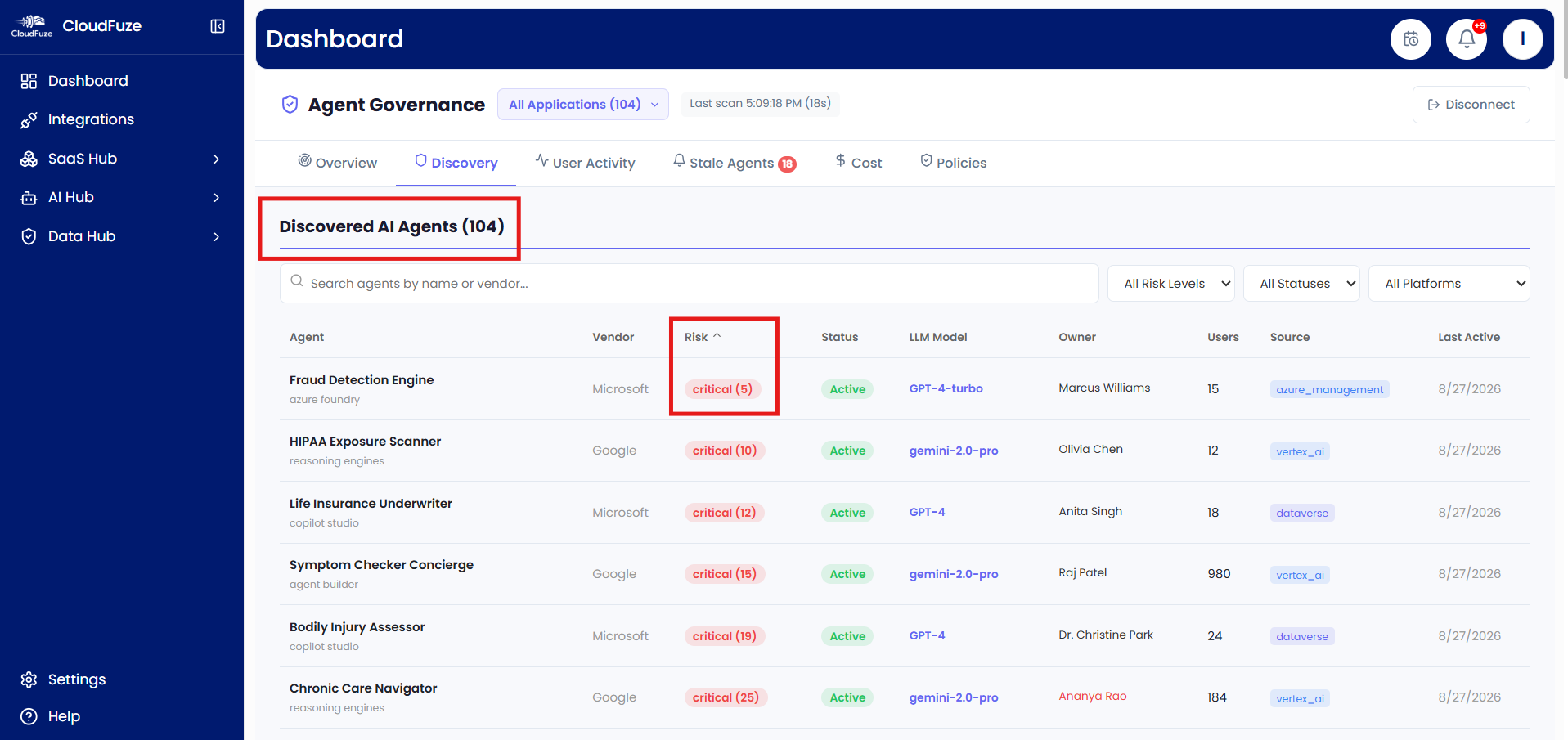
Give it a short try with a free trial or talk to us for more details.
Frequently Asked Questions
1. What are the biggest governance risks with Gemini Enterprise agents?
The biggest worry is quite simple: an agent may be allowed to reach far more information than it really needs. It could have access to internal files, customer information, credentials, or other important business data. If nobody keeps watch, that access can become a nasty little problem.
There’s another thing worth keeping in mind. An agent doesn’t necessarily become harmless just because it has been running for a while. If its job changes or its access is no longer needed, those permissions still need to be checked and cleaned up.
2. Why isn’t a one-time permission review enough for Gemini agents?
Because things don’t stay still. An agent may gain new data sources, connect to another system, or take on a different job after it has been approved. The permissions that looked perfectly sensible at the beginning may not make quite as much sense later.
That’s why it’s better to keep checking rather than tick a box and forget about it. IT should have a clear view of what each agent can reach and be able to spot changes as they happen.
3. How can IT find out what Gemini agents are accessing?
First, make a proper list of the agents in the organization. For each one, IT should be able to see who created it, where it is being used, what files it can reach, and which permissions it has.
But making the list once isn’t much use if it soon becomes old news. Agents can change, and so can their access. Keeping the information up to date gives IT a much clearer picture of what is really happening.
4. Do Gemini Enterprise agent permissions expire automatically?
That’s something IT shouldn’t simply assume. The concern is that access given to an agent can remain in place until someone reviews it and decides it should be changed or removed.
Imagine giving an agent a key and then never checking whether it still needs it. A sensible governance process means looking at those permissions from time to time and making sure they still match the agent’s job.
5. How should companies monitor Gemini Enterprise agents?
Think of each agent as something that needs looking after, not something that gets forgotten once it has been launched. IT should know who owns it, where it works, what it can access, and what permissions and triggers it has.
Regular manual checks can easily miss something that changes between reviews. A central, up-to-date view of the agents makes it much easier to notice an odd permission, an unclear owner, or an agent doing more than it ought to.
About the Author: Arun Jyothi


