
AI Governance for Retail: Protecting Customer Data as Teams Adopt AI Tools
Quick Answer: Retail teams use AI everywhere, from marketing to customer support, and customer data goes with it. AI governance in retail enterprise settings keeps that data safe. It finds every AI tool in use, sets clear rules for what data staff can share, assigns an owner to each tool and agent, and closes access when people leave, so teams can keep using AI without risking customer trust.
Key Takeaways
How Is AI Used in Retail Today?
So, how is AI used in retail right now? In nearly every team. Generative AI tools and AI agents now support the whole customer journey, from the first ad to the post-purchase message, and most of them handle customer or business data.
1. Marketing and Content
Marketing teams use AI to write product descriptions, emails and ad copy, personalize offers and segment audiences. Those tasks often involve customer lists and purchase history.
2. Customer Support and Chatbots
The support staff utilize AI assistants to generate responses, synthesize orders, and answer frequently asked questions. Staff can simply copy names, addresses, and information on orders into an app for a faster response.
3. Merchandising and Demand Forecasting
Merchandisers and planners utilize AI to generate forecasts, determine pricing, and develop assortments. These operations are based on sales information, supplier information, and inventory information that are treated as private by most retailers.
Why is AI Governance Important in the Retail Enterprise?
For a big retail firm, the rate at which AI is being adopted surpasses the rate at which it is being regulated. The reason why AI governance is important in retail enterprises is because of the data utilized, teams, and high turnover rate of staff.
1. Customer and Payment Data (PCI DSS, GDPR, CCPA)
Retailers process customer identities, payment information, purchase history, and contact details. Employees using AI tools to analyze customer data or generate responses can unintentionally expose sensitive information. Appropriate safeguards, privacy policies, and access controls help retailers protect information and support applicable requirements under PCI DSS, GDPR, and CCPA.
2. Shadow AI Across Stores and Teams
Employees may independently adopt AI tools for marketing, customer service, reporting, or daily tasks without IT approval. This shadow AI creates visibility gaps, increases data exposure risks, and makes it difficult to enforce consistent AI usage policies across stores and departments. A 2026 Retail AI Playbook survey found 59% of retail leaders had discovered shadow AI at their company.
3. Seasonal Employees and Quick Turnover
Typically, retailers hire temporary employees during busy seasons. Without adequate access control, the temporary staff may receive access that is not required or even maintain their access after leaving their roles. Onboarding, access review, and offboarding are critical processes for ensuring that security is maintained.
AI Governance within the Different Segments of the Retail Industry
AI governance will be different among the various retail sectors based on how AI technology is utilized, types of customer data processed, and the type of business decisions made through the use of AI. It will be critical for clothing retailers and auto dealerships to develop the necessary controls around the adoption of AI technology.
1. Clothing and Fashion Retail
It is crucial to have AI governance in the retail clothing industry because the use of AI technology in this industry will entail making personalized recommendations, demand predictions, inventory management, customer service and analysis of the latest fashion trends. Retailers need to have governance on how customer data is used, how AI is marketed, pricing, and how employees utilize AI applications.
2. Automotive Retail & Dealerships
Retailers and dealerships in automotive utilize AI for customer profiles, lead scoring, sales, financing, forecast, and customer communication. For brands that have responsible AI governance in automotive retailing, it is important to have controls for customer financial data, AI-driven recommendations, automated decisions, and third-party AI applications.
Having controls for human oversight, application access, and AI usage policies can help dealerships implement AI in a responsible way while preserving trust and business data.
Best Practices for AI Governance in Retail Product Teams
These best practices for AI governance in retail product teams can be used for marketing, merchandising, and support as well.
1. Maintain a List of Approved AI Tools
Publish the list of approved AI tools that teams can use and for what purposes. Include a simple review process for new AI tools requests and provide safe alternatives for each common use case so that employees don’t resort to personal accounts.
2. Protect Your Product and Customer Data
Define explicit policies around things that are never allowed to appear in any prompts, for example, customer records, payment information, upcoming products, and suppliers. Then back up those policies with data loss prevention systems that will automatically detect sensitive data when it tries to leave.
3. Appoint an Owner for Each AI Tool and Agent
Each AI tool and agent must have an appointed owner responsible for using, accessing and managing the tool. The unowned tools and agents are the ones to flag.
4. Check Your Access When an Employee Leaves
Tie your AI and SaaS access management to the offboarding process, especially if your team is seasonal or part-time. Make sure to terminate access immediately upon employee departure.
Starting AI Governance in Retail for the First Time
If you are starting AI governance in retail for the first time, do not begin with a long policy. Begin with what you can see, and pilot with one team, such as marketing or support, before you expand.
- Discover. Find every AI tool, embedded AI feature and agent in use, including shadow AI.
- Set policies. Publish an approved-tool list, data rules and an owner for each tool.
- Monitor. Watch usage and flag sensitive data and risky access.
- Report. Keep records and dashboards that show leadership and auditors what is happening.
Repeat the loop as new tools, agents, and seasonal teams arrive.
How CloudFuze Manage Helps Retail Teams
CloudFuze Manage is a unified SaaS and AI governance platform that gives IT, security and finance teams one place to see and control AI tools, agents and SaaS apps. For retail teams, it covers four needs.
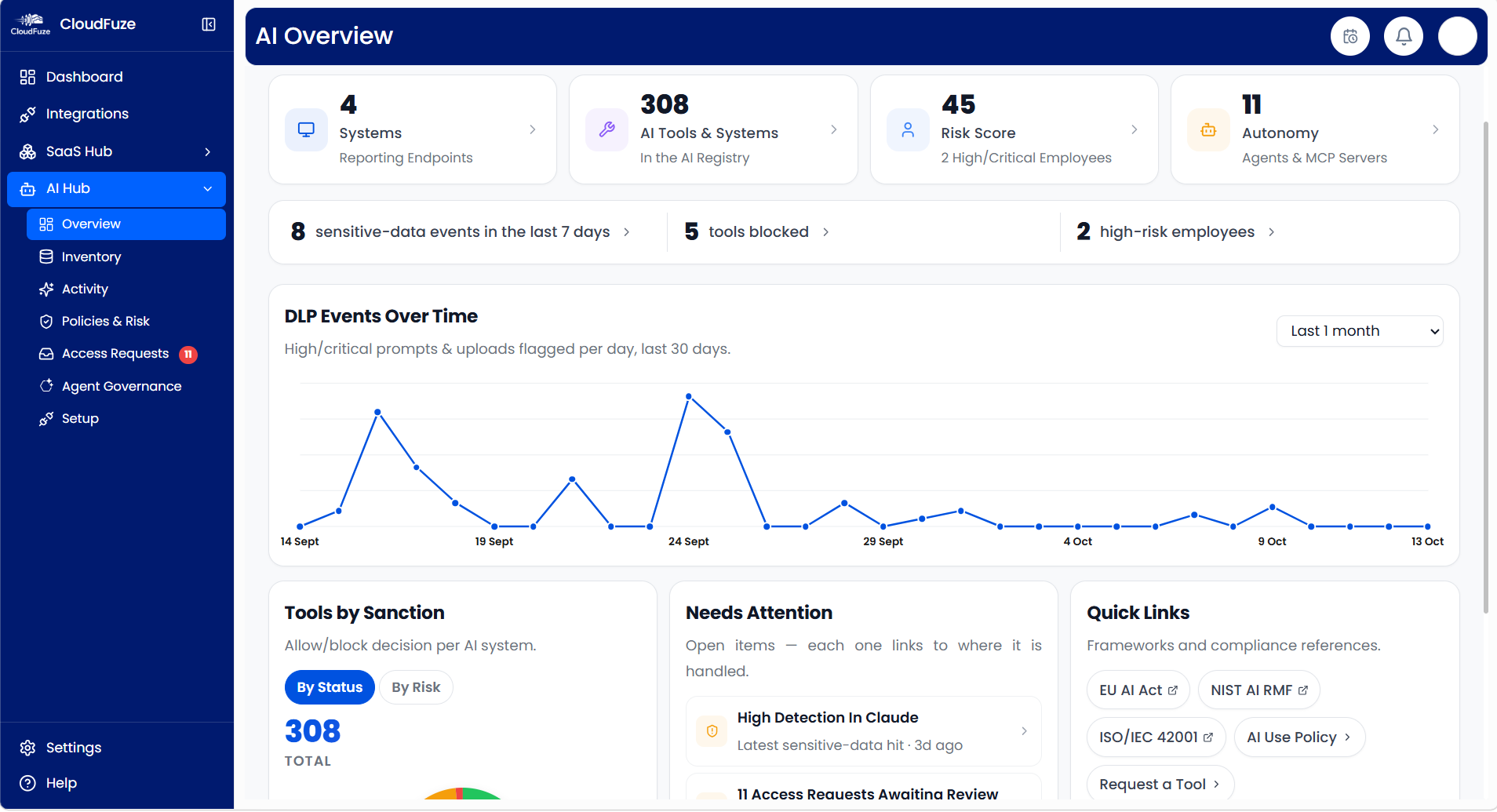
1. AI and SaaS Discovery
CloudFuze Manage automatically discovers AI apps, embedded AI features and AI agents, including shadow AI, across platforms such as Microsoft 365, Google Workspace, OpenAI and Anthropic Claude. Each agent shows its vendor, owner, and underlying model, so IT gets a live inventory instead of a spreadsheet.
2. Policy Enforcement and DLP
IT teams set rules that run automatically, and the platform monitors AI conversations, assigns risk scores and flags sensitive-data exposure, such as customer details. Ready-made policy packs align with the EU AI Act, ISO/IEC 42001 and SOC 2 Type II.
3. User Lifecycle and Offboarding
Lifecycle management handles onboarding and offboarding, which helps with retail’s seasonal and part-time workforce. Every agent is also mapped to a named human owner, with orphaned and stale agent cleanup to limit sprawl.
4. License and AI Spend Savings
Dashboards track AI and SaaS usage, and cost reports reveal unused licenses and wasted AI spend, so IT and finance can right-size subscriptions and make renewal decisions.
Bring AI Governance in Retail Under Control with CloudFuze Manage!
AI governance allows retailers to ensure the protection of customer data, monitor shadow AI, and keep control of the process as their employees use AI solutions. CloudFuze Manage enables retail IT staff to discover SaaS and AI applications, increase access visibility, find unmanaged apps, and optimize software spend.
Frequently Asked Questions
1. Are we able to use approved AI solutions for marketing purposes?
Yes. Retailers can enable the use of approved AI solutions for marketing with customer data, campaign information, product details, and AI-generated content guidelines.
2. Does AI governance assist with minimizing SaaS costs?
Yes. AI governance increases application visibility, identifies unused licenses, eliminates redundancies, and assists in making better SaaS spending decisions.
About the Author: Aayushi Raj


