

Migrating all channels and messages from Slack to Google Chat is a complex IT project that requires careful planning and execution. Businesses must ensure that all the Slack Workspace data, including direct messages, channels (private and public), emojis, timestamps, mentions, replies, reactions, attachments, etc., is migrated to Google Chat accurately. Therefore, it is crucial to choose a tool that performs the Slack to G Chat migration smoothly while meeting business requirements.
With over a decade of experience in ensuring successful cloud migrations, including Slack to Microsoft Teams migrations, for Enterprises and SMBs, we bring our expertise in Slack to Google Chat migrations.
With the availability of the ability to import data from Slack to Google Chat (using Google Chat API), you can pair our migration tool with the latest Google Chat APIs and perform high-speed and secure migrations.
You can watch this video for a brief walkthrough of the process of migrating using our migration tool.
Why Migrate from Slack to Google Chat?
Migrating from Slack to Google Chat offers numerous benefits to enhance collaboration, streamline workflows, and improve organizational communication.
While both Slack and Google Chat facilitate seamless communication among team members, a comparison, of Slack vs Google Chat, reveals significant differences in their respective features and functionalities. Some of the reasons why organizations consider making the switch from Slack to Google Chat include:
- Integration with other Google Workspace apps, creating a unified workspace
- Centralized collaboration
- Cost-efficiency
- Streamlined user management
- Enhanced security
- Effective data retention policies and compliance features
Slack vs Google Chat: Key Differences for Enterprise IT
Both Slack and Google Chat are strong collaboration platforms, but they are built for different use cases. Slack, for instance, is a standalone chat platform offering one of the broadest third-party app integrations and workflow setups. Google Chat is part of a larger cloud office suite, Google Workspace, similar to how Microsoft Teams sits inside Microsoft 365.
For enterprise IT teams, the differences that matter most are:
- Ecosystem: Google Chat works alongside Gmail, Drive, Meet, and Calendar, so conversations, files, and meetings live in one environment. Whereas Slack connects to these tools through integrations.
- Licensing: Google Chat is included in Google Workspace subscriptions. Slack requires a separate license, which adds to the overall SaaS spend.
- Administration and compliance: Google Chat is managed from the Google Admin Console, with retention and eDiscovery handled through Google Vault. Slack needs its own admin and compliance setup.
Businesses that prefer the industry-leading 3rd party app integrations and workflow customizations of Slack choose to use the platform while other companies that are using Slack along with Google Workspace often consider consolidating into Google Workspace and simplifying their cloud licensing structure.
Pre-Migration Prerequisites and API Setup
Most migration delays trace back to setup work that was skipped before the first message moved. Google’s import process has specific requirements on the Google Workspace side and your Slack workspace needs the right level of access too.
Here are the prerequisites your IT team should check off before the migration begins:
- A supported Google Workspace edition: Google’s import process requires a business or enterprise Google Workspace account with access to Google Chat. Make sure Chat is turned on for your top-level organizational unit in the Google Admin Console.
- Chat history is turned on: Google recommends turning chat history on, and checking that sub-organizational units have no conflicting history settings.
- Retention rules that match Slack: If your Slack workspace uses message retention, configure Google Vault to match it. Otherwise, Chat may remove messages earlier or later than expected.
- Licensed Google Workspace accounts for every user: Messages are recreated to each user’s Google Workspace account, so accounts need to exist before the migration. Only active accounts with active licenses are eligible for chat content and membership migration.
- Domain-wide delegation for the migration tool: A Google Workspace super admin must grant the migration tool domain-wide delegation with the chat import scope.
- Admin-level access in Slack: CloudFuze connects to Slack through OAuth, and the account you authorize needs access to the channels and conversations in scope.
- A batch plan that fits the 90-day import window: Google gives each imported space 90 days from creation to complete the import. A space still in import mode after 90 days is automatically deleted and cannot be recovered, so batch large channels with that window in mind.
Once these boxes are checked CloudFuze’s pre-migration scan gives your team a full count of users, channels, direct messages, and total messages so you can finalize the scope and timeline with confidence.
Challenges of Migrating from Slack to Google Chat
Migrating from Slack to Google Chat presents significant challenges that businesses and their IT teams must navigate to ensure a seamless transition. Some of the key challenges associated with this migration are as follows:
- Mapping user’s chat accurately
- Migrating all the direct messages
- Migrating public and private channel conversations
- Retaining channel memberships
- Migrating all the Slack features such as emojis, threaded messages, files, etc.
- Migrating incremental changes
CloudFuze streamlines the process of migrating from Slack to Google Chat, guaranteeing zero data loss, minimal disruption, and comprehensive data security measures. By working with our experienced migration team, your organization can navigate the complexities of the migration process and eliminate the risks of downtime.
CloudFuze Automation for Enterprise Slack to Chat Migration
As the first migration solutions provider in the industry to launch a Slack to Google Chat migration tool, we offer some of the most advanced functionalities that enable businesses of all sizes to replicate their Slack environment in Google Chat.
We have developed our Slack to Google Chat migration tool in collaboration with Google Workspace. With our Google-trusted tool, you can make the entire transition secure and smooth for your organization.
Real-World Case Study: Enterprise Slack to Google Chat Migration
Right from the get-go, we have created migration success stories for a lot of businesses. Our combination of advanced tool functionalities and proven methodologies have enabled a lot of large enterprises, SMBs, and MSPs to embrace Google Chat securely, without any operations disruptions. Here’s one case study overview:
Case Study Highlight: Vendasta, a leading e-commerce technology company, planned to consolidate into Google Workspace by embracing the revamped Google Chat app. The challenge was to migrate over eight years’ worth of Slack data to Chat. By configuring our migration tool with high-performance dedicated servers, our migration team enabled the Vendasta team to transfer everything over while keeping the channel memberships fully intact. Learn more about the Vendasta case study here.
Watch this testimonial video featuring Jason Coutu, Vendasta’s IT Czar, as he shares his positive experience with our Slack to Google Chat migration solution.
You can also check out our other case studies to gain more clarity on how our migration solutions enable businesses to achieve their migration goals.
CloudFuze vs. Competitor Migration Tools Evaluation
As a leader in Slack to Google Chat migrations, our tool functionalities are unparalleled in the industry. Here’s an overall comparison of our tool’s features against other options in the market:
| Features | CloudFuze | Competitors |
|---|---|---|
| Workspace migration | Yes | Yes |
| Channels migration | Yes | Yes |
| Group messages migration | Yes | Yes |
| Direct messages migration | Yes | Yes |
| Message threads preservation | Yes | No |
| Message attachments migration | Yes | No |
| User mentions | Yes | No |
| Syncing new users | Yes | No |
| External channel members migration | Yes | No |
| Filtering messages with date range | Yes | No |
Steps to Migrate from Slack to Google Chat
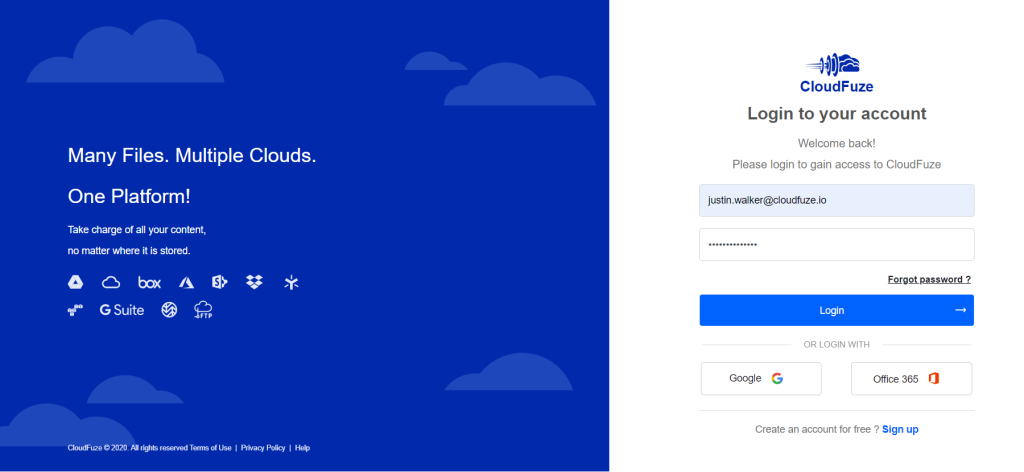
1. Log into CloudFuze
Visit our webapp and create a CloudFuze account. You can contact our migration team for a live demo or quote.
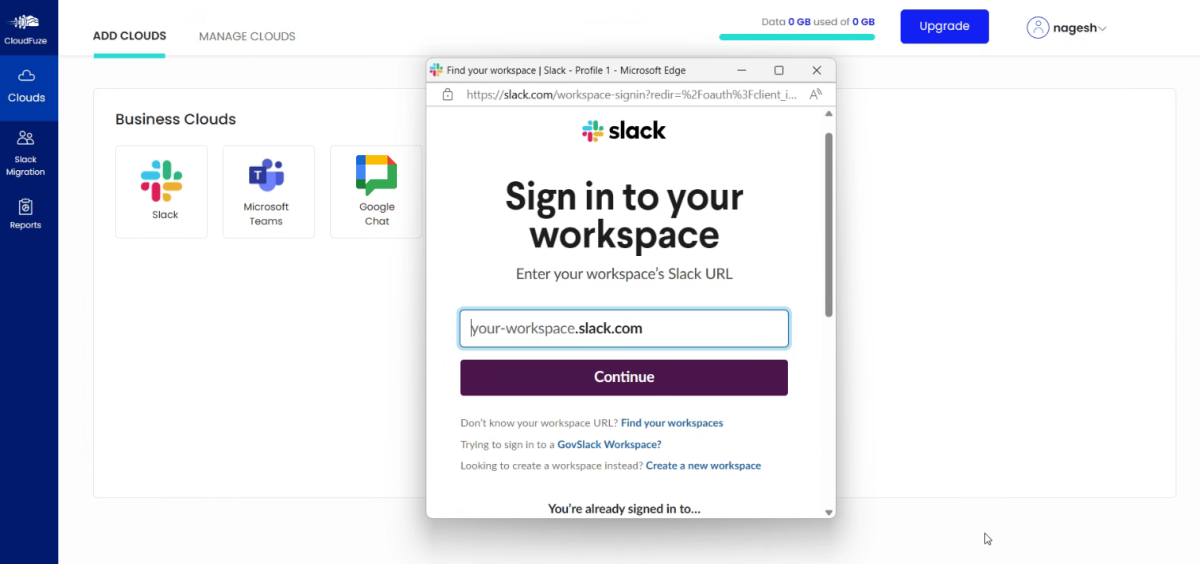
2. Add Your Slack Account to CloudFuze
Locate the Slack cloud in the business clouds list and click on it. A popup will appear where you need to enter Slack account details.
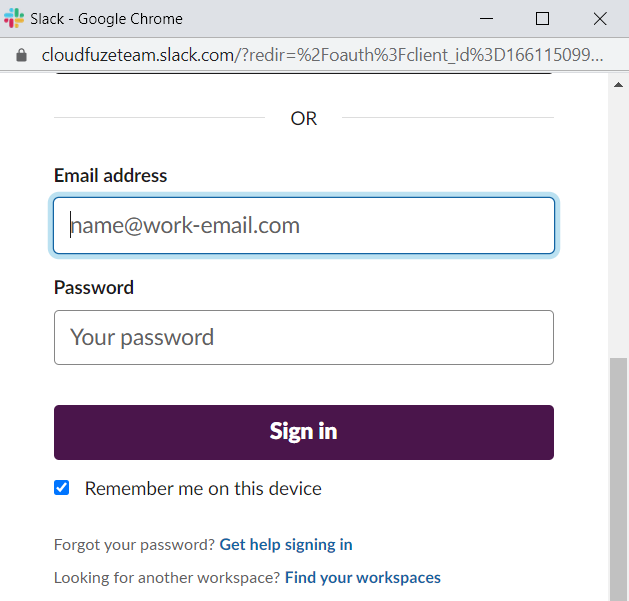
3. Enter Slack Login Credentials
Enter your company’s Slack login details and click on the Sign-in button.
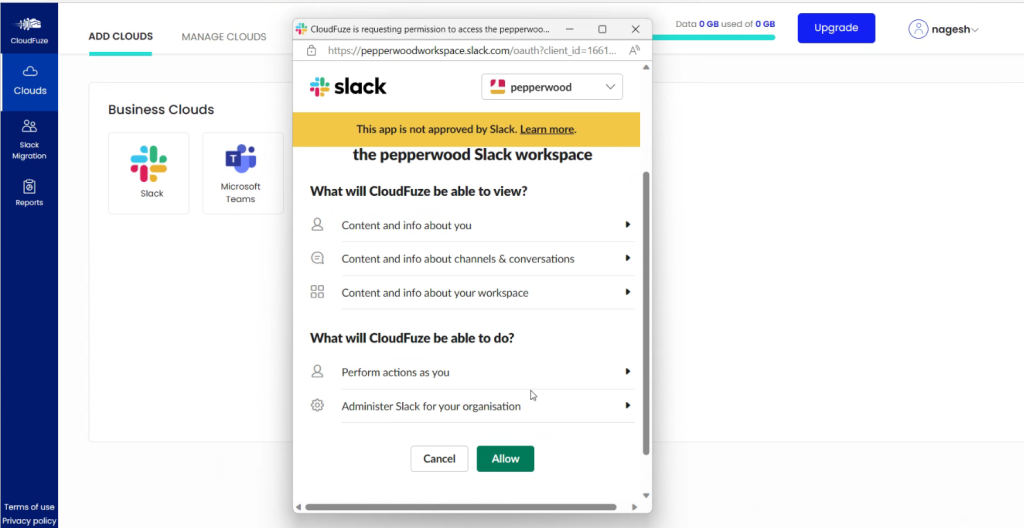
4. Provide Access to CloudFuze
Click on the Allow button to provide access to CloudFuze.
5. Add Google Chat to CloudFuze
Click on the Google Chat logo that you can see in the business clouds list and enter the credentials.
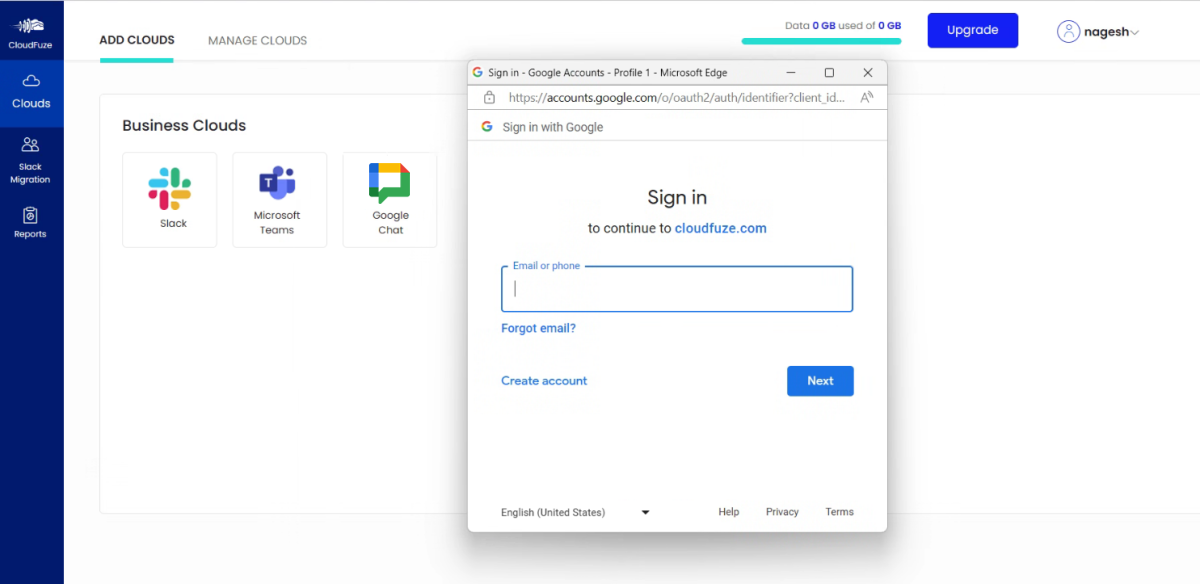
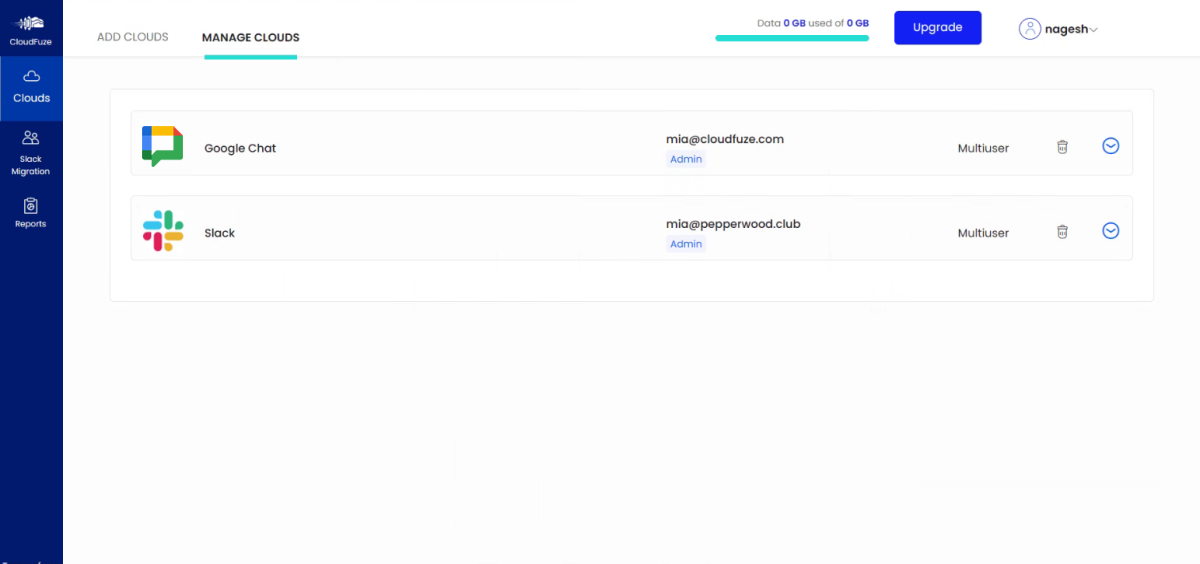
6. Verify Whether Slacks and Google Chat Are Added
Click the Manage Clouds tab to check if Slack and Google Chat accounts are successfully added.
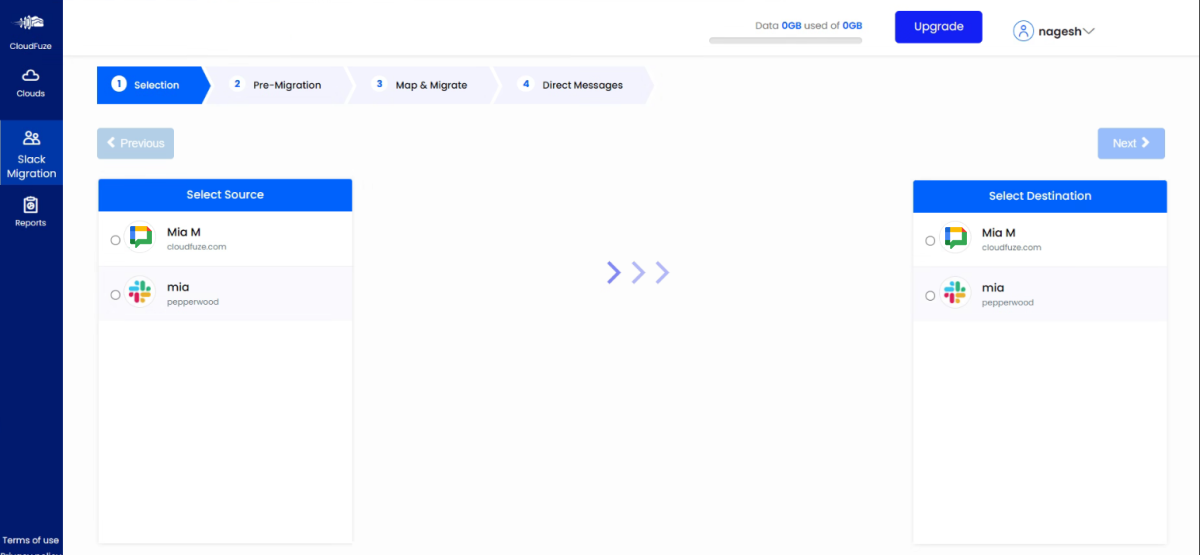
7. Select the Source and Destination Cloud
Click on the Slack migration tab in the navigational menu on the left. Since it is a Slack to Google Chat migration, you must select Slack as the source and Google Chat as the destination cloud.
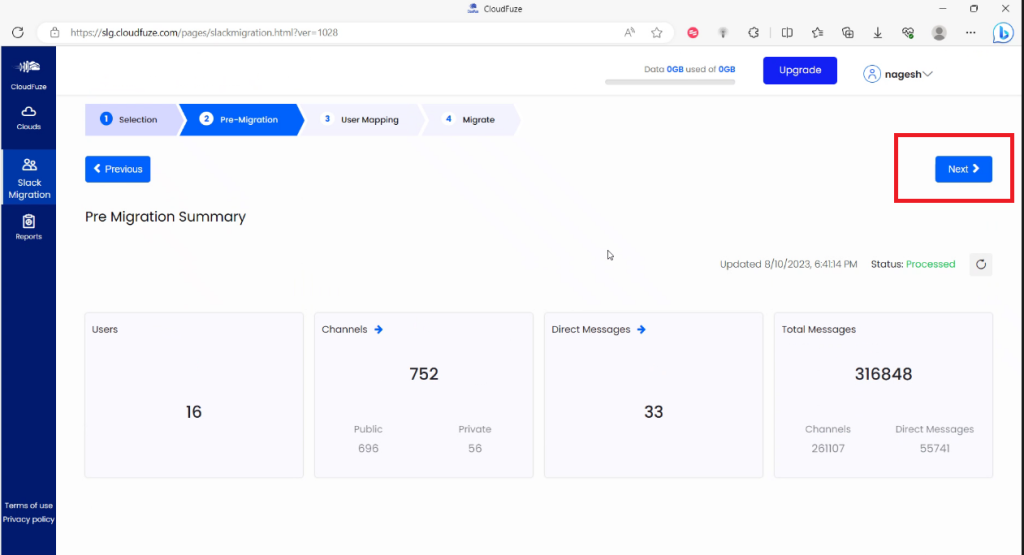
8. Run the Pre-Migration Scan
After selecting the source and destination clouds, click the Run Pre-Migration button.
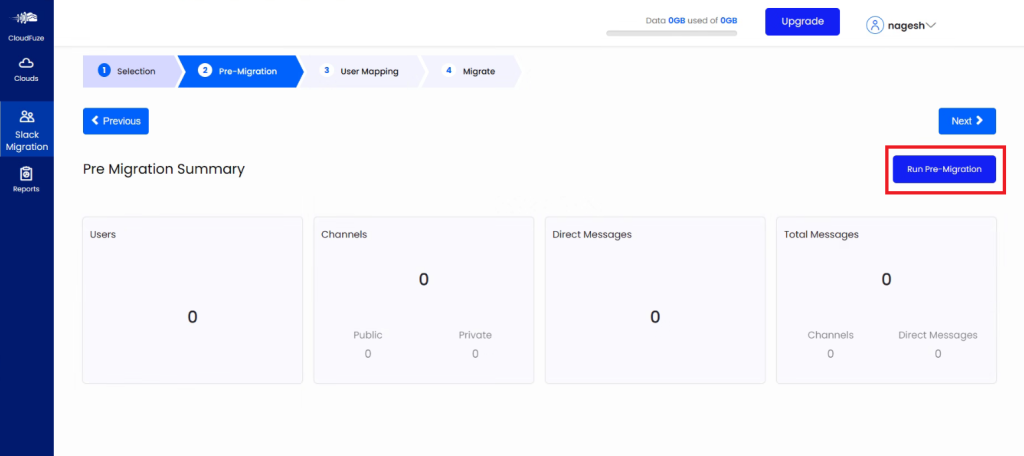
Our tool analyzes your source cloud, i.e., Slack, and fetches all the details, such as the number of users, channels, direct messages, and total messages of a Slack Workspace.
9. Select the Users to Migrate
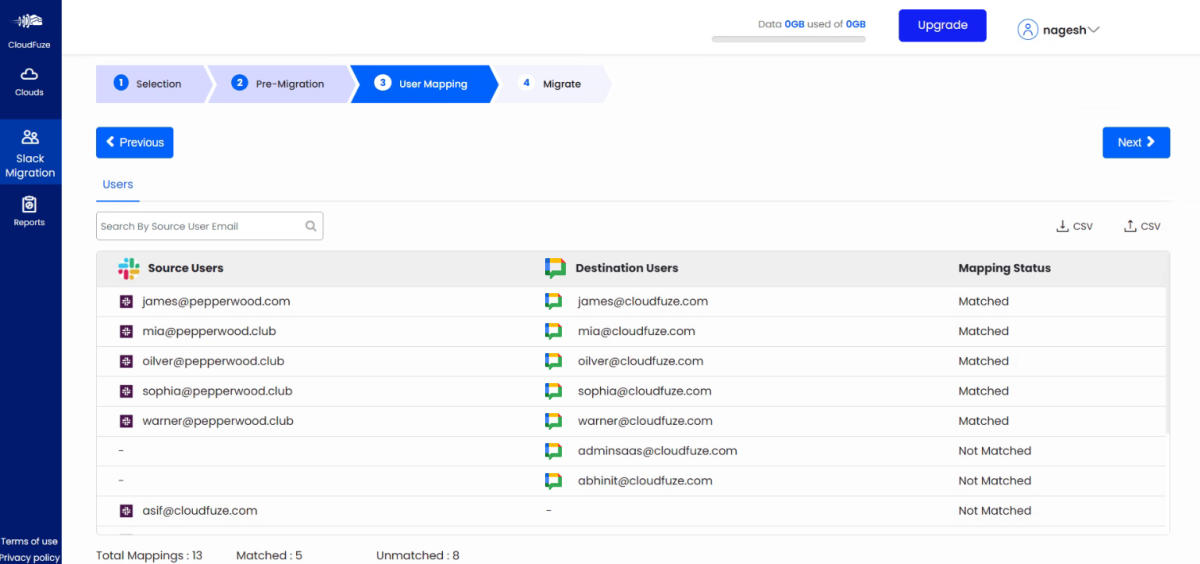
Our Slack to Google Chat migration solution maps users automatically based on their email addresses. IT admins can choose CSV mapping to map source and destination users as required if there are any changes in the email addresses.
10. Select the Channels to Migrate
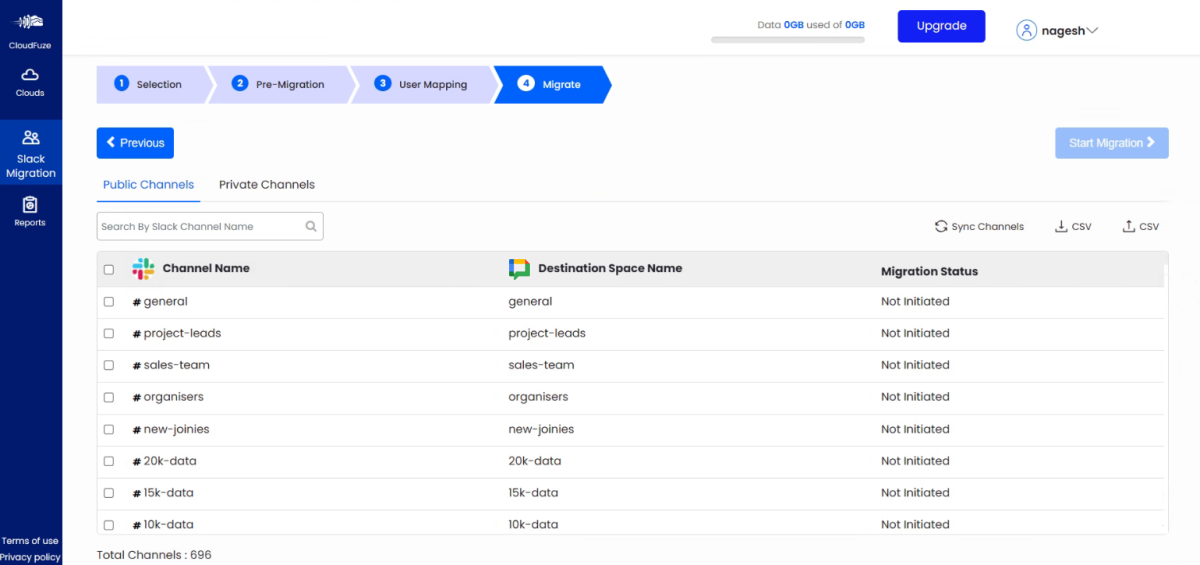
Our webapp pulls and displays all the public and private channels of Slack Workspace. Select the channels you want to migrate to and click the “Start Migration” button.
11. Monitor the Migration Status
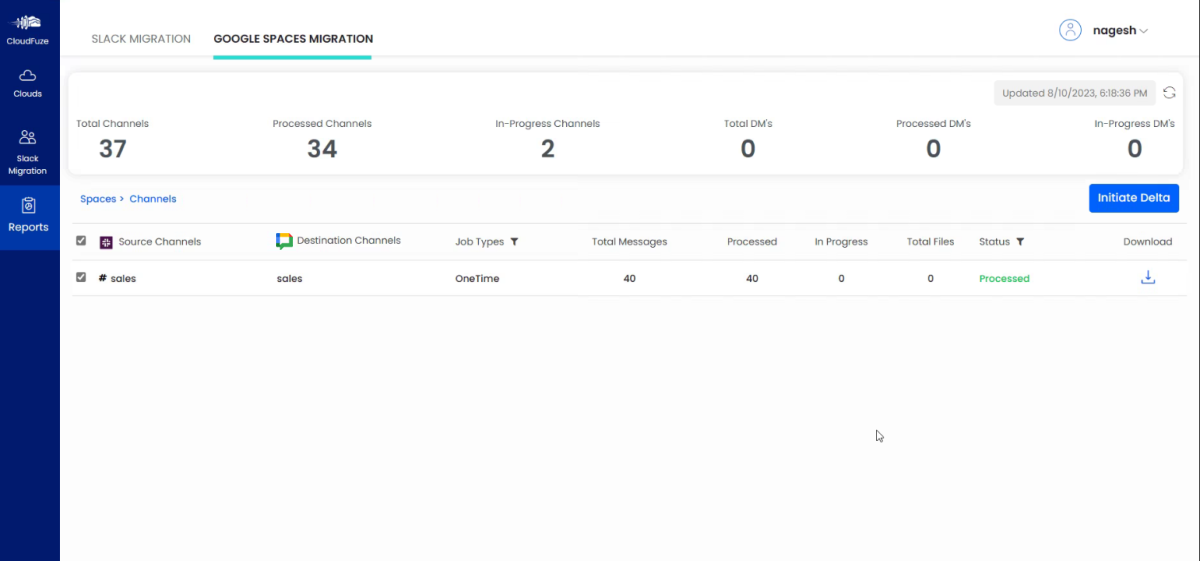
Go to Reports and check for the status of the migration. The status will be displayed as “In-Progress” during the chat migration process. Once the migration is completed, the status will be changed to “Processed.”
Post-Migration Verification and Cutover Checklist
A migration marked “processed” is the start of validation. Before you switch users over, it is important to confirm that the data in Google Chat matches what was in Slack, and the compliance settings are retained.
Here is the checklist we recommend running before cutover:
- Reconcile migration reports: Compare the count in CloudFuze’s migration report against the pre-migration scan, covering users, channels, direct messages, and total messages. Investigate any gaps before moving on.
- Validate high-value spaces: Open sample busy or important channels and leadership spaces. Check that threads, mentions, emojis, attachments, and original timestamps carried over correctly.
- Confirm memberships and private access: Make sure members of private Slack channels can access their spaces, and that no one gains access to a space they shouldn’t see.
- Capture last-minute Slack activity: Run a final migration pass for messages posted in Slack after the one-time migration, and then set a firm cutover date.
- Rebuild integrations and workflows: Slack apps and Workflow Builder automations need to be manually replaced with Google Chat apps or Google Workspace equivalents.
- Onboard end users: Train users to find spaces, threads, and DMs in Google Chat. Google’s Workspace Learning Center is a useful starting point for training.
- Decommission Slack: Move Slack to read-only. Export anything your legal or compliance team needs to retain, and then retire the licenses (if needed).
Conclusion
A successful Slack to Google Chat migration comes down to four stages:
- Setting up the right prerequisites
- Migrating channels and conversations with full fidelity
- Validating the results
- Cutting over with a clear plan
CloudFuze handles each stage with its Google-trusted tool and a dedicated migration team, from the pre-migration scan to post-migration support. Get a free consultation and a tailored migration plan for your organization.
Slack to Google Chat Migration FAQs
1. How to perform a secure Slack to Google Chat migration?
The first step is to perform the migration via Slack and Google Chat APIs. The next factor to consider is to use a secure, enterprise-grade migration tool. Equally important is to have proper SLAs between your company and the migration vendor.
2. How much does it cost to migrate messages from Slack to Google Chat?
The migration cost depends on the volume of messages your team plans to migrate. The number of users and metadata to migrate are other variables that determine the cost.
3. How to choose the right Slack to Google Chat migration tool?
It’s always best to choose a migration tool that is secure, scalable, and customizable. With these three parameters in check, it becomes simpler for your IT team to plan the migration around your company’s use case and overall Google Chat adoption goals.
4. Can we migrate archived Slack channels to Google Chat?
Yes. CloudFuze can migrate archived Slack channels to Google Chat as Spaces, so historical conversations stay searchable after the move. Verify archive channel support for Google Chat as a destination and whether they land as active Spaces.
Your IT team can choose which archive channels to include during channel selection, which helps keep low-value history out of the new environment.
5. What happens to Slack users who are no longer active or have left the company?
Google’s import process only accepts active Google Workspace accounts with active licenses for chat content and membership migration.
Your IT team has two common options: temporarily keep or create licensed accounts for former employees during the migration, or mark their messages to an admin or placeholder account. Either way their messages can stay in the channel history for context.
6. How are attachments and inline images handled during the Slack to Google Chat transfer?
CloudFuze migrates message attachments along with the messages they belong to, so that files can stay in the context of the conversation. Google recommends uploading attachments as Google Drive files and linking them to the messages, which keeps large files within Drive storage.
7. Does the migration cause any downtime for active Slack users?
No. Your users keep working in Slack while the migration is in progress. In Google Chat, imported spaces stay hidden until the import completes, and users receive no alerts from them in the meantime, so there is no confusion during the project. Once validation is done your team switches over on a planned cutover date.
8. How does CloudFuze handle Slack direct messages (DMs) and group DMs during migration?
CloudFuze migrates both one-on-one DMs and group DMs to Google Chat. Google’s import mode only supports named spaces, so DMs and group DMs follow a separate migration path from channels. Users then find their private conversations in Google Chat alongside their spaces.
About the Author: Pankaj Rai


