
How IT Staff Training Drives Enterprise SaaS & AI Governance
IT staff training is an important lever that determines your SaaS and AI governance status. It must be treated as a structured, ongoing process of teaching your IT team how to discover, secure, and govern your org-wide SaaS and AI tools.
This is because a recent report from IBM states that 61% of organizations that faced AI-related breaches lack AI governance technologies and provide no adequate training to their IT staff.
This blog post explains how IT staff training drives better governance and how SaaS and AI app management software, such as CloudFuze Manage, supports it.
Key Takeaways
- IT staff training turns your enterprise governance policy into daily action across your SaaS and AI stack.
- Full visibility into your IT stack makes your IT training a successful one because staff need to see the exact metrics about what to act on.
- CloudFuze Manage provides 360-degree IT visibility in your IT stack, which supports and eases your IT staff training with flexible per-user pricing.
What is IT Staff Training and Why is it Important for Enterprises in This SaaS and AI Era?
IT staff training is how you equip the employees who run your business environment to do their jobs well. It includes everything from basic IT training for staff who manage IT tickets and user accounts, to IT security training for the team that defends your company’s data.
In this age of SaaS and AI, multiple teams within your enterprise now own a long list of IT tools (SaaS tools, AI apps, and agents), and your IT team has to govern hundreds of those apps and agents, including shadow IT apps.
You may ask why training IT staff matters so much in 2026.
Because these days, tools and software are getting updated weekly, but your org-wide IT policy is being reviewed and altered once a year. Similarly, when you assess the importance of training IT staff in an organization, the honest answer is that untrained people can’t protect your company’s data and handle it safely. A governance policy that lives in a PDF nobody reads does or governs nothing. Training your staff is what moves your well-defined IT policy into practice.
How Does IT Staff Training Strengthen Enterprise Saas and AI Governance?
SaaS and AI governance depend on making the right decisions at the right pace in your organization. IT staff training helps you standardize those SaaS & AI governance and management decisions.
A well-trained IT team can:
- Apply Standard User and Agent Access IT Controls
Following standardized user and agent approval workflows and implementing least-privilege access ensures that your org-wide employees and AI agents have only the permissions they actually need. - Identify and Report Org-wide Shadow IT & Shadow AI
IT training on recognizing unauthorized software applications and AI tools before they introduce security or data privacy risks. - Manage Company-Owned AI Agents Responsibly
Agentic AI governance training can help enterprises govern their autonomous agents by defining named ownership, controlling agents’ access to enterprise data, and monitoring their activities throughout their lifecycle - Standardize Employee Onboarding and Offboarding
IT user lifecycle workflow training can help IT professionals provision and revoke user accounts, data access permissions, and AI agent access consistently to eliminate orphaned user accounts and lingering orphaned agent privileges. - Reduce Administrative Errors
Quarterly IT staff training can help IT admins follow your company’s documented IT governance policies and repeatable IT workflow processes. This helps enterprises to minimize employee access misconfigurations and accidental data exposure via agents and reduce license waste. - Improve Audit Readiness
Regularly training IT engineers helps maintain accurate user activity logs and IT governance records. This one simple step can simplify your IT compliance reporting during security audits. - Protect Business Data and Lower Compliance Issues
Proper IT staff security training ensures your IT staff handles your confidential company information in accordance with your company’s established data governance and IT security policies. This helps IT teams reduce the risk of unauthorized user/agent access or data leakage. - Support Long-Term IT Operational Resilience
Periodic staff training and simulations can build scalable IT governance processes that help your enterprise adapt as SaaS applications, AI tools, and other business requirements change continuously.
Ultimately, IT staff training is one of the most cost-effective investments an enterprise can make in 2026.
What Happens if IT Staff Aren’t Trained on SaaS and AI Governance?
Without training, most enterprises become victims of the following SaaS and AI governance risks:
| Dimension | Untrained IT staff | Trained IT staff |
|---|---|---|
| Shadow SaaS & AI tools | Discovered late, often after a data breach incident | Can identify shadow activities early and route them for IT approval |
| User offboarding | Inconsistent employee account revocation | Repeatable offboarding process, and the user’s app access is revoked on exit |
| AI agent permissions | Inherited data permissions and remains unreviewed | Scoped to the least-accessible privilege and reviewed on a frequent schedule |
| License decisions | Licenses are renewed on guesswork | License renewals/modifications are made on real usage data |
| Audit readiness | Prepared before every audit review | Evidence ready year-round |
Example: An employee leaves your company on a Friday. An untrained IT admin disables the departing employee’s email account and marks offboarding as done. However, the admin failed to remove the AI assistant that the departing employee had connected to a shared drive months ago. On the other side, a trained admin runs a full employee offboarding checklist, revokes all linked SaaS and AI tools, and confirms that no agent is still acting under that user’s old permissions.
How CloudFuze Manage Supports IT Staff Training for SaaS & AI Governance?
Training works well when you can measure the desired outcomes. For example, are departing employees’ accounts revoked on exit, shadow apps caught early, and AI agents scoped and reviewed?
That’s where our platform, CloudFuze Manage, comes in. It is the unified SaaS and AI app management platform that enables enterprises to ease their IT staff training. It supports 190+ leading SaaS and AI apps such as Okta, Insightful, Workday, OpenAI, Cursor, and a lot more.
Also, it gives your IT staff training team a single pane of glass to track key IT metrics and implement IT workflow automations like:
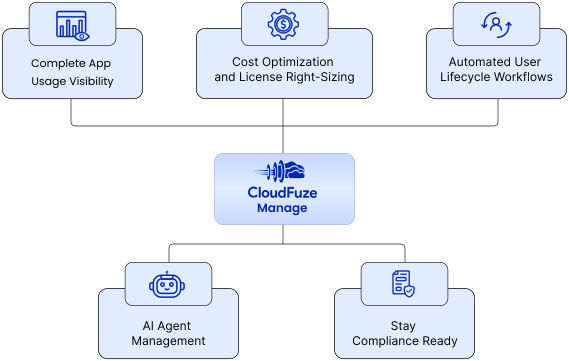
- Complete App Usage visibility: You can get a clear view of all your enterprise-owned SaaS and AI apps, their users, cost, and approval status in one view, so that staff can spot shadow tools instantly.
- Cost Optimization and License Right-Sizing: Our platform surfaces redundant apps, unused SaaS & AI licenses, and renewals automatically. With our AI-powered license-optimization recommender, your IT admins can make data-driven decisions.
- Automated User Lifecycle Workflows: User account provisioning and deprovisioning happen through automated workflows, so no orphaned user or agent accesses remain open.
- AI Agent Management: Discover and govern all AI agents, including orphaned agents your teams own.
- Stay Compliance Ready: IT staff can enforce data security policies (external-file sharing, orphaned agent cleanup, stale content removal, and more) and instantly download user logs for a time frame of 30/60/90/180 days in a single click.
Watch this YouTube video to know more about our platform:
Best Practices for Building an Effective IT Staff Training Program
Follow these best practices to get the most out of your IT staff training program:
- Always provide role-based training so that help desk staff, IT administrators, and security teams learn the skills most relevant to their work responsibilities.
- Make sure to train your IT staff using real-world workflows such as user onboarding, offboarding, SaaS approvals, and AI governance instead of just teaching them basic security concepts.
- Do not forget to offer continuous learning through regular refreshers to keep your IT employees up to date with evolving SaaS applications, AI tools, and data governance requirements.
- Nowadays, it’s mandatory to cover AI governance during IT staff training. This training must include shadow AI detection approaches, AI agent permissions handling, responsible AI usage, and overall data protection best practices.
- Measure your IT training effectiveness by tracking metrics like offboarding time reduction, number of orphaned user accounts, shadow IT discovery rate, and audit readiness to improve your training program.
Maximize Your IT Impact with CloudFuze Manage
Your IT staff training turns your written policy into real practice that keeps your SaaS and AI stack secure and audit-ready.
By pairing that training with CloudFuze Manage, you’ll gain full visibility into their SaaS and AI stack, control IT costs, manage the complete user lifecycle, and stay audit-ready without adding more IT complexity.
If you’re interested in discovering how CloudFuze Manage turns your IT staff training into measurable governance, schedule your free demo here!
Frequently Asked Questions
1. How often should IT staff be trained to keep up with SaaS and AI advancements?
You should aim to refresh your knowledge of SaaS and AI management every 3–6 months. With CloudFuze Manage, you can easily spot which apps need attention, so your training stays focused and impactful.
2. What are the signs that an enterprise needs better IT staff training?
When you find an increasing number of orphaned user access after employee departures, surprise unapproved IT apps during audits, auto-renewals that nobody can justify, and inconsistent handling of the same IT ticket by different admins, your IT team needs immediate staff training sessions.
3. Can IT staff training reduce SaaS and AI costs?
Yes. Trained staff make renewal calls on real license usage, catch redundant tools, and reclaim unused software and AI licenses. They have the potential to turn guesswork into decisions that cut IT spending by up to 30%.
4. How to measure the ROI of IT staff training programs
You can watch metrics like time-to-offboard, number of orphaned employee accounts, shadow apps caught before any breach incidents, and audit-prep hours. Whenever the above metrics are improved, it’s a positive sign that your ROI is improving.
5. How often should IT teams receive SaaS and AI governance training?
It is advisable to plan for quarterly staff training refreshers at a minimum, with quick updates whenever a major new software release, AI capability, or policy lands at your company.
About the Author: Rashmi Ramesh



